
Episodes
Find your way in
Two ways through the conversation. Sit with a topic that fits where you are, or work the run in order from the first episode on. Every one opens to its description and full transcript.
Doorway
When life breaks the easy answers open, can a believer still trust God? These conversations sit with sovereignty, lament, and doubt, and with the difference between a God who fixes things and a God who stays with you in the valley.
-

Through Many Dangers, Toils and Snares: Can I still love and trust God with all this hurt?
All five friends together in Phoenix for the first time, recording over a long weekend. They wrestle with whether you can still…
Read the transcript Hide the transcript
Auto-captioned and lightly cleaned. Rough in places. Speaker labels and timestamps coming with the new transcripts.
Hi, this is Bob Roberts and I'm the Dead Man Talking. I have stage four cancer and my liver and possibly only a few months to live. So I've invited four of my best friends from college days to talk about cancer, suffering, death, hope, and God. I can't wait for you to meet Will Galkin, Jason Janz, Ellis Murphree, and Josh Darnell. My desire is to tackle big questions and challenges that my probable near-term demise raises and to always season the sobering with humanity and humor. Don't expect nice and tidy solutions with a bow on top. It's going to get messy. All right, welcome to the Dead Man Talking podcast. Here we are with all five friends in the lovely town of Phoenix, Arizona. First time we've all been together and now we're recording this podcast. We flew in on Thursday. We've been around for a day and a half. What's been the most enjoyable part to you? The ministry of proximity, man. Just that your presence is here in town and that we're together, that we're all within earshot of one another and we have had very meaningful conversations as well as uproarious laughter. Yeah, I think just even yesterday just sitting in the pool and just talking and getting sunburned. Yeah, Ellis got so sunburned he couldn't walk this morning. No, Ellis got so sunburned that he used it as an excuse not to take the hike this morning at 6 a.m. that Bob ordered everybody who was his friends to go take and Ellis copped out. Yeah, Bob has a little bit of a passive aggressive way to make sure that we kind of feel what he's been feeling here all by himself. Especially when you say feeling what he's been feeling, he has encouraged all of us to get colonoscopies, which I think haven't all of us gotten one since Bob's diagnosis. I have. I have not. I had a coffee-oscopy. I have not had a colonoscopy. But I should do that. Yes, you should. Our listeners do need to know that Bob has tried to push one of his treatments, little packages of gifts to us when we came to the house of coffee enemas self-induced. Yeah, those are like $7 a piece. So I mean that just shows you my commitment to the team. But then you pushed it on us to make us want to try those. Yeah. That was part of your love to us. Absolutely. I think that that's something you in particular should do at least twice a month. We had a great time at Walmart yesterday. We had a great time on the boat last night, and we've had a great time. I didn't have quite as good a time at Walmart as the rest of you guys, but we had fun. Why did you not have a good time at Walmart there, Murph? It was just the sheer amount of pink, the sheer volume of pink on my body. It was vivid, vivid color. So Bob's favorite place to go shopping is Goodwill. So he made us go to Goodwill, and we had to pick out clothes for other people. And then we traipsed around public places. I was very kind to Will. I probably looked the most normal. You did. Actually, you thought Will was a step up. Will was a step up from what he was wearing prior to the Goodwill clothes. But I picked you, Murph, and I just decided to dress you in more of a soft hue of pink theme, including stuffed animals and backpacks. But I thought you looked really good. A pink hat that said bride, I think. Yeah. But you made a comment that like you were nice to Will. What was it you said? You've been nice to Will, but? I'm not remembering. In my whole life, I'm nice to other people. But constantly, oh yeah, you get wrecked. And I still get wrecked by the other people in my life. So they say they love me. It's just enduring one trauma after another with Jason. So ask Bob for the photo if you want to see it. Amen. Well, it's fun to be together and it's fun to be friends. And so today we actually want to do an episode responding to all the communication we've received. Various ones of us have gotten responses from listeners. And so we want to actually address some of this come up numerous times. And the question that we want to answer today is what do you do when you encounter suffering? And that suffering and the experience of it causes you to experience doubts about God or his people, the church. What do you do in that space? And so Bob, you want to talk a little bit about what led you to say, I think this is what we should talk about. Absolutely. So one of the surprising results of doing the Dead Man Talking podcast is that many have reached out to us that were there with us either at college or shortly thereafter. Different time periods of our lives. But people that knew us or knew one or two of us at least. And they saw the genuineness of our friendships and they saw the transparency of the things we were talking about. And the fruit of that was notes along the lines of, Bob, I just want you to know I've been away from the Lord for 15 years or 20 years or I left church 25 years ago or I haven't read my Bible in a decade. There's just about a surprising number of those types of folks that for whatever reason this gathering of men and just the rawness and reality has given them like a little crack in the door, almost like a permission to say, what? Yeah, you may have made a mistake 25 years ago or 10 years ago, but there's still light there. So, I think we should be here and maybe take a baby step or maybe even just look back. Just take a look back at Jesus. Yeah, I think as we talked about this, as we were getting the responses in, it almost became obvious to us that we ourselves almost could see ourselves in them. At different times in our life we experience suffering and it caused doubts in our own lives. And so there was an empathy there around the shared experience. So we almost want to take today and poke at where we were, take a peek into that and say what was that like for us and then what did we do on the other side that led us to be sitting here? And there are a lot of tread on the tires in this room and some deep and dark experiences. What caused us to hold on? And maybe that can help some other people or at least give them a way to move forward. Because sometimes I think there's this very clinical way of thinking that maybe we have it more together than others or that we don't we didn't experience deep suffering, but we're all in our 50s and we've been through some serious life circumstances. So we want to start by just opening up the table here to say, let's talk a little bit about the times where the valley became the deepest for us. Yeah, so there was, we talked a little bit in these prior episodes about some of my dark valleys, but the one that really led me towards a doubting phase of my life or was the vehicle towards that, there was a period of about four or five months where in rapid succession, my body began to fail with undiagnosed rheumatoid arthritis. Shoulder stopped working. I couldn't get dressed, couldn't do any of that stuff. And just incredible pain that was depriving me of sleep. And the same time I had a child trying to hurt themselves. And then shortly thereafter, my wife had a stroke and it was just pile after pile after pile of stuff. So that's that's the episode that we're focusing on. And what did that provoke in you? Yeah, so there was a... I kind of put it like this. I've never had any problems in my head saying and agreeing with scripture that God loves the world, but I was pretty sure he didn't love me. Yeah. How do you explain the pain of the suffering? Yeah, so... How long was your body broken? Well, it still is. But there was, I mean, that journey with my body around RA, that was almost two years of waiting for a diagnosis, waiting for treatment, and then trying to find medicine that would put it in some sort of managed remission. And during that time, a good week was if I only flared up and lost two days of sleep. So it was a pretty gnarly period of time. I remember you reached out to us when Karen had her stroke. Yeah. It was quite devastating. Yeah. And you were asking some pretty deep questions about that. Yeah. it's funny because when I talk about a lot of the dark valleys in my life, so much of it's in shadows. I mean, just going through the motions and some of it. But there was flashback with her because the stroke, I mean, it was a very, very, very strong stroke. It was a very, very strong stroke. And I think that's what I remember from that time, just going through the motions and some of it. But there was flashback with her because the stroke in her brain was in the same part of her brain that Sonia, my first wife, her aneurysm was and she had passed away. She was about to have two interviews for new jobs. I was going to push that income up again to she couldn't remember her name or social security number for some time. She couldn't draw the face of a clock in the days right after. So we were going into this space like how long is it going to be before she's getting to someplace resembling normal? And obviously this was more personally devastating to her than it was for me. And she's still years later still, still frustrated in dealing with some of the after effects of that. Tough, tough valleys. And if you were to say the level of doubts, scale of 1 to 10, how extreme were they? Yeah, I would say that when we get into it, I had moved, scale of 10, I had moved to a solid 8 at different points and maybe a little higher at times just being certain that God just had suffering for me for the rest of my life. And was there any love at all or worse yet did he even care? I mean that was a serious struggle in my head. You even leaned into the story of William Cooper there for a while, didn't you? Yes. for those that are listening and don't know, William Cooper in the 1700s is kind of considered maybe the hymnist of the Great Awakening between him and John Newton, who was a pastor and friend of his. And Cooper was in that space. I experienced a little bit of a kinship with William Cooper because he had these times of deep valleys, deeply depressed, where he had just decided I am a vessel of suffering for the Church and I'm going to play my part, I'm going to play my role, and I'm probably going to hell. And you leaned into that. Oh yeah, I'm like I know where this dude's coming from because I feel that. Here's William Cooper who writes, God moves in a mysterious way that we're still seeing in this day. He thought God wanted him to do that. He believed that about God, but he just thought he was a vessel destined to destruction. Yeah, yeah. Yeah, I, the first time I ever heard Cooper's story that was staggering to me because I'm like, come on, look at the depth of the words. He encapsulated the theology of the Great Awakening so well through hymnody and it was beautiful. And I'm like, how can a guy be writing like that and doubt God's love for him because he's clearly a dude speaking from a transformed space. When I was going through my valley, I was like, I get it, and he's onto something. Tough spots. Will? Yeah, I think mine is probably about a decade of internal wrestling with two doctrines that I knew. I've gone to seminary. I preach the gospel every night and it's really the sovereignty of God and His love. And, I take each of those individually and you can just, you can go forever on them, but you put them together. And I think somewhere in the 30s, my 30s, I began to wake up to the incredible amount of suffering around me. My dad passed away, my father-in-law passed away, and there's things about even their passing that wasn't what I thought it would be. And then I think just beginning to actually care about people and extreme cases of abuse. And here are some victims who then spiral into a life without Jesus. And it wasn't their fault. They didn't do that to themselves. And then to consider just that intersection of what is their eternity like just began to bother me on a real emotional level. And what made it so difficult is that in God's providence, every night I'm preaching the gospel of Jesus Christ, but I'm waking up like it's almost like the computer's broken. And I'd be like, is there even a God? And how long did that last for? It was about a decade. And every morning it was like I had to reboot. So you're out there every night preaching to church crowds about the hope of Jesus and trust in God and your own foundations were shaking around the problem of evil and suffering. And what would happen is it would start with, man, this isn't true. This is all a bunch of bunk. And then somewhere there'd be like a reboot process where I'd be, no, there is a God. I mean, look at creation. And I probably, the reboot of it would allow me to get to the evening. And maybe I can share more about the reboot later. But by the time the evening came for me to speak, I was fine. Like I wasn't speaking out of duplicity then. But the fear every morning that I'm just a hypocrite. But I would think if you said it's a decade, that that would become like in some sense existentially exhausting. Oh, without a doubt, without a doubt. And my wife would testify that she would understand that that angst and that wrestle because it's it's and then what happens at the very core is you begin to invest in people. And you're investing in people on a deep level and you really love them. But you you look at their own suffering and their own trials that could cause them to walk away from the faith. And you're like, what else can that person do? And it and it puts the the sovereignty of God and the love of God at such angst that it's hard just to rest. I think at the very core, I don't think and this is probably family of origin stuff. I just don't think I live with a trust in God. I don't think that I could really trust him. So the suffering would be almost like there was a moral suffering around the calling that you had in the beliefs you were struggling with. And I'm a truthy. So that conscience backs grind. And that just took its toll. And then the emotional side, people you care about that go through incredible suffering that then maybe fall away that you find yourself saying, is this really fair? Can I trust God? Which was the real issue in my life, which I see now, 15 years later, but in the middle of it, you don't see that. I've never heard an evangelist say such things. And this is one reason I I really have been kind of fearful to even shoot this cast. But it was comments that we have gotten that kind of pushed and prodded us to just getting to the absolute nitty gritty. Wouldn't it be a nice thing if we could say, hey, man, I really struggle with only having devotions four out of seven days. can you guys give me some good input? put them in a nice little box. Give me three Bible verses and wrap it in a bow and, solve my issue. And so, coming here face to face talking about this pre show, we know we're going for the jugulars that impact us personally. And all of them, all of us have specific ones a little bit different than the other guy. But in a sense, it really is the Jacob wrestling with the angel and not letting go. But Jacob walked with a limp the rest of his life. And I think that in all the things that we're going to articulate here today, like we're still limping. Some of us worse than others. And that's OK. And there's actually there's actually a bit of a beauty in that because, for many years I looked at you, Jay and you, Will, and I've always been close to you guys. But there was still this you guys got it all together. Like you're former Mr. Northlands. Now we just want to sit on your right hand and your left. But but there's there's actually almost a permission as you get to know this person like, oh, cool. They're broken, too. Oh, they're messed up like me. And they were not. We're not as messed up. All right. It was like they love Jesus, too. Hope. There's hope. Even the William Cooper story. Right. There's a lot of hope in that. So why do you think I you know, we you and I took many walks when we go speak at a camp together. Yeah. And I would share this Vax. Yeah. But you then would share what would be your story that you'd share. Yeah. So I my suffering has been more of a mental anguish, mental, emotional anguish over the doctrine of eternal punishment, more specifically, eternal conscious torment or just in a word hell. And I think this really came to a head for me when I was living in Hong Kong from 2010, 2014. And, God just gave me a heart to love those people. I just loved I loved Hong Kong people. I got to take my daughter back there in December. And I tried to show her showcase her the joys of the culture and the the beauties of these of this people group. I love these people in Hong Kong. But there's a moment where you're living there and, you're bumping in to crowds and you're observing thousands or tens of thousands of people every day as you're walking to and fro a place. And then you're thinking in terms of OK, I read my Bible. I read the words of Jesus in red. And I know these people are these are actually ancestor worshipers. They don't they don't love Jesus. They kind of like him sometimes. they like Jesus, his kindness, his punctuality, his, his helping of other people. But they don't love him. And. the Bible's theology is pretty clear that unless your heart has been changed to love Jesus, that your your eternal soul does not have good in in store in the future. And man. That that has been the single biggest thing to absolutely. Bring me low, bring me wrestling before the Lord to consider if I really buy into this book, into this faith with if I jump in with both feet. Yeah, so you take the passage like broad is the way that leads to destruction, narrow is the way that leads to life. You're led to believe that with the passage is around eternal suffering or damnation. Like is this was this the really the good divine cosmic story that a vast portion of humanity might experience suffering and punishment. And that that became a moral anguish for you. It became a moral anguish. It has continued to be a moral anguish, although now I would say I have some some pretty strong handholds, but it is I think it's the hip out of joint until I see Jesus. Yeah, you won't be able to. Yeah, you're you're actually saying there's still an element in your own soul and suffering on this point. There's still an element where I look for loopholes. Yes. And sure hope for them. But and and and and that's very transparent. Right. And I mean, you're not going to hear an evangelist say that you're not going to hear a camp speaker necessarily say what I've just said. And I just wanted to invite people that are arrested by that right now to just just hang with it. Stay with it. See where this goes. Pull the tension up. So I'll go ahead and talk about mine briefly. Mine was not a doctrinal struggle or necessarily a physical struggle. I mean, I've had, my brother pass away and things like that. But I think for me, when this question came up with us, it was more around, I would say, this issue of betrayal by people close to me, but especially those in ministry leadership. And, I went we all went to college together to study for ministry. And, we all walked out. We were taught have the basin in the towel and just go serve people's feet. Don't worry about what the finances look like. Don't worry about anything. Just go serve and love people and charged into that. And then I've been working in that world for 30 years. And the hardest part of it has not been the work. It's been who you work with. And actually what I expected was I was going to walk into spaces where people were all saying I'm a follower of Jesus and they were giving their lives in service to him. And we were all on the same mission. And then after three decades of ministry work, I realized that the deepest hurts and suffering I experienced was at the hand of other people, especially those in positions that we call spiritual power and the abuse of power and the infliction of pain. Upon Christian servants really first of all personally rocked me. And I say to people now because I think part of my what called side pocket ministry is hearing tons of stories of people who've been deeply harmed by people in Christian leadership and the church. And I now say I think if you experience a deep vocational or ministry hurt at the hands of another person, it takes at least two years to get the smoke off your clothes. we tend to think, oh, I'm going to forgive and forget and move on. And then I find myself six months later still giving a speech to this person in the showerhead in the morning. Right. why did you do this? And I use the word betrayal because betrayal happens when you think that you're in partnership on a common mission. And then sometimes God leads you to another mission or another way. And also, you actually find out what the nature of the relationship is. And they betray you. They harm you because you're no longer in lockstep with them. Or what you're going to do is going to threaten their ministry position or power. And it is a deep betrayal because you thought you were all with your eyes solely fixed on Jesus. And so I think for me, I began to ask the question of I didn't really have the theological struggles as much as I thought. If this is the script, if we all say we believe it, then we all should be acting a certain way. And why are you saying you're completely dedicated to him, acting in a way completely contrary to the kingdom of God? And hurting you. Yeah. And my family and my friends. Because you're the host, but you're asking us. You're like, how did that make you feel? So let me flip it. I mean, so how did that make you feel? I mean, what did that do to you? Can you remember what you felt? I was. This happened on a couple of occasions, but spinning. Like no foothold. Like you're out in orbit. You know that movie with Sandra Bullock where you're out there and you're flipping around dizzy. What just happened? And going. I know there's a faith, but is there genuine faith in a group of people? And if I'm going to survive, I'm going to have to find that. So it didn't shake my belief in the text and the mission. It shook my belief in those who claim to live it out. And so then I was lost for a period of time. Makes sense. Well, first of all, just a feelings check in for just a moment. I my sons and I for years have walked up to big bodies of water with high elevation and jumped in. And I really feel like I'm fixing to walk up to a precipice and jump into the water. We talked a little while ago about the fact that we could do this podcast two or three times with different valleys that we were in. And so now that I'm hearing my brothers, my closest friends talk about theirs, I'm like, wow, I've got a couple. But I would just like to mention. Before I start, I just want to say I really love my sons because they went through this with me. And it just feels weird to even talk about it without mentioning Eli and Evan. But the loss of a mate is caused me to challenge me to consider what's really true in the spaces of faith. And in one sense, an even deeper space, the person that I had been with for a long time is no longer there. Is no longer saying the things that I was expected to hear. Did we? How am I going to continue? And and I questioned. So the loss of someone that I expected to live the rest of my life with. Which then provoked. Doubts. What were the doubts? The doubts were, I guess, at its. If you if you took away all the other levels of the deep level was, wow, if I invested so much and I've loved this person so much, how in the world could the Lord. How could I? How could they? How could he take that away from me? I mean, I mean, I didn't waken up alone and just, oh, wow. How's that going to work? So it had it had lots of effects. It still does. I mean, I'm healing up, but but anyway, the space of pain for someone that goes through a life. And in the Bible says to become one. So what do we do now when my left arm, my left leg and the far better looking when I might add of me was gone? So it's tough. So it's almost like deep relational severing in a core relationship. Left you in a space just devastated. Yeah, I had a friend came up to me and had gone through it and they said, you feel like you're shot, don't you? Yeah. And I just kind of looked at him. And I remember that person said, you feel like somebody walked up with a shotgun and put it right to your chest and blew it out, don't you? I went, yeah, I don't even feel whole. So it's interesting that like we've been talking about doubts that arose. It sounds like when I'm listening to you, it's just like the pain. I'm not even in doubt territory. I'm just I'm a mess. Like I've been I'm so hurting. Right. Yeah. And the thing is, it's not just me. It's the people around me. It's people hurting for me as is often in suffering, but especially in a family unit when you lose a member of your family, everybody else is looking around. I mean, I mean, my son's loved me. But during that time, I mean, no doubt, they probably say, hey, how is this going to work? And, this podcast is is around somebody may may not make it. And so it just, man, it's just a lot of pain and it's just a lot of pain. Yeah. So this is not the Tony Robbins show. And there is a question almost is like, why? Why are these five really broken, messed up guys even entertaining this kind of topic or subject? And I would say and I'll let you segue in transition here, but nobody here has forsaken God. Glory to God. Not one man here and all the pain that you've just heard recounted and retold. Not one man has forsaken God. In fact, just the opposite has happened in all that pain and weakness. There has been a drawing close to our creator God. How did that happen? Yeah. I think I'm just drawn to say. this is not the first time we're talking about this. Right. this has been a topic for years with this group. And it's been probably part of the depth of the friendship because it's been so painful for you. And we've had to. We have our own pain that we've had to deal with, but walking alongside each other in proximity, because you talk about being shot through like bullet holes don't heal in a day. Right. And so you're even admitting that the hurt is present. Right. I don't think I'll just live through it at some point and look back at it. I think it'll be there. So then the question that comes up is when we're all in this liminal space around this deep tension around our beliefs and what reality looks like to us. And we're going through an aspect of suffering and we're seeing five different aspects of a diamond here. There are that in that space, ourselves were tempted to go a certain way, maybe to what we would think is the dark side. Or we've seen other people in similar spaces go to the dark side on this. Let's just talk a little bit about because to Bob, your point, we chose not to go to the dark side, but maybe not through any like strength of our own. Right. The grace of God has preserved us. But we love people who've been in exact same spaces who haven't done that. And perhaps we even went further down the dark hole than was appropriate. We never dreamed that we would. Yeah. We didn't think we were going to be there in Bible college, walking forward at missions conference saying, God, you can have everything. And then also we're experiencing this stuff. I'd also say to Jay, like probably we've all walked down the dark side long enough that there's probably compassion for people that walk too far. Yes. Like I don't I don't like in our conversations this last couple months, like I'm not here. One thing of judgment towards people that have fallen away or people that are struggling or people who are now enslaved. But I think we've all tasted enough of the consequence of our own suffering that we've actually been like, very, yeah, in some sense, we're sitting here saying we hear you. Right. And we actually feel you. Well, that's why you're getting that's why we're actually sharing some of those things. Right. The core level. So let's just talk about the dark side. And let's let's let's talk about us being in that space or perhaps seeing others. And how dark does it get? what are you tempted to do? What are the thoughts going on in your heads? We'll just start back with Murph. Yeah, there there were and I'll preface this by saying some of this, I still feel some shame over because when I started leaning a little bit harder into that doubt about God's love, I was I was very private in walking that darkness. I wasn't I wasn't inviting my wife into a conversation. I wasn't necessarily inviting you guys into the conversation. Occasionally I would. But I think that that isolation, self isolation I was doing with my with my thoughts and with those doubts around the love of God. Just drove me deeper and deeper and deeper into it. And that feeling I would get, I just described as hopelessness because you move to this space where it's like not just hopelessness around this situation, hopelessness around this God love me, hopelessness around all of this. All the junk going on in my life at that time, just this utter hopelessness in even living. what is the point? And I couldn't I had gotten so far down that path, I didn't see much sunshine anywhere. I think we would say that as you were talking to us, you were talking to us about the situation. I think we would say that as you were talking to us in those moments, I think we felt the same way. Like we we ran out of words, we ran out of verses, we ran out of like, it just got worse and worse and worse. I mean, there were days you weren't getting out of bed. You wonder if you could ever hold on a job again. And there was a despair there that I remember feeling quite helpless as not I didn't know how to be a good friend to give hope because the pills had run their course, the moralisms had run their course. Like there was nothing else. I mean, we were basically sitting on the heap of ashes, I guess you would say, scraping the boils and like no answers. Yeah, there was one conversation I remember distinctly with you, Will, where you were just like, I don't even know what to say. I mean, I'm watching this. I don't even know what to say to you. And I'm listening and I love you, but I don't even know what to say at this point. I actually appreciated that on the one hand. And on the other hand, I was like, yes, pretty hopeless. It is bad. Awesome friends. I think mine, I think the end of it is a walk away from God and atheism. I think the mode is actually through fear. Because, if you can't reconcile or you can't, see how is God loving and still sovereign, then it creates fear. And first, Sean talks about fear of torment. the ultimate type of fear is that you're cast away. And and so a fearful person can only think about themselves. So it's actually like it's a double damning effect. Like you you get fearful and so you withdraw and because it hurts or it's scary. So you withdraw, which only causes more fear. And it's a cycle that causes some to just run away and pretend that there is no God. Or there's some that live in torment. Like they're emotionally tormented that there is a God. But both of them don't result in love. They result in a real selfish life. And I think in the season, just the torment of why even invest in people. But that's what I was called to do. Why even disciple? Why even preach? Why even, why even travel down the road and go to the next place? Why don't I just go live a life of self? But the end of all those fruits, I'm so thankful the Lord didn't let me go because a selfish life is a destructive life. And sadly, I know people that I've had conversations about this very thing that they have chosen to allow selfishness to reign in their life. [Transcript continues — see full transcript at transcripts/Ep_07_Ep_7_-_Through_Many_Dangers,_Toils_and_Snares_Can_I_still_love_and_trust_God_wit.txt]
-
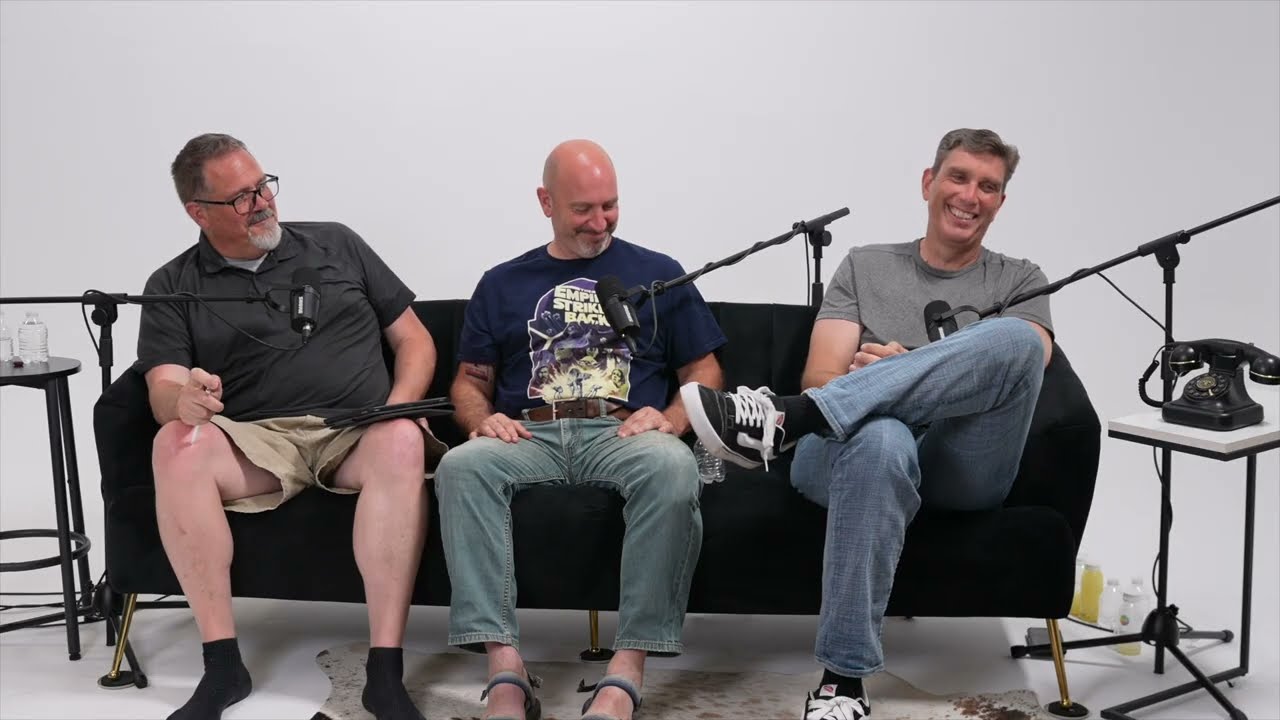
The Sweet Aroma of a Crushed Flower: How Suffering Can Change For Good (Live from Phoenix)
Live from a Phoenix studio after Bob completes 24 rounds of IPT chemo. The conversation centers on the metaphor of a crushed…
Read the transcript Hide the transcript
Auto-captioned and lightly cleaned. Rough in places. Speaker labels and timestamps coming with the new transcripts.
Hi, this is Bob Roberts and I'm the Dead Man Talking. I have stage four cancer and my liver and possibly only a few months to live. So I've invited four of my best friends from college days to talk about cancer, suffering, death, hope and God. I can't wait for you to meet Will Galkin, Jason Janz, Ellis Murphree and Josh Darnell. My desire is to tackle big questions and challenges that my probable near term demise raises and to always season the sobering with humanity and humor. Don't expect nice and tidy solutions with a bow on top. It's going to get messy. Welcome everybody to episode eight of the Dead Man Talking podcast. We are sitting in the studios here in Phoenix, Arizona together really for the first time cutting live episodes. And so we want to talk today just about another topic that's come up for us. But first of all, Bob, why don't you give us a health update? So I just completed the 24th round of IPT chemo. This was over a 12 week period of time. I would love to praise the Lord for just a moment. I didn't miss one day of treatment and I did not miss one of the IPT chemos over that 12 week period of time. They are sending me home for two weeks to take a break. I will be doing some special detoxing coming back here on June the 6th and then I will be getting a fresh PET scan and they're going to compare my liver from the first PET scan to my liver from the second PET scan to see where we go from there. And how are you feeling? As far as the whole man, probably about 80-85%. We did a little hike this morning together if you remember that. We remember. You beat us up the mountain. They don't remember. Right. Why didn't they go? You guys went on a hike? Oh my. Yeah. I mean, for those who are listening, Bob being here, he's taken lots of hikes. And so when he got here, he wanted to take a hike. But he wants to take the hike at 6 a.m. Yeah. He'd go earlier. Up a mountain. But we didn't get going until 7 a.m. So by the time we got to the base of the mountain, it was really hot. The sun was baking down. Actually, it was only like four of us that got to the base of the mountain. Yeah, because one guy just said he couldn't do it. Because he had a sunburn? Was that right? You had a sunburn so you couldn't make the hike? My shoulders hurt. Was it a big owie or a small owie? It's a pretty big owie. He was slathered up with a lot of aloe vera on his back. But that's why you couldn't hike? Like walk? Man, the heat radiating through my shirt just hurt. I did not want to really overly discomfort myself for Bob. I'm glad it's all out now. You'll take the flight, but you won't. I love him, but I mean, I flew down here. Okay, then we got to the base of the mountain. Let me go ahead and- Josh, you were with us. I'd like to go to bat for my buddy Josh here. Definitely would like to go to bat. Because Josh wanted to unite at different points with my journey, my cancer journey, which I think is true friendship. True friendship is not just like a listening ear. Or just going up a mountain. It's not just going up a mountain. True friendship is actually uniting with the sufferer at different intersection points in the story. So how does he unite with you? Coffee enema. Oh, what? I think this needs to be explained. It does need to be explained. Let me just say one thing. I haven't drank coffee for 20 years. I make fun of it. I don't like Starbucks. I don't drink coffee at all. But I did take some coffee straight up my tail end for my brother. I'm not sure we can say that. Okay, at an angle. I don't know what you're saying. You said enema. Yeah, I think enema is enough. I don't think you have to do any clarifying after that word is out there. I took on a medical procedure because I loved you. And it worked. It worked so much that I didn't make it up the mountain. And I encouraged this procedure because I loved you. Because it's part of my cancer protocol detot. And I did it because I love you. I have found it very helpful. I found it very helpful. I think everybody should do it before you take a hike. Is there a responsibility in medicine to do no harm? The Hippocratic oath? I'm just saying, are you sure you should be advising this medical procedure for untrained people? I've been doing it for 12 weeks now. I did it. That's no problem. Just don't go on a hike up a mountain in Arizona an hour and a half after you do it. And I just want to say, and don't use the shower after Josh does the procedure. Now speaking of having a good time, speaking of having a good time and changing the subject for changing the subject. We went on a boat ride last night and it was beautiful. It's important. I'm not even trying to be serious, but it is important that in great difficulty, you have fun. Have fun if you can. I mean, a cruise ship, more of like a cruise pontoon. No, it was a redneck, huge pontoon. The cruise is a... That's a... Sunset though, it was romantic. It was. Will and I sipped a pineapple sprite together twice. I felt very close. Anyway, it was a great time. All right, so we've got the update here. What I'm talking about this podcast is this issue of the transformation as a result of suffering. Bob, you have said to us this famous line, I'll let you say it, around your personal growth. Sure. So, I am the best version of myself I've ever been when I think I'm going to die. When I truly believe I am going to die, I am the best version of human I've ever been. I've lived with myself for 52 years and I think that's a pretty objective evaluation. Talk more about that. I think that there's been a massive reprioritization of values and loves and things that my eyes were not necessarily open to see before they are open to see. Whether that's a little orb, a bright orb of grace that God's given me for that day or another person who is suffering in my proximity. I am just so generous with whatever it is I've got in me with other people. I want to be there. I want to be praying, kneeling by their bedside. I want to be holding their hand. I want to be crying out to the Lord on their behalf of other sufferers. You would say that Bob B.C., before cancer, that would not have been as true or as strong as it is now. No. I think that is very, very much the case that I was not the full-orbed human. I think part of my journey has been God's just sovereignly had me in the Sermon on the mount for almost two years right now, which I believe is the definitive handbooked guide to what the full-orbed human looks like, where you have the very image of God, Jesus Christ, telling you what it is to be the image of God. He preaches the sermon and then he goes and lives the sermon for the next three years. So I'm going to stop you there because if you're watching this podcast and you've been following Bob Roberts, there's stuff coming out of Bob that is different and this has become a subject of our conversation. Like Bob, you're becoming a better human. Praise God. We're really grateful. That's Christianity. If you read the Bible, and it's not, and I really want to be careful and precise here because when we think about sanctification, which is God's process of changing the Christian into Christ-likeness, we tend to think it's God's part and my part, that it's a synergistic thing. I think a better word is cooperation, but I think an even better word is forcing. Graciously forces you into a mold that looks more like Christ-likeness. So the question- He squeezes Christ out of the Christian. He loves you that much. Yeah. So the question came up at breakfast, we have a telephone here, the golden telephone, that if you could pick up the phone and call God and say, please stop it, and if you did pick up that phone, he would. The cancer. Yes. Would he stop the cancer? Heal the cancer. Boom. Would he heal the cancer? Would you pick up the phone? And that question provoked this whole thing because we don't order suffering off the menu. It is forced upon us, and it produces such goodness that it would make us almost hesitate to pick up the phone. So what does Spurgeon say? He says, I've learned to kiss the wave that tosses me against the rock of ages. And so if you would have asked me two years ago, would you pick up the phone? Without hesitation, yes. Right. I don't want cancer. I don't want to die a cancer young. I've got a family, I've got a kid. But now I've lived with two different bouts of cancer over a period of almost two years now. And so there's actually- Right. Because I am aware to the glory of God of a different level or a different brand or a different quality of fruitfulness because of my suffering. And I'm not. I'm not keen to give that up. Right. And we're also, as individuals, we seek comfort, and so we tend to not do the maintenance on our own vehicles, right, our own vehicle of our life. So we get forced into these spaces. And the Scripture talks about this. So once you frame it up with the passage that came up at breakfast- Yeah, we kind of worked our way through a couple of them, but Romans 5, let me read it for us, actually just three verses, it's talking about how we've got this right standing with God and this hope of eternal glory, but then Paul throws in kind of a, well, I'll read it. Not only that, referring to eternal glory, but we rejoice in our sufferings. Knowing that suffering produces endurance, endurance produces character, character produces hope, and hope does not put us to shame because God's love has been poured into our hearts through the Holy Spirit who has been given to us. So when you see that we rejoice in our sufferings, is that what you're talking about with the phone? I think that is a big part of it because the joys that I've tasted during the valley have been deeper and more profound than any previous joys. The love that I have felt, I made mention of this in one of the other podcasts, is like, if this suffering is a form of discipline, then I have felt very, very loved in the middle of that. And that's what a loving father does, right? He does discipline his children for his glory and their good. So I think the biggest part of it really just gets back to the square one basic theology of why do you think you were made? What were you made to do? What does the Westminster Confession say? To glorify God and enjoy him forever. So you are made to be a worshiper of God, and in being that worshiper of God, you are designed to find ultimate joy, peace, and satisfaction. For whatever reason, it has been the vehicle of suffering that has taken me there and connected me to that, what I believe is our ultimate mission. It seems like the end of it is that glory of God, the joy, but the process of it, I mean, rejoice in sufferings knowing that suffering produces endurance. So yeah, they call it the divine dominoes in this passage. Suffering produces perseverance, then that domino says that produces character, then that domino says that produces hope and love should have brought in our hearts. So we don't unpack the domino fall there and say, the first one is that suffering produces endurance or perseverance in some translations. So Will and I are here to interrogate the men on the couch here today because they've been the recipients of long-term suffering, Ellis and Josh, both through decades plus loss of spouse through death or divorce, and Bob through a multi-bout cancer experience. And so the first question we're going to throw on the table to you is, as suffering hits that first domino of endurance, why do you think the spirit of God inspired the writer of scripture to say, this is how it goes and what you need at the first step is endurance? Why? One of the reasons why I believe is because we do have a natural tendency to either coast, self-reliant, not need the Lord. And so he's gracious and merciful to us enough to put us in a difficulty that in his love, he sees that we're going to look to him. I remember Robert Burr-McShane used to would say, it is the look that saves. It is the gaze that sanctifies. So in that difficulty, it gives us a natural tendency, Oh Lord, I'm hurting. I'm not doing well. And so the Lord graciously lifts our, spiritually lifts our chin to him and says, I'm with you, son or daughter. So just stay with me. This difficulty may last the rest of your life, but endure this with me. And then there's going to be the fruit of whatever the next verse says. Yeah, I just kind of dovetail into that. I think that suffering, especially when it's persistent, a little bit longer term, and we could endure anything for one day, but most forms of suffering are weeks and months and years. And what it does is it connects you to the reality that you're in. And then it really teaches you what's true about you. Because when you're not suffering, it's so much easier to connect to the comfort matrix of this world. Lust of the flesh, lust of the eyes, pride of life, sitting on a nice cushy couch watching Netflix all day, ordering DoorDash. Like humanly speaking, that's my jam, right? What suffering does, when I have the mule kicks, the internal mule kicks of the liver reminding me that Netflix show, that DoorDash, that's really not my reality. There's something much, much bigger and more meaningful going on. And what that reality requires is for you to believe. You have to have faith. You have to have a presupposition about the nature of the world that you are in. And James says that it's actually the trial of your faith that is much more precious than of gold that perishes. So in God's economy, you being connected to the reality where your faith is there and growing is more precious than gold. And I would submit to you based on my own experience now that what really gets you there is a form of perpetual suffering. Bob, just to push in a little bit, you've been like emphasizing the spiritual realm. Yeah. Okay. But you just said it was actually the physical realm hurting. So do you have any thoughts on that? What's the connection between the physical and the spiritual? Well, I think maybe that it's actually suffering that has that interdimensional aspect where, you guys watched the movie Interstellar back in 2014. And the whole theory there is that it's gravity that has this interdimensional ability to travel across dimensions and communicate. And I'm just wondering if that's actually not suffering that has that ability to send you a gracious message. I know this sound, this is so upside down, right? Because we just want to, we want to take a pill. I want to have an operation. I want to get rid of my suffering. But that suffering is actually sending you a message that could save your life. It's telling you about the world that you're actually in. It's objective. You don't get to define reality. Reality is reality. Many people never fully connect to it. That's right. Because they don't have, I remember one time I was in a great difficulty. I was paralyzed in Wisconsin and my father walked into the room at the hospital. He said, man, Josh, you've been so honored that the Lord allow you to go through this. You're going to see things about the Lord that I may have never seen. And I'm listening. There was a jerk, I was paralyzed from the chest down and I was like, okay. But here's the thing, when dad left the room and I was crying, I was like, there is another reality. My dad just pointed me to something rather than the seen, the unseen, and it opened up another world. So to me, the difficulty, the pain allows us graciously to see the unseen, which is so powerful. Now, if we go into our darkness and we just sin and we say, no, I am going to isolate, I am not going to trust the Lord. I don't have a view of God that I need to have. My father mistreated me or whatever. The Lord will even help you there. The prodigal son, it took some time, but the Lord will help that person there too. So to summarize this, you mentioned the book of James. The book of James says, count it all joy when you fall into diverse, difficult temptations. But from a human standpoint, no way, man. No way. Yes. And I mean, right before we got on this podcast, we all, my brothers, we prayed for the war in Ukraine, for the missiles going in. And my prayer is not just that the Lord protect them, my brothers and sisters there, but that the Lord would deepen their faith in this. And they're going through a, they've been in years in war and they're trying to persevere. And many of them are seeing Christ, a soldier just spoke with a few hours ago. I shared with him Psalm 140 and literally 30 seconds later, I sent him a screenshot of Psalm 140 and Shorty who is in that situation said, I've already read it, Matt. I've already looked it up. Thank you so much. That's great. Now, to riff off of you two for just a second here, we, this isn't, we aren't being massacists when we say this. Amen. But we need suffering. And your statement that kicked this off, that you're the best version of yourself when you think you're going to die. We need suffering because suffering in the life of the saint has a way of stripping off all the, all the places that we make our boast and all the, all these, all these places that give us, I love that the way trip frames it. It gives us that, that illusion of autonomy and, and strips us down to dependence, to dependence. And yeah. So James says, let perseverance finish its work so that you can be mature and complete. It would seem that the temptation, the reason the spirit says do this is because the temptation is to short circuit the process. I mean, Josh, part of our relationship was born out of tragedy when you fell out of the tree and I was chasing you. And you know, that was 30 some years ago, but just this year due to the Brown's Accord syndrome and you've had to have a hip replacement. Like you're actually still, that suffering is not complete. And it's 30 years still causing you daily pain. So talk about the temptation to short circuit or escape and not follow through on the biblical admonition for perseverance. And pragmatically were there moments where you wanted to escape? Well, yeah. Well, yeah, I mean, we just, we just, we, the last session we recorded, we, we tiptoed around some of that where we actually didn't tiptoe, Josh tiptoed, but we, we, we move into these spaces where, I mean, where the doubts start to creep in because we are trying to short circuit that. I'll rephrase that. I don't know that it's even a deliberate short circuiting. We are, I think at times still grasping onto this idea that maybe we've got more control than we do and maybe we know a better way through. And so the temptation is to not just, it is to run from the suffering to try to find our own way out, but that temptation is really to run from what God has for us through that suffering. I mean, I was in a dark room at one point considered suicide. So the ultimate separation is I'm done. I'm, I'm the, my brain is hurting me so much. I'm done. Now, suicide is, is one option. Another option is, is drug use. Another option is some false relationship for whatever it is, sex, whatever it is. One option that most people never talk about is I'm going to, I'm going to be so successful in my job and my business. I'm going to have a position and I'm going to make money and I'm going to find my security and money. I don't care about anybody else. That is a form of idealization of not being in control. I'm going to be in control. That's just another form. So there's lots of different ways to try to get away, but I am, I'm forever thankful that even in all those scenarios, Psalm 23 is very clear. He will chase us all the days of our life. Yeah, because he's very interested in your relationship with him. He's very interested in your faith. Without faith, it is impossible to please God. It's more precious than of gold. He's more interested in our relationship than I am with him. He is the center of the universe. That takes pressure off. You and I have talked about that in your faith, which in this time, which might be coming to the finish line, you found God not only to be gracious, but a heavy carrier. He can carry it. And I'll tell you right now, and you've mentioned this to me in private, so I'm not trying to go past what I should say, but I'll tell you this. It's not always about us. Not only can the Lord carry me, can the Lord carry my child? Can the Lord carry my son through a difficulty? Can the Lord carry the country of Ukraine and the people of Russia that are losing their soldiers? If the Lord can help me, can he carry all these other things? And you found that he can. So we talk, the next domino then is that it actually produces character. So if James is true, that I let it finish its work so we can be complete and entire, lacking nothing, it's get the idea that on the other side is character transformation. And Bob, you have said, I'm the best version of myself when I'm dying of cancer. Yeah, that's the Romans 5, where it's the endurance produces character. Yeah, and we have experienced that. We think you're actually a better human. Yeah, praise God. Your friends closest to you like, what's happening to Bob here? Because we're experiencing a different aspect. Without a doubt. Yeah. He's more selfless, more savior fool. What is the phrase you used? I'd like to back way up and talk about- Before we get into the- Only child syndrome. I mean- The lack of ability to be touched. I just remember traveling around the nation with him doing Cold Wars, and he was so touchy that just for fun, the three other guys on the team would just go jump on top of him in his bed. And he was freaking out even though there's a blanket in between us and him. Just to abuse him- Better when it was two or three. But talk to us about that, Bob. What is that, here you are guarding yourself before this trial, and now you're actually like this. So I think there was some awarenesses that God had given me a few gifts, a few ministry gifts, and I enjoyed using them to the glory of God, especially in regards to kids or teens. And I have always really coveted an opportunity to talk to people about Jesus. I think I'll be that way until I die. But as far as just the nitty-gritty bedrock, sitting down and just giving of myself to love somebody, that was- Well, that was why I was glad you were in the World Will, because you were pretty good at that. And I just thought, well, God just- When God was giving out that ability, and he said, come forth, I came fifth or sixth. I just didn't have it. And I think a big part of it has just been, there's been a gospel fearlessness in me, because when you've got one foot in the grave, who really cares what people are going to think or say? I've seen it at your treatment center. Yeah, I would say, going on that theme, it seems like you were comfortable with Will having a ministry. You were having a ministry to the crowds, and he was maybe really good at the ministry to the individual. He was good at both, but I mean, I think- Well, I think you were a better preacher than Will, probably, but- Wow. That's great. Can we leave it there for a few minutes and just talk on that? No, I guess my point is, is saying that there's been a definite upgrade in your heart, focus, and attention to individuals. And why don't you guys speak to what you saw in the clinic? I just went one day, but I'll just go quick, and then maybe Ellis, you can take it. Without calling out specific people there, but you just knew their name. You walked in. They know that you're a person of faith. They're listening to your worship music as you're getting the one treatment with all the lights. And you just, there was a, I love the gospel boldness, but also what I saw was a care for the individual. And I think that with your other fellow patients, were walking in, and they're lighting up. And I was like, what's going on? So I'm doing this little recon as you're going to your next treatment. I'm saying, so what do you think about this guy? I mean, is he for real? And they're just saying such wonderful testimonies of your kindness and your love towards them. So I think, I mean, I just want to praise the Lord. I just really feel like that's Jesus loving them through me. I'm just a conduit, but it's there. Like it's never been before. What's different? What do you, why are you feeling it? Because I feel loved. I feel free. Oh, that's so good. I feel, I just feel so shielded. Even in my, even in my affliction and the unknown future, I just, I'm so confident that Jesus loves me. Yeah. And that's the passage we'll get to in a second. Yeah. when to piggyback off of Will, I got to go, how many treatment days did I go to with you? Three, I think. Yeah, three or four. And yeah, there was a, one, when Bob walks in, not only does everyone know Bob, and that makes a little sense because he stands out just a little bit, not always everyone knows Bob, but Bob knows all their names and Bob knows their story. Bob knows where they came from. The other, the other people that are being treated in there, he knows what kind of cancer. And not only that, he's giving me backstory to everybody, backstory to everybody, who his mom is and what she fought and all this stuff, because he's diving deep into these things. So I would see him, and I mentioned this on another episode, but it's worth mentioning again, when Bob has an IPT chemo day, you were seeing him, I mean, how long? It's smelling him. How long? It's smelling him. How long is that treatment? It's like 45 minutes, right? Yeah. And you're seeing during that 45 minutes, I sit right beside him and like one time I'm like just poking him. Are you still here? Because he crashes so hard and then it's back up and then it's crashes so hard where he just he's unconscious almost and he gets done with the IPT treatment and he's like, all right, let's go. We're going to go eat lunch or no, I think we ran out to the lake that day. And as he steps out, he is unbalanced. He's weak and unbalanced. You step out of that room and the move is to turn right, go through a door, turn left and go outside and leave. And Bob comes out of that door instead of turning right, he turns left and he starts looking in the rooms and it's back to that touching ministry because he knew everybody. We were there the second to the last day before he left. This guy comes in that I hadn't seen. Bob just starts talking to him. And when the guy walked off, I'm like, who's that? I don't know. I've never seen him before. And I'd like to I pop in for a treatment the next day and Bob calls him by name when he comes walking through and he tells me more of his story because again, pops leaning into those spaces. And I want to praise the Lord for just a second. It's not a bull in the China shop. I just want to tell everybody about Jesus necessarily. But there's a sensitivity to it. There's the Lord and the Holy Spirit. You're not just thinking of how you can communicate. You're thinking of the person you're communicating to. That is a fingerprint of the Holy Spirit. So Bob, let's do it right here live. People in your clinic are listening to this. Talk to them right now. I'd die for you. I love them all. Talk to them. Who? Oh, my word. I love Linda and Jennifer and I love Lynn and I love Vicki and I love all the staff. I love Yeye and Frank and Misha and Bianca and Mika and Yehema and Scott and Steve and Pam, Tanya. So you know, one of the things, guys, is I'll talk more to them, but just, to you know, just before cancer, I felt like my biggest enemy in this world was my flesh. And I just want to put this out there. I think that if you're a Christian and you think your biggest enemy is your flesh, you've actually lost that unredeemed part of you that wants to tap into the lust, flesh, lusty eyes, pride of life. And we'd all have what the old theologians would call indwelling sin, right? Because there's a part of you that's not yet redeemed until you see Jesus face to face and then you're glorified. But I think the danger of that is you actually lose the plot of the story. The big overarching narrative of Scripture is that there was a foreign evil already here when Adam and Eve were formed from the dust of the ground. And that foreign evil was a spiritual evil. It came in the form of a serpent who was really the satan and it infected humanity and death by sin. So my primary enemies are Satan and the power he wields, which is death. And I think that's really important that you get the public enemy number one down in the story. Because I've never hated that enemy more than I hate him now. And I think that's spiritually healthy. Because when I go into that clinic, I want to put on the Lord Jesus and I want to minister grace like he's been ministering to me. And I just want to give. Like these are hurting people. And they've got one foot in the grave, many of them, and I want to keep them from going. And I'm waging battle royale for the glory of God, trying to connect them to the reality and the savior of the reality, the God of the reality. So, Bob, I think this is really key because this is another part of the character that seems to be formed in you. We've had a relationship for 30 plus years. where the content of our conversations was ministry, growing ministries. Then it was during COVID, we all traded stocks together. Like that was around making money to feed the family. And we had a conversation around money for a year and a half there. Now, the conversations are really about spiritual realities and human people that you love. It just seems to be a shift in your focus. Sure. So all I can say is God did that. And it was a blissful, sovereign manipulation. And when the Holy Spirit does it, it's okay, right? But it was a forced thing. The only kind of sanctification that's ever really worked in my life is the forced kind. So what you're getting is just, I have nowhere where I can say, well, I did my part and God did his part. I can only say, I just kind of leaned into God and him doing all of it. So just to amplify that, go ahead. I just keep on hearing it. Almost if we had a meter of would you pick up the phone or not pick up the phone, it's like there's certain things like what you're talking about that seem like you don't want to pick up the phone. Yeah. There's certain aspects that you're like, no, I'm thankful that this is, I can actually say not only that we rejoice in our sufferings, but we, I mean, excuse me, let me read it again. Not only that, but we rejoice in our sufferings. Is this been a good thing for you in these areas? Oh, there's no doubt it's been good for me. And you guys can evaluate, this is, what you see is what you get. All right. So just to emphasize that point, even personally, like Bob, you're different to us. Like before we went to breakfast this morning, you sat us all down and gave us gifts that were these beautiful rocks and said words to us. We'll just go around and say what he said. Yeah. So mine was this, it's a perfect sphere with orange and red, lots of red in it. And he said the particular type of rocket is formed only through trauma, volcano, pressure, heat. And Bob and I have fast tracked a deeper relationship in the last two months and have been able to share in our mutual suffering and in our individual suffering. And just part of the reason that was so meaningful to me is Bob, for Bob to look at me and say, lots of suffering, lots of pain, and lots of beauty was deeply, deeply moving and meaningful to me. Bob knows me pretty much more than now, more than anybody. Bob expressed that the rock that he gave me represents the fact that it's hard and it's strong and it's an enduring rock. [Transcript continues — see full transcript at transcripts/Ep_08_Ep_8_-_The_Sweet_Aroma_of_a_Crushed_Flower_How_Suffering_Can_Change_For_Good_(Li.txt]
-

Red Pill vs Blue Pill: How Suffering Connects You To What’s Really Real
Using the Matrix's red pill / blue pill framing, the crew explores how suffering strips away the illusion of comfort and connects…
Read the transcript Hide the transcript
Auto-captioned and lightly cleaned. Rough in places. Speaker labels and timestamps coming with the new transcripts.
Hi, this is Bob Roberts and I'm the Dead Man Talking. I have stage four cancer and my liver and possibly only a few months to live. So I've invited four of my best friends from college days to talk about cancer, suffering, death, hope, and God. I can't wait for you to meet Will Galkin, Jason Janz, Ellis Murphree, and Josh Darnell. My desire is to tackle big questions and challenges that my probable near-term demise raises and to always season the sobering with humanity and humor. Don't expect nice and tidy solutions with a bow on top. It's going to get messy. Right, welcome to episode nine of the Dead Man Talking podcast. Here we are coming together once again after our time together. We're all in different locations. I'm actually in the mountains of Colorado in Crested Butte on vacation. Josh Darnell is coming from the land of the Ukraine. And Bob, where are you at right now? I'm at the Wild Christian Camp in North Carolina, Brevard, North Carolina. And Will and Murph, you guys are at home in Idaho and Wisconsin? Utah. For like eight of us. It's all the same to most of us, man. Once you go west of Colorado, it's the land of fruits and nuts. Potato. All right, so welcome to the podcast. We're having a good time tonight talking. So Bob, why don't you kick us off? How's your health? So I finished three months there in Phoenix. And the net net is basically, it just kind of kept the cancer at bay. I'm trying to give a metaphor. The water has come up to the dam and the dam is holding it, but it's not pushing it back. The water is still there. It's still ugly. There's still a lot of it. And it's just looking for cracks, looking for little places where it might push through. So the PET scan I got after three months wasn't too awful. One of the big praises is it did not show cancer in my lungs or my head, which is where it likes to go. It's still there firmly in my liver, two spots, but it's still there. So kind of living in that liminal space. Not sure what's going to happen. Not sure what my future holds, but I do know who holds my future. And that is not right. That is not trivial. That is all the hope I need right there. I just thought I heard the gathers in the background just now. Yeah. And I know who holds my hand. This would be the home, the Gaither home coming might be the Gaither home going. What are you doing with the Wilds? Oh, I'm getting to speak to precious souls, man. I'm having a blast. Having a ball. The reason why I brought it up is I just know you're speaking double duty. I like speaking three times a day, which is not normal. Oh, it's so fun. Yeah. I don't know what they think of me, but I know that I'm giving them the word of God, right? So I think I'm unique because I think I'm a pretty good preacher and a really, really awful invitation giver. Well, we will say you are unique. I'm not sure what the preacher, but you are unique. Is anyone else telling you that or is that just your mom called me today? What does the Baptist are the ones that worry about how many people come forward? My Anglican friends like I don't know what's wrong with you Baptist. Like they all came forward today in our church. All right. Yeah. Yeah, Sarah, she just gets she gets sick of my insecurities. She just gets sick of hearing me nitpick on my sermons because I don't think I've ever preached a sermon where I just felt good about it. It's like Sunday. You guys, you guys know in the context of local church, you do ministry on Sunday and And then you quit from about 9 p.m. Sunday till about noon on Monday. And then by about noon on Monday. What's that? It's about nine to nine. Yeah, right. And then you just you just pick up the mantle again. It's like, yeah, hey, supposed to do this. So what do you want to talk about tonight, Bob? Well, I want to talk about how there's a grace in suffering that actually connects you to reality, connects you to the world that you're actually in, because I think the human tendency is to make self-constructed worlds that aren't real, that are built around things like comfort and pleasure and thrills. And I think that as a human, we tend to be self-deceived or at least self-deluded about what's really going on and what we're really a part of, especially when there's times of cushion, times of comfort. All my kids are getting good grades. I don't have any cars in the shop. I've got a little extra time. I've got extra money in the bank. And it's times like these where you can build your own matrix. There's been a gracious red pill in my world. I'm not talking about the way they use it now, politically speaking, I'm talking about Christian ease, the Christian red pill of suffering, which has awakened me from self-constructed matrixes, self-constructed comfort to, oh, this is the reality I'm in. It's a big one. It's an invisible one. It's an eternal one. It's not the small one that I was chasing after for many years. And there's actually blessing in being connected to the real world. What do you feel you're disconnected from? What have you lost attachment to? I've lost attachment to smaller, lesser joys, shallower joys, cheaper joys. Now at the time, at the time I did not perceive them as cheap because I really wasn't fully awakened by the suffering to this reality, this very broken reality. But this very broken reality has been invaded by heaven. Jesus first ministry words, repent for the kingdom of heaven is at hand. That is the rule and reign of God is here. And we know that because the king himself stepped into this kingdom. So we know that. But it's priceless to be connected to that. It's priceless to see it. It's priceless to chase after it. It's priceless to actually have your eyes opened. And I think you're going to find you're going to see what you're actually looking for. And I think suffering does that suffering opens up your eyes. It gets the gaze off those lesser joys, those little things, the advancement at work, the extra money that just came in. And I'm not necessarily relegating all those things to those are bad or those are sinful. It's just a matter of that's where your gaze is. When your goal is comfort, when your goal is pleasure, when your goal is I want to live my best life now. I want to squeeze whatever I can out of this reality. But what if your reality isn't really real reality? And that's what suffering kind of jolts you into. So let's play that a little bit and just go, you've spoken at summer camps to kids and teenagers for decades. And now, so there's definitely a vertical nature to the real, the real world. But the horizontal nature, have you noticed a difference in your horizontal ongoings of the last couple of weeks in camp ministry? I think by horizontal, you might be referencing just like the personal touches, right? The one on one. Human relationships, yeah. On the human plane, that must be different. If it's all different, that's different too, right? Yeah. I mean, the content of the conversations, the substance, it just goes right for the jugular. Like I'm very keen to help people move their gaze from things that just don't ultimately matter to the things that do. And I have this, I have a real leg up right now because I am a living, breathing example of somebody who's about to die. And they know that. They know I've got cancer ravaging my body. And so there's almost a supernatural tool of one like me that is suffering, that has been awakened to the real world, to amplify that truth. Not just in word, but in life. So in studying Colossians chapter one here recently, thinking a little bit deeper about this, Paul makes the comment that he's making up or making up what was lacking in Christ's affliction. And that troubles me because I don't feel like Christ lacked anything or ever will lack anything. But the idea there is basically Paul is saying, yeah, I've been waiting my turn in line to And it seems like there's a quota of suffering that God has ordained for his people. So get in line because the baton is coming to you and it's for the church. It's for other people. It's not just for you. Your suffering is always for anyone and everyone around you. So you don't know who the church is all going to be. You don't know who's not yet in the church. So you could say like this, you could say actually your suffering is for the world. Now you're not saving anybody. Your suffering is not a propitiation, but your suffering is a propagation because there's I think there's a supernatural sense in which God is pleased to connect somebody that's suffering with joy and hope up to the saving message, the saving savior, and now you're propagating. So Jesus' suffering was for propitiation. Your suffering, Christian, is for propagation. You're not allowed to suffer in secret if you're a Christian. This is his fourth sermon of the day. So to get real here, to get real, I mean, I just want to like, for those that are listening to this, it was probably five or six years ago, several of us on this call right now got together and said, hey, we should get together more often and we want to spend time together. We want to get together on an annual basis. We want to have monthly phone calls and we're going to go deep. And you opted out. I think there were multiple reasons that didn't just pertain to this area. But if we're going to get real, I remember talking to Will about this, you did not have a desire to go to this level in your life. And it was kind of a piece out. Now, maybe I read that wrong, but in some sense, suffering has taken you not only from being a little bit distant from that to actually speeding in front of where we're at, where you're like every conversation is kind of ultimate. I just want to throw it out there. Will, you're dying to say something. To encapsulate it, I just feel like, Bob, as a whole, five years ago, if there was something deep within you, you would protect. And now you are just like gushing it. And I'm the one that's supposed to pull the inside of you out. But I feel like you now are like the dispenser of the pill. You're calling us out. You're like, why would you waste your suffering? Why are you keeping that internal? Can you just get real people? Can you just take off the facade? So what happened? You became like Will. Sorry. Wow. I repent. No, I mean, but there's a beauty to that, right? I think, though, I needed this. And Will may just be more, I would say naturally, but I mean, Will's a very spiritual man. I mean, his walk with Jesus has been deep and abiding. there's some sense in which I'm jealous of it. I praise the Lord for that. I've needed Will in my life. And there's always been a certain fearlessness and boldness with him. And I don't think I ever would have gotten anywhere near that or tasted that had it not been for this cancer, because I do I wake up absolutely connected to what's really going on. And what's really going on is not me getting excited about going fishing or going to tracking or whatever. And those things aren't necessarily sinful, right? But like, what's really going on is my time is short. Life is a vapor. And this is this again is not trite or trivial. Only one life will soon be passed. Only what's done for Christ will last. And man, suffering's got me plucking that string, that one string on the banjo every day. that's what I'm here for. Do you have anything to add to that? I think something that comes to mind with me is that we tend to treat suffering from the outside looking in. We tend to view suffering like if it's coming on us, like this is a disruption to my story, this life I'm living. And I think it actually, and to paraphrase a little bit what you've said, Bob, it can pull us actually deeper into the real story and into the bigger story, because suffering is an integral part of the Christian life. Do you remember the time when Bob pre-suffering, how he handled depth and transparency and vulnerability and attuned to the real world? Pre-suffering? Yeah, the interactions I had with Bob were frankly pretty surfacey. That was probably both of us though. Most of the interactions that we had prior to the last, there's been a few deeper touch points over the last 10 years, but most of that's been really over the last two years. So Bob, I feel like you've run past us and now you're like devouring the blue pills, you're throwing the red pill, you're throwing the red pills around and saying, this is great. And I find myself going, I don't want one. No dang way. I'd rather live in the blue world for a little bit longer? And you know, I mean, if you're on mission, I think you have a low level of suffering. Someone's always not happy with you. You're technically, you're up against true forces of evil, that kind of thing. But like you're at a level 10 on the red pill suffering gateway. None of us would order off the menu, but there's no doubt the spiritual is pretty big. I think we'd like to kind of go around a little bit and say, we've seen this awakening in you that is obvious, that's attractive. Yeah. And so how do we get that without getting stage four? So I think it'd be fun to do something first, kind of that dives into that. I think it'd be helpful for people, too, because, all the comments that we receive, most of them have a common denominator of, man, it was so helpful to me to hear you guys be so transparent and admit and acknowledge your brokenness or your messiness or whatever. I think we should just go around and talk about what we love about the blue pills specifically. what are those things that we, in a self-deceived sort of way, construct in our own little universe that really attach our hearts and attract our hearts to more of a blue pill reality versus the real one? So I'd like to kind of put that out there. for me, and I don't want to speak in generalities, I really want to speak in, specifics. So because we all have designer lusts, we all have idiosyncrasies that are, would really appeal to us and attract us. So, for me, if I could have a really nice big living room that's at peace, it's got a lot of beautiful rocks, okay? Geodes, geode towers, and a big aquarium that I can just go lay down and watch my 100-gallon aquarium and watch fish and feed fish and be proud of them because they're actually, they're expensive, expensive angelfish and cichlids, and I know a lot about fish. that's a blue pill for me. what is that? Put a headline over the top of that. Yeah, because is that necessarily wrong? help me understand how that would be considered blue pill when it could be you're just enjoying God's good creation? Yeah, and I mean, it can, right? I'm not trying to, do 1980s flame-on camp preaching here, and just blast everybody. I'm talking about knowing me, having lived with me, knowing how easy it is for my affections to grab out those kind of specific things and then just make that my world and find my identity, stability, and comfort and security and just those things that I like. So you're saying that even a good thing, when it's the ruling thing, is the bad thing? I heard a preacher say that once. Yeah, I know. Yeah, when a good thing becomes a ruling thing or when the gift usurps the place of the giver. I think, though, even if it just numbs you, that's all it needs to do. It doesn't need to be the lord of your life. It just needs to be a distraction to the lord of your life, right? Yeah. Because would you say what you're talking about, Bob, your big living room with your little cichlids is comfort and calm? Is that the blue pill world for you? Yeah, I mean, and I had that pre-cancer too, and I invested a lot of time and effort into it. And it's so subtle because there's nothing really overt about that, right, in scripture. thou shalt not have a big aquarium. But I mean, there's all kinds of things about your loves, right? Thou shalt love the Lord your God with all your heart, your soul, your mind, and such your affections on things above, not on things on the earth. Take no thought for the morrow, what you shall wear, what you shall eat, what you shall drink. so it just seems like the whole motif of the New Testament is Jesus is trying to help you understand. Look, you're created for a different world. You're on a pilgrimage. So don't get too attached. All right. Other blue pill confessionals with the group? Yeah, I need them. I think mine's control. I think the Lord is just like peeling a control. I think it kind of steps back to our past podcast with some of the fears and doubts. And it was like, I think at the very bottom is, like not wanting to trust God. So I'm going to control circumstances. I probably don't think I would live. I wouldn't say this, but like once, shame on you, twice shame on me type. And I think my family's felt it. I think the people have served with me and felt it. those fears. So it's like order. So my daydream, my big fantasy. I remember once preaching in Denver and they put me up in this really nice hotel, like a grand height or something that it's phenomenal like mattress. And I'm just like, to me, like the escape is that mental, like no problems, no issues, nothing out of control. It's quiet. I'm sleeping. And in Denver, yeah, that that that hotel in Denver, I think I've been back to the hotel and I did not get the same room. It just didn't. It just didn't deliver. How is that controlling to you? Oh, so so that's escape. That's a very controlled environment. That's like the that's like a safe place. there's no problems, there's no issues and everything's OK. And so I think I think when the busier I get, like the more activity I'm a part of, which a lot of times is missional activity, but it's a desire for some form of a diversion. And so if I can't control, then I'm going to read the news. If I can't control, I'm going to figure out where the stuff with the with the EPL is soccer. I'm going to trivia. I'm going to get a lot of facts. But again, it's just an escape because life's out of control. Like there's too many deadlines. There's too many people to please. I can't please. There's too many things undone. So then the drift to this other thing. And that's why I like what you said, Jason, about. It just doles you. Yeah, no. And and then you go another day and you really did you really communicate with Jesus or did you just do the check? Did you really love people or did you just kind of put them in the ministry checkbox? Did you really like consider eternity or were you safeguarding your own passions? Well, yes. Yeah, mine. Mine would be, there's noise, distraction, numbing. It all it's all covered under leaning into different kinds of addictive behavior, which could be, a tendency to escape and just binge watch something or to scroll mindlessly through Reels or through YouTube or. I mean, how how honest are we going to get here? I mean, there's addictive behaviors that that I have engaged in as a means of escape. That's that's very shameful. Right. But all that stuff is to distract, to numb. And suffering has a way of kind of breaking through that and and and waking you up a little bit. Hmm. Josh. I've been living in an illusion. For three or four years, that no matter what, my friends, my brothers and sisters here in Ukraine, we're going to be OK. So it's a it's a blue pill to think that. That some sort of outcome that I want. That we fought for and desire for and prayed for and long for. God's will is better. So I love the idea that we've been saying here that some of the blue stuff's not bad. But Christ is better. Amen. Far better. It's interesting, Josh, that you have to the course of the podcast and before you essentially jump back between the blue and the red world a little bit. I mean, there's a little bit of a psychology here to the fact that you're back in the States, a little bit of a crying prophet about what's happening in Ukraine. And you got to land there and immediately feel you're in red pill territory. Right. We just I sense a sobriety in your voice as compared to when we're your stateside doing the podcast. Yeah, I have a batch of verses in my right pocket. The reality is right here, how good the Lord is in the middle of it. I had a nine year old girl run up to me yesterday in tears as missiles were coming in. And she looked at me with big eyes and I grabbed her up and said, the Lord is good. Let's pray. And so when I set her back down after prayer, she had seen the red and it had comforted her. And so and I was suffering at the time. And so was she. And she was grabbing some of blue for her. She had a big kitty cat she loves. She was holding on to that cat, trying to find comfort. But of course, that there's not real comfort there. The comfort is with the Lord. So I just want to admit that sometimes the blue stuff can become an idol, even if it's good. I mean, I want peace for here. Badly, I'm tired of the pain. I'm and I don't mind going to see the Lord. I don't want to necessarily, but I don't mind. I just. The Lord is good enough to put us all through great difficulty so that we see him. Amen. Yeah. And. War. Is a perpetual reminder that you that we are in a broken world that is groaning in futility. Because of the curse, because of the curse of sin, because of death. And that's reality. But what is also reality, and it's a reality that actually trumps that one, is the resurrection of Jesus Christ. And because of the resurrection of Jesus Christ, death is guaranteed an expiration date. So to be actually to be living, breathing, buying into that hook line and sicker, sink sinker with everything you got and having that kind of real substantive hope. There's an absolute light to walk in the real reality with an even greater reality that trumps the groaning of the world, which is, hey, I actually know death has an expiration date. I'm walking around with cancer and I've got goofy, silly joy because I know that I really don't ultimately die. It's temporary. Whatever gets planted grows back up because of the resurrection of Jesus Christ. This one gotten louder and louder from you, Bob. I found myself going away from these times going like, man, he believes that. And I want that. So true. It's rich, deep. I'll round out the confessions. I mean, I would have to say mine is money. And I know everybody's thinking the love of money is the root of all evil. Of course, I don't love money. I really, really, really, really like it a lot. And it comes out of, it comes out of, my suffering. I mean, basically, when I was 11 years old, my family moved across the United States because we lost our home. We got our house foreclosed on. We lived in poverty. We came to Denver to get a fresh start. We quickly moved into middle class life. And I had a nice five or six years there. But then I went off to college, paid for my own way, had a family of six making less than thirty thousand dollars a year. And, I basically qualified for public benefits until I was 42 years old, right, in ministry work. And it's a lot of like insecurity, pain, suffering, going without, struggling, stress, trying to make it all work. now I work at a job where they pay me more than I need. Like it is unbelievable. And I love it. After suffering financially for most of my life. And it's really hard for me. I think to volunteer, we were, we we talk about generosity a lot in our lives, but it's amazing how much it gets inside of you. Like you always say, once I get to a point where I'm self-sufficient, I'll I'll do more by percentage and all that. And I mean, just creeps all throughout you. And so it's not so much of you getting in the world. The world gets in you. And I find myself like if I don't practice radical generosity, like I see only way you can keep yourself from being thrown into the inner vortex of the blue world. And it's tough. I mean, this is probably why I've given my life to alleviate poverty is because it is the core of most human suffering in the world is a lack of resources and power to make changes in your life. So and I'll tell you right now, like when the checkbook gets low or whatever, I get a flinch in my gut. When our nonprofit doesn't have the money to pay its staff, I get all worked up. I become a really angry, distempered person, right, because it triggers me. And that's why I struggle, because I don't want to go to the red world, at least for a little bit. It's like, OK, I'll take another crazy dive when I'm 60 or something. So just as propensity to avoid the red pill gateway into reality. I'm just saying like I'm there. I'm living it. And so, Bob, for me, the podcast has been these like. Every other week, times we get together, where you're pulling me back away from where I could easily just go right to comfort, to where I can make my own decisions for my life. And so you've been a big testimony in that way. And I think we could go around. And I think everybody could kind of say like when you're on the red side. Like you see things differently. And Josh, maybe I could kick it up to you quick, because you said in our pre-call, when you're on the red side, love is pure. And if you want to kick us off with that thought, I think I thought it was great. Tell me what you tell us what you meant by that. The great runoff is the fact that. It's delicious to be enjoying Christ yourself. Because of the red, in other words, I don't. I experienced the overflow. And it goes deep into everything about me because of how good Christ is. I. I'm a little bit overwhelmed right now because I'm fixing to near one of my old military bases, and it's almost like and a bunch of my guys are no longer here. And so it red pills me to the fact that, man, what? I sure hope I can see those men again. But I remember the difficulty we went through and how good the Lord was in it. I don't know if that answers the question or not, but. Murph. Yeah, I think as you as you're on the red pill side, there's a lot of people on the red pill side, there's a. I don't know, it's almost jarring as we are stripped of. Our you know, what's the trip quote? We're we're strip of our illusions of. Independence, our illusions of self-sufficiency, and I don't know the beauty of the red pill side. It's hard for me to say that tonight for some reason, but the beauty of the red pill side is it starts to strip away all these things that we hold close to distract us and to numb us and to. God isn't necessarily breaking us through suffering, but he's freeing us from pretending maybe we're already broken. Say it again. Yeah, kind of a stripping away. God, God's not breaking us through suffering so much as he is freeing us from pretending that we weren't already broken. Yeah, that's good. I got I got a thumbs up from Josh. I'll stop now. Well, yeah, I think I kept on as I was listening, you guys, I had this unique kind of flashback to Daryl Champlin. And, he was preaching at Northland one time and he was talking about how God breaks in and like and I think through pain, I think that's the psalmist before I was afflicted. I went astray, but now I've kept your word. It's good that I've been afflicted that I might learn your statutes and and like God breaks in. And then he gave that illustration of somebody on your chest and they're like they're like doing something and he's like, say, Uncle, say, Uncle, say, Uncle. And I think that's the that's the goal that like I'm grasping for the blue pills and the Lord's through afflictions actually like don't go there, don't go there. And it's like the pain increases so that I actually go like, what? I just want Jesus like I'm tired of the effects, the consequences of it. I'm tired of the broken relationships because usually my control comes out where I hurt somebody. And I usually hurt the people I love the most. So then then also you see that and you're like, I never want to I don't even want to ever touch that again. There's two major themes in the Old Testament regarding Messiah, the promised Messiah, who would be the. Serpent crusher and the nation blesser, one is that he would be a suffering servant. That's everywhere. And the other one is that he would be a conquering king. And further clarification, both in Old and New Testament is the suffering happens first, then the conquering happens. And so if you're a Christian, which is little Christ, little Messiah, and you unite to King Jesus, I think that those two things happen in your own life, too, that you will be a suffering servant and you will also be a conqueror. But it's really just uniting with his conquering. It's uniting with his dominion, his cosmic rule and reign. One theologian said, because of Christ's resurrection, there's not one maverick molecule. I love that. Not one rebel atom because of that. I think to. To call yourself a Christian. To accept him into your life and to not expect. Suffering is the height of not reading your Bible. it's just it's replete. It's everywhere. And I think that's the only way to do it. And. It just seems to be God's program for his own. And I think the mercy and grace inherent in that is it connects you to your ultimate reality and it gets you craving. It gets you craving the only thing that's going to satisfy you in your real ultimate reality, which is Christ. You seem more joyful with cancer. Yeah, I think so. I think I am. Just Jen, your general disposition is noticeably different. I'd say, yes, I mean, they love God's work. So like, here's OK, so here's the liberating thing. OK, so I'm suffering. I'm not I don't want everybody to feel sorry for me. They there's some kids here and they're just so sweet and they, that's I wish I wish I could push back on that. I don't want people to just like come up to me and cry and they have. And that's weird, kind of awkward. It's not cancer. It was just your general odor. To cancer chemo order, the order that we've all smelled. Yeah, yeah. Oysters and garlic with a side of ferret. That's generous. You had people don't do crime before you had cancer. If I could say something real quick, yeah, I may have to go here pretty soon to meet up with another soldier, but hey, I don't know if we're going to discuss this at all, but when I'm when I am enjoying Christ, after having been squeezed by difficulty or pain, I would like to say, I would like to say. Without Christ in great difficulty, a person can go insane. It can go all the way to great mental health difficulties, especially in a war situation. But I just want to show something real quick to those, especially those of you that are teenagers or young folks. I keep this little thing with me here. It's a bunch of verses. And I keep it in my right here in my pocket. And I'm not worshiping these verses, but I'm worshiping the God of these verses. And it helps keep me in the red zone longer. Normally, the Holy Spirit keeps me thinking about it so I can give it to somebody else. And in that sense, we can all preach. We're all just giving the word to somebody else. Anyway, I'm sorry that I have to get off the podcast, but I sure love you guys. And and if you would, I mean, just close by saying. The Holy Spirit, the desire of God is for the kingdom to go out throughout the entire world, not just Ukraine, in Russia, in India, in Africa, in Israel and Gaza. And I believe he's doing a great work. But anyway, I love you guys. I'll see you guys. Be safe, Josh. Be safe, brother. Love you. Praying for safety. Hmm. So. Yeah, that was awesome. I think there's a there's a sense. If I can pick you back real quick off something you were saying a minute ago, Bob, there's a there's a sense in our. Maybe we were growing up, we were kind of sold a bill of goods a little bit about Christianity, and I think there's a lot of traditions that still do it where everything's just better. [Transcript continues — see full transcript at transcripts/Ep_09_Ep_9_-_Red_Pill_vs_Blue_Pill_How_Suffering_Connects_You_To_What’s_Really_Real.txt]
-
You Say You Believe in a Sovereign God Who Orders All of Life. How Then Do You Have Regrets?
Bob is preparing for a histotripsy (focused-ultrasound) consultation while the crew wrestles with how a believer in God's…
Read the transcript Hide the transcript
Auto-captioned and lightly cleaned. Rough in places. Speaker labels and timestamps coming with the new transcripts.
Hi, this is Bob Roberts and I'm the Dead Man Talking. I have stage four cancer and my liver and possibly only a few months to live. So I've invited four of my best friends from college days to talk about cancer, suffering, death, hope, and God. I can't wait for you to meet Will Galkin, Jason Janz, Ellis Murphree, and Josh Darnell. My desire is to tackle big questions and challenges that my probable near-term demise raises and to always season the sobering with humanity and humor. Don't expect nice and tidy solutions with a bow on top. It's going to get messy. Welcome to the Dead Man Talking podcast. We are here with Bob Roberts, Ellis Murphree, and Will Galkin on this beautiful evening. We are gathered here because our friend Bob wanted to strike up a conversation about suffering and friendship and all the things that accompany that on his journey of stage four cancer. So Bob, why don't you give us the latest update on how you're doing and then we'll plunge into our topic for the evening. Hey, I'm still stage four and I'm not in remission, but I am going to a new clinic tomorrow morning to explore a really cool bleeding edge technology called histotripsy, which is high frequency sound waves aimed at your cancer in an effort to obliterate it. So I find this extremely cool. I find this extremely better than injecting my body with nine different types of radioactive chemotherapies. So I'm pretty pumped on the eve of this consultation and I hope that I am a candidate for histotripsy. And how are you feeling? I am in a constant pain as far as my liver goes. I have, as I've deemed them before, my cancer liver donkeys that feel like they're always kicking from the inside out. And I would say that the pain is like on a scale of one to 10. It's just a constant four, sometimes a five, sometimes a six when I want my wife's sympathy. Does she go? Yeah. How's she holding up? Oh man, my wife's awesome. She's a gritty spiritual prayer warrior and she has just been a joy to travel this valley road with. So she is a precious gift to me. Great. We'll dive into tonight's topic here that Bob wanted to talk about and that was this issue of regret. And obviously we're doing some heavy emotional issues over the last number of episodes. And this one seems to pop up every once in a while. We want to thank you for your comments. We still get many of them. We share them with each other. We got one specifically on this issue of regret, especially as it relates to Christians and how they handle it and why they would even experience it. And this came from one of Bob's relatives. And so Bob, why don't you read us the question? Yeah. And not just one of my relatives, probably one of my closest friends, this side of heaven. And she is not a believer and she is a PhD. And I have daily contact with her. I love her as much as I've ever loved anybody. So she says, one truly cannot regret that which cannot be changed from the past. It changes nothing. One can only take what was learned and then apply it going forward. So I have no regrets. Do I wish aspects may have been different in some way? Sure. But I don't regret that it was there, happened, didn't happen, or whatever the case may be. I am not religious in any way. So take this next bit with a grain of salt. And from that lens, I'm always perplexed when devout faith holders express regret, especially from those who believe various aspects of life and death are preordained and determined. So regretting that one didn't do X thing or X with said relationship, might that simply not be that one or both didn't have capacity for or need for whatever the regret is at the temporal space of time referenced, often expressed in past tense? Okay. So if we truly believe in the sovereignty of God or God's control of all things, why would we ever give room for regret in our lives? And so regret comes up a lot. Bob, you've even mentioned that you have experienced regret even in your bout with cancer. Why don't you elaborate on that? Sure. I mean, it looks like my cancer is not hereditary or genealogical in nature. So almost assuredly, my cancer is probably caused from years of poor dietary choices. And I am the first one to admit that, I have enjoyed camp food for about 25 years, and that's a lot of fried food. So even taking it from that aspect of my cancer is probably a result, realistically, of years and years and years of a bad diet. I have regrets about that now. I certainly have developed a sweet tooth, a carb tooth over the years, and I regret that. But at the same time, here we are doing this podcast that's reached thousands of people. So there is this weird, mysterious way that the Almighty condescends to man's interplay and his own choices and his will and somehow weaves his tapestry of goodness and Jesus into that mix. I look at this podcast as a serious God flex. He's taken this weakness, probably brought on by my own bad decisions, and he's used it to reach an awful lot of people with Jesus. And he used me this summer. Okay, Bob, you're giving the answer, so let's continue to give the problem here. I can't believe I ate crumble cookies! We are reaping the benefits of French fries and fried chicken. I'm absolutely in despair over my stupid diet and I hate myself! What shall I do? We're laughing because we have cautioned Bob that Bob can't let anybody sit in uncomfortable space for longer than 2.3 seconds before he's got to deliver them and show them that there's a happy pill on the end. We told him not to do that. People like him. He just did it again. But that's okay. We're not laughing at Bob's pain. We're laughing at Bob's inability to let people sit in uncomfortability. So Bob, talk about you also have other regrets too, even on the cancer journey, something around I think this second diagnosis kind of took you by surprise and then you were like kicking yourself. Yeah, I mean, I think that if I would have gone to the clinic that I've been to for six months called Euromed, if I would have gone to that clinic instead of just doing typical Western protocol after my stage three colon cancer, I feel like I would never have reached stage four. I feel like I would have been proclaimed truly disease free because of the superior techniques that they use down there. So yeah, I regret, humanly speaking, I really regret going all in with typical Western protocol, frying my peripheral nerves so I struggle with neuropathy, pretty extreme neuropathy in my hands and feet 24-7. Yeah. So yeah, these are deep issues and your cousin would say, hey, if you guys believe in a deterministic world, then it's live and learn. So it's obvious that regret is almost a universal human emotion and experience, but let's figure out what is it really? So Will, you have a definition of that. Yeah, regret is the deep sense of sorrow, disappointment or remorse. We feel when we recognize that a past decision, action or inaction was wrong, unwise or harmful, especially when we cannot change this outcome. I mean, that kind of makes us all go to this liminal space of sadness because I think we can all think of things like that. I mean, I'll go and say, I think back after 52 years of life, you can stack up the list of regrets. I think the one that seems to have a slow revelation to me is the more I actually get to know myself, and if you're a part of the Enneagram cult, I'm an Enneagram 8, which just means a challenger. And that in an unhealthy state can be an over-aggressive, domineering personality, can steamroll other people. And I think it was probably in my late 30s and early 40s before I started to really understand myself, how I handled anxiety. The problem is I've been a leader for a long time, so I've worked with hundreds and hundreds of people who worked alongside me in leadership, over me in leadership, under me in leadership. And I almost cringe when someone comes up to me and goes, hey, I remember back in the day, you said this or whatever, because I cringe because I think I had so many blind spots to how I was showing up, how I was perceived. And there was this insecurity around all that kind of stuff, and I think it just hurt some people. And I can't change it. I can't go back. I mean, I can go back and say, hey, I'm sorry, and I should when a situation comes to my mind. But I just find myself having a hard time. You can kind of whip yourself over and over, wishing you had like, I was raised in kind of an environment where emotions were something you didn't trust. And like, you didn't listen to them. And it's like a lot of things made me anxious and they wound me up. And then I became this, I got larger in conflict and anxiety where some people get smaller. And that's not always helpful in leadership. So lots of regret around that in relationships. I know your pain. Like when people, they start that conversation and they're like, hey, you remember that one time? And you're almost like, oh, crud. Yeah. I actually, when I think of regret, I probably could rattle off eight conversations that I just wish I hadn't said it. It's like I just kept it in, kept it in. I got, I just, in one sense, I got pushed, but I'm still responsible for my, what I said. And, but probably the one that is the most nagging is, and without getting into the environmental reasons why or the pressures in my life, but if I take responsibility for it was probably how much I cheated and I just got by in all areas of life. Like a deep seated bad character that I just went through my high school years and really didn't learn. I really got through my undergraduate and didn't learn. And because of, my own personality and how I get out of stuff. And, and I, like when I misspell a word, I hear in my head something like you loser. And, and it, and it triggers this whole, I'm like as simple as not being able to articulate something. And I can just hear those, those echoes from the past. And it's like, you feel like, you feel like a loser, a loser again. It's just so amazing. Like you could be just cruising. You, I mean, just like love and life. And then all of a sudden that regret, it just totally. It's like your jam's, jam's the gear back in and it stops. Yeah. I don't think, I don't think I don't help you in that area either. Probably. I'm not sure. Either. Exactly. There were quite a few, there were quite a few environmental things, but at the same time, it still is a point of regret, that I participated in. Yeah. For me, again, I could, like you just said, I could probably have 20 different conversations about regrets of my life, but kind of a persistent one over these last years has been without again, without getting into detail, but has been in the area of addictions for me. And the regret there is that not just the damage I do relationally, particularly the damage it's done in seasons of my marriage, because there is a duplicitous lifestyle occurring during that time. This, this is often led when I reflected on it, it's led to isolation at times. My feeling of being an absolute fraud, a pretender. So that's, that's, that's kind of the regrets that I settle in from time to time and seasons of my life. So we would take the point of view on Dead Van talking that regret is a God given emotion. That this is part of the normal human experience in some sense. We want to normalize this and say this is what every human has to go through, but that there is a negative side to it and a positive side to it. And on the negative side, we would characterize that as despair. In other words, I did something wrong. I said something wrong. I missed something. And now I realize that I experienced regret and then I kind of like play that tape over and over and over my mind. It becomes a script, even as Will said. And I go into despair. So you guys, we've all been there in this pit of despair. What are the thoughts that go through your head in despair? What are the other feelings that come around? What are the things you start telling yourself when you're in that space? I had another regret. And, Jay, you said earlier that our old college president, Dr. Olola said, show people your heart, not your underwear. And I feel like Ellis just showed us his dirty socks. it was kind of like in between that. And I appreciate that. But just in case people came to this point in the podcast and are thinking, wow, these guys, these guys' regrets are pretty easy. Well, there's these are sanitized regrets. Like we all have things that we're not going to share online here that probably to this day impact and afflict us to some extent. So I'll share one with my own father. I took him on a fishing trip when he was still had some capacity in his mid 70s. And we're in the canoe. And because of his age and health, he kind of shifted his weight in the wrong way. And he ended up tipping the canoe over. And I flew into an absolute fit of rage. I started criticizing him. And in that moment, I realized I was I was really in many ways like him and his anger towards me when I was 11, 12, 13 years old. And I would make a mistake on a fishing trip or throw the bait in the tree or something of that nature. And even while I was sitting there yelling at him, I just felt the shame and the regret. And I just pushed through it and I kept going. I probably derided him for about 10 minutes. And boy, I regret that. And it's still something that I deal with to this day. I tried to apologize to him a few times over the years, but it's been kind of a shields up. oh, yeah, don't worry about it. Don't worry about it, Bob. And now his mind is gone with dementia. And so there's really no chance of having a meaningful conversation about that. But probably once a month, maybe twice a month, that memory is gone. And then the memory comes up and I'm like looking at myself from a camera on the shoreline and I see myself just being a total jerk to my dad and saying things I wish I could just plug back in my face. And and I can't I can't change it. So where do we go? what are those despairing thoughts we have when we, we reminisce and we're like, oh, I feel like I look at the clock of being 52 and thinking, yeah, I'll never change. and I lose hope of the grace for hopefully maybe maybe 25 more years if I don't if Bob's not contagious. But but eternity like I will be it will be fixed, by lose hope. Right now I lose hope and I and I just I just pummel. I just I feel like, as a pastor, sometimes I'd be disqualified from ministry if I treated other people like sometimes my regret can cause me to treat myself. Yeah, I can I can kind of echo that to you. You move into this. You move to this headspace like, and for me, like, again, like it's the same. It's the same pattern. And even at times, at times wanting to almost give up like, like, why keep fighting this battle? You're you're damaging a marriage. You're damaging a family. You're damaging yourself. Leading into it from that mind frame can lead to a despair of like hopelessness, the relationships being broken, et cetera, et cetera. And at those times, it's heavy. Yeah. Yeah, I think I'm similar to Will and that I was raised in a home where there was a lot of anger and yelling. And, it's pretty debilitating and kind of decided as an adult, I'm never going to yell. This year, I was thinking about this week, I raised my voice three times this year. And one was to a donor to our ministry. And the other two were two employees. And they were all like white boomer men. And I kind of like unloaded both barrels, not necessarily volume wise, but just like ratatatatatat. And it was just like this glimmer of like, oh, my gosh, the beast is still alive. I have to like put full throttle on this because I still hurt people because I go over the top in that. So I feel where you're feeling, Will, it's like, yeah, I can think of, things a decade or two ago. But like when there's still residuals, you might be like a shade, more well behaved, but you still are like, oh, no. Like Johnny Cash says, the beast in me is still there and alive. So I get kind of like, yeah, I'm this guy. Yeah. I think that amplifies when you do stuff like that, Jay, it triggers some of the some of the muck that's still on the bottom and it amplifies it. I think that I think that over the years, our memories get less clear and probably more amplified. I think those those times when we think we did a lot of good, I think that's probably amplified in our memory. Like we didn't do quite that much good. It's like the idea of, how good of a basketball player I was in college is improving every year. Right. I go back and I look, it just gets better. And I think the same is true with our failings and our regrets, because we shouldn't we should not fully trust our memories of what happened 20, 30 years ago. And when I when I say something out of turn or I say something that I know is immediately injurious and some of that muck on the bottom stirs up, I just feel like my my memories hyperbolize it. They're exaggerated. Probably more than what really happened. Yeah, there's some great stuff. Yeah, with with, we all have kids and I think that's like sometimes where we have a ton of regret, like my son, I think he was 13 years old. And, I was, busy in ministry, underpaid, trying to run, an urban ministry and to work a couple of jobs. And I ran it off my phone, right. I didn't even really have a office and all that stuff. So I like I remember one time like we were sitting in the car and he grabs my phone and he says, he steps outside, says, come outside, dad. He goes, you can you can have me or you can have this phone. So if you want me, I'm going to smash the phone. But if you want your phone, you can have your phone, but you're not going to have me. And it's like shocked me. And it was a seven. It was a seven hundred dollar iPhone and I was broke. So I was like, so I looked at him and I said, smash the phone. And he didn't. But I mean, there are there are days like where I still have that come up in my mind of like, when I'm on my phone around family, I'm like, yeah, I'm still that guy. I'm more interested in what's going on on here than I am with my my own blood. Like my other son, I remember discovering weed on him and he walked in the door and like I found it on him and I like dropped an F bomb. I don't do that. And it surprised me when it came out of my mouth. But like I like, went to a bad place. He still remembers it to this day. There was some redemptive part to that. But, it was just like just misbehaving. It was the wrong for that child. It was the wrong response. So I go to this place like I'll I'll just never get that parenting thing right. And that stuff, I remember the stuff as a kid with me that lasted with me for a long time and decades later. I'm like, oh, I've just done those things. Yeah. Jason, you you you brought that piece up and, we're familiar with the with the turmoil of your childhood home. And you're definitely you're certainly familiar with the turmoil of my childhood home and you set these you you set these standards. Well, whatever I do, I'm not going to do that. And when you find yourself sliding into those same spaces, it can be disheartening. my my dad, I didn't know him as well as you guys know your fathers. But my dad was a man of excesses and he was a man that valued things much more than he valued his marriages and his family. And when I see shadows of that in myself, it is way disheartening, way like this is this is this is what I swore I wouldn't be. And look at me. So despair leads us to these places where it becomes pretty unhealthy. You can say pretty toxic. But let's jump out of that and say, we want to get into like, what is the right response to this God given emotion of regret? But I want to pause at this point and actually go back to the original objection that was voiced that kicked off this episode idea of like, OK, if you Christians are determinists and you believe that God's in control of all things, then why would you regret? or even we'd say sometimes this verse can be cliche, but God works all things together for good to those that love God. And so therefore, hey, I'm sure God will turn this miserable experience or whatever into something good. So that would seem to back up her objection to this idea that she brought. So, Will, you've done a lot of time studying these type of things. What are your thoughts? I mean, how would you speak to her if she was listening right here? Well, first of all, when I heard that Bob read that, I was actually like, there's some truth in there. There's some common grace in that. if you really do trust God, why are you regretting? I mean, I think that's that's kind of what she's saying. And that's that's a really good question. And I I had a friend who was not religious, and he would always he would always say he I was always like expressing my regret. I should have done this. And he'd always say this little phrase, stop should he should have been on yourself. Stop should have been. And and it really I say that to myself even now. I mean, I think that's a good common grace thing. I think the where maybe if there was an opportunity to have a longer conversation, she mentioned she she kind of pushed into it, said, if you really believe in determinism, it's almost like a negative. I wonder I wonder if we're really thinking that what's the other option? so what? it's like it's one thing to bring up maybe an objection to Christianity, but then what's the alternative? And I think in our naturalism, naturalistic world view that's around us, that that really just is like things just happen. It's more of a fatalism. So it's like on the Christianity side, the objection is that seems deterministic. And then on the other, the non religious side, it'd be a fatalism, a naturalism that's just the survival of the fittest. And it just kind of unfolds. And yet it leaves out the fact that for a Christian, King Jesus is going to one day make all things right. And there's going to be justice and evil is going to be punished. And and and then he's going to reward that, which is good. And I think that what makes it even more personal and that's usually the the real sticking point for a lot of folks is that God himself came to this earth and he endured sin and evil. And he tasted of all those negatives, so much so that even when he was on this earth, one of my favorite stories is how Lazarus is in the in the tomb and and Jesus weeps. And he cries over this hurting circumstance. And remember, it's like if you would have come so somebody is trying to actually project their their grief and their regret on Jesus. Like they were someone was saying, hey, if only you would have come earlier. So she's having a regret that Jesus didn't come earlier. But Jesus, rather than taking their correct, he just weeps. And and then foreshadowing when he himself be raised from the dead, conquering sin, he raises Lazarus from the dead. And then and then he continues on to Jerusalem, dies and is buried, is raised from the dead and and then wants to give us that life so that we can experience all things being made new. And I don't know. That's just a quick, quick, quick little vignette that I'm not trying to mic drop at all. It's just these are the things that I would want to consider when I read that, heard that. Bob, you had something you wanted to add to that. Yeah, I think that if you think that you understand sovereignty, then you don't. Because how are you going to put a being who is both imminent within within time and space and yet transcendent so that he in a sense sits outside of time and sees the beginning from the end and ordains things? Isaiah talks about very clearly. And there are some views that are just very, very cold, robotic forms of determinism. But the Bible actually has several examples where it seems like there is a great mystery involved where this. Majestic God, who is active within time and space, allows into his tapestry of, the Bible says in him, we live and move and have our being that he condescends to a man's choices and decisions. So there's a couple examples here that I think would would warm some of the more frozen views of sovereignty. So in first Samuel 23, David has just liberated the city of Kiela from the Philistine. Then David asks God, he says, Hey, will Saul come down as your servant is heard? And the Lord says, yes, all is going to come. And David then asked again, will the citizens of Kiela surrender me into this into his hand? Well, well, well, Kiela, the Kielaites give me to Saul. The Lord says, yes, they will. And David hears this stuff and then he just gets out of Dodge. And neither of those things happened. Okay. And then you look at Jonah going to the city of Nineveh and Jonah, the prophet of God, is commanded to preach this very short sermon. I think it's only five words in Hebrew. It basically says 40 more days and Nineveh will be overthrown. Like you're you're all toast in a month and 10 days. But that doesn't happen. So this is like the greatest revival in history. About 600000 Ninevites repent. I mean, they even put sackcloth on the cows, on the cattle, penitent cows, man, to avert this great disaster that looked like it was part of God's sovereign plan to destroy. But that's not what happened. And so you have to leave room for this this mystery that you just don't know. I mean, David, when he was when he was told, your son is going to die. He went and he fasted and prayed for days and the son still died. And his servants came and said, David, your your your son is dead. And David washed and got up and he was in the right frame of mind. His servants were kind of amazed and said, why, why are you OK with this? And David says, well, I didn't know. I didn't know if God was going to take him or not. I didn't know if he was going to be merciful or not. So I think that's a really good view for us to have of the Almighty. Like we just we really don't know a lot of things. And that's OK. Well, Bob, I think the Theo Bros are going to be coming for you in the comments. Because I think we like we like a God we can understand that checks the boxes that the package, we got the package, we know exactly why he, quote unquote, change his mind. We have all the explanations. And I think what you're saying is there's some mystery there that we may never solve. And we've got to give room for it. Yeah. It doesn't quite fit into our tidy theological box. Right. And I can't I cannot put the God of Scripture into that box. I cannot systematize that being. So I think you just have to take Scripture as it stands and let the chips fall where they're going to fall and not try to explain everything according to a system and its derivatives. So all right. So then let's move into we've talked about what regret is. We talked about when it goes into despair. But then we said, hey, there's there's a redemptive side to regret. And Ellis, you named it lament at least as the first step in dealing with this emotion. This is more of like how we should respond to regret. And I just want to make clear that we're not we're not talking about misplaced regret. We're not talking about shame and misplaced guilt, things like that. We're talking about like real regret over real like wrongdoings, whether they're sins of omission or commission. yeah, this is these are human failings. And, you start with this thing on lament. So, Ellis, you want to start riffing on that? Yeah, I mean, I think the great maybe I'm skipping ahead a little bit here, but I think the great juxtaposition we have in scripture between just despair and moving towards something better with lament is what we see in the events run into the crucifixion of Christ with Judas and Peter. And Peter didn't go into the isolation that Judas went into. He didn't go into that. I mean, it was utter hopelessness with Judas, right? Was he sorry for his sin or he was sorry for the consequences? We don't know, but we know that he was isolated. Whereas Peter wept bitterly and then stayed within community a little bit. We see him go back to where he came from, but there was still this space of I'm going to go around these other men who were in the inner circle. The beauty of the Peter story is we see that sorrow and that shame come full bore when they see Christ on the shore at the end of that fishing trip. And there's restoration that follows that. We don't see Peter's lament outside of the outside of the weeping bitterly. But that lament was going somewhere with that pain, going somewhere with that regret, going to Jesus and finding the hope there. Yeah. And then him saying, feed my sheep, feed my sheep, like almost like when there was like acknowledgement, lament, a seeking of a reconciled relationship, there was this commissioning by Jesus to say, Hey, you're not washed up. You're not used goods like you. I will use everything in your life. so there was this huge like to leave regret and despair is missing the entire gospel moment for what it can do as a kickstarter to transformation. I love what you're saying. And it just stirred up my thought process that Judas in that moment, he was just forgetting that there was a God that not only saw his sin, but that there was a God who sent Jesus to save him from his sin. And I think our regret actually has so many means of grace, like just hardwired into it. So like, like pets and animals that there's not like they have like real regret, like my dog. I mean, eats all our food on our, our pizza, a whole pizza, and I'll come around the corner with a little like, sad. And the minute you touch him, he's all, he's all happy. And like, I don't think my dog's thinking about that pizza. Like we're thinking about like anger and all these other things. And I think God actually has given us this to cause us to gain wisdom to actually to go like I need to save your outside of myself. Like I can't get myself out of this hole. I need help. And I think it's actually like a springboard to actually come. It's like a common grace springboard to go. Is there any hope? And then when somebody talks about Jesus, you're like, grace, forgiveness. I don't deserve this because you've meditated on it enough to realize that like, even when this in this podcast, we said a couple times, all of a sudden there's this trigger that we see the monster in us. And even though for 52 years, we've been trying to shove that monster down, we definitely need grace. So I actually think regret is is like this hardwired way that God leads us to the gospel. Yeah, we see this. We see this a lot with the ministry, the Apostle Paul, like he would call himself the chief of centers. like that, that oozes of regret, right? I just flipped to Romans seven, where he's, he's talking about not being able to do the things that he knows he's supposed to do and then doing the things he doesn't want to do, etc, etc. Wretched man that I am who's going to deliver me from this body of death. And then this is what you just said, will thanks be to God through Jesus Christ our Lord. Two verses later, there's no condemnation. So there's a hope there, even as he's expressing the regret and almost guilt over these things. There's still the hope in the no condemnation. There's the hope in Jesus Christ. And that is regret handled rightly. I also think that, we all, live inside the Protestant stream of Christianity. And so Protestants pride themselves on not having to go through a priest and just going straight to God. And we have definitely really emphasized the personal relationship with Jesus. But the step beyond lament, is a form of confession, right? And confession is a spiritual discipline. [Transcript continues — see full transcript at transcripts/Ep_15_Ep_14_-_You_Say_You_Believe_in_a_Sovereign_God_Who_Orders_All_of_Life._How_Then_.txt]
-

Bonus Episode: Revisiting Cancer, Suffering, and Friendship and More (Live from Emmanuel Baptist PA)
A live recording from Emmanuel Baptist in Pennsylvania, hosted by Pastor Steve, where Bob — Reverend Robert Ralph Roberts — recaps…
Read the transcript Hide the transcript
Auto-captioned and lightly cleaned. Rough in places. Speaker labels and timestamps coming with the new transcripts.
Hi, this is Bob Roberts and I'm the Dead Man Talking. I have stage four cancer and my liver and possibly only a few months to live. So I've invited four of my best friends from college days to talk about cancer, suffering, death, hope, and God. I can't wait for you to meet Will Galkin, Jason Janz, Ellis Murphree, and Josh Darnell. My desire is to tackle big questions and challenges that my probable near-term demise raises and to always season the sobering with humanity and humor. Don't expect nice and tidy solutions with a bow on top. It's going to get messy. My name is Bob Roberts and some of you that are sharp have already figured out, is that really Robert Roberts? It gets worse. My middle name is Ralph. It gets worse. I'm a Reverend. Reverend Robert Ralph Roberts. And I am the Dead Man Talking here. And I actually have a 30-year relationship with Pastor Steve because I graduated college with a degree in secondary education, in mathematics, and P.E. And you'll notice I'm not doing either of those things. And I think I have you to thank for that because he was one of my advisors as a student teacher. When I came in 1996 to Tri-City Ministries, Pastor Cruz was one of the teachers there in the big Christian school and they assigned me as one of his underlings. And I just remember him being so gracious. Is he still gracious? Oh yeah, that's good. And because he could tell I wasn't a good teacher at math or P.E., but I was okay with And I remember you sitting me down after I'd been with you about six weeks and just gingerly approaching and trying to steer the very trajectory of my life. And you know, here I am. So who knew 30 years later that I would be here in your church, brother? And I invited myself. I have to be honest. I knew I was going to be in the area and I knew you were in the area. So I called Pastor Steve and said, hey, well, and I guilt-grenaded him. I said, I'm dying of cancer, right? So let me come speak at your church. And of course, he's so sweet and gracious. And he let me come, let me bring my friends here. These guys represent something that began about nine months ago because in 2023, I was diagnosed with stage three cancer. And then about nine months ago, I was diagnosed with stage four cancer. And don't think I have to go into too much detail. But as you go up in numbers, your life expense, your life expectancy goes in direct proportion opposite to that. And about nine months ago, I was at Vanderbilt in Nashville and they more or less said, we typically give somebody in your condition, I had two big tumors on my liver at that time. We typically give someone like you about six months to live. And that is, let me tell you what that moment is. That moment is a connector to reality. That is an absolute, it's a punch to the gut about what's really going on. It's the moment where you can't run to comfort. You can't escape to binge watching things on Netflix. And so by God's grace, by God's grace, it was a final exam I didn't need to cram for because I had been, I had been walking with the Lord for many years. God saved me in 1995. And I feel like in many ways, and I think some of the, those of you that are a little bit older or seasoned in the crowd, you understand this. There's really three stages to life. You're either coming out of a trial, you're either about to go into a trial or you're in a trial. And so this is, this is part of Christianity is preparation for the storms of life. Will your anchors hold? And that anchor is more than just, just static, dry, dusty old truth. That anchor is a person. That anchor is the Lord Jesus Christ. And I called these guys in that moment where I just felt like my life was going to be short. In fact, very honestly, I'm shocked to be here and have the kind of capacity that I do have. And I called my friends and I really believe this was of the Lord to call my friends and say, I'm going to, I'm going to need you before I go. I said, I think it's only going to be a few months. You don't have to give long-term dedication and commitment. And they're all a little bit bitter that it is a little bit longer than they realize they're expected. And I said, what I want to do is I want to create a kind of a digital journal, especially for my wife and daughter. As I go through these last months, I want people to hear how I'm thinking. And I want, I want to be a good steward with this cancer. I don't want to waste this cancer because I knew that cancer would connect. And at that point, I didn't know how well it would connect with others, but oh, to the glory of God, the doors, the doors for the gospel, the doors to lift high the name of Jesus from this chaos agent that's in my side. And only, only a victorious savior like Jesus could do that. So the plan is this. And we know, we know that usually on a Sunday night, you only go to about eight, eight fifteen. Though we're going to try to, we're going to try to do a little panel discussion here. And then I hope to preach sort of a mini sermon, but we just really want to bless you all. So this is the dead man talking crew. And I'll let Jason start. Thank you, Bob. And it's a delight to be here. And thanks for having us. When we pulled up, I was telling the guys I have flashbacks because last time I was here, I was 22 years old traveling with the Steve Pettit evangelistic team doing kids ministries. And I have trauma from this church because he had me preach in the Christian school and I preached on Monday and he came at Steve Pettit, came up to me after and says, what were you trying to do there? And I said, I don't know. You told me to preach on sin. He goes, yeah, that's not it. So he took me to the woodshed, said, get another chance tomorrow. What's happened in your life? And I was like, oh, I've had a struggle with bitterness and anger. He goes, do that. And I preached the next day and revival spread through the land, that chapel service. So just so you know, this was a pivotal place. And if you were in those early sermons with me, I just apologize. I know it's 30 years ago, but probably warped you a bit. But it's a joy to be back here. Todd Savinsky was the youth pastor here at the time. I don't know if any of you were here at that time, but it's good to be back. So Bob mentioned the podcast. I think what surprised us was the reach beyond our intended audience. And it's now had about 20,000 downloads over 17 episodes and about 30,000 YouTube views. And I think we also started spending more time together. We usually cut these late at night on Wednesday evening. We're usually tired. And but then something something good comes out of the episode. But chaos of cancer has thrown us back into deeper relationship and it's been a huge blessing for us. So obviously, 30 years as friends, we were all young and naive and in college. And some of our college friends are all out here. Good to see you. But everybody here has earned their stripes in the suffering seasons as well. And so it's not just like that Bob is going through suffering. He pulled in fellow sufferers to walk with him. So I want to each got to introduce themselves and kind of like not all the stripes, but one or two stripes they got on their sleeve in the life of suffering. Yeah, I'm Ellis Murphrey. Live in Milwaukee, Wisconsin. So just a little bit away from home tonight. My story back in 2012, my wife of 15 years passed away suddenly. We had four children that were all pretty young back then, ages two to 14. And life life changed overnight. Some some of these guys were there to help me navigate some of that. I'm remarried now, but still navigating some of that. My name is Josh Darnall. I'm from Nashville, Tennessee. And just to be straight up with you, I've wrestled the last 15, 20 minutes of what I was going to tell you. Yeah, but I'll be brief. Number one, I broke my back in 1994. I have 14 and a half inches of steel in my back that take the place of three vertebrae. I also buried my wife a number of years ago and also buried over 11, 12 years ago. I'm a proud man as of two days ago of my soldier brothers that I fought with in Europe. So, but I can also say that the broken back and bearing my wife and bearing 12 of my men has told me that I need the Lord and that the Lord is present. Yeah. My name is Will Galkin and I've been here before. We've preached. We had a team of folks that ministered with us and so thankful to see some of you and thank a couple of you for your kind words. And went to Northland and then we traveled. And then about six years ago, we moved to Salt Lake City, Utah, where we're helping getting some churches started there in Salt Lake. And, when I, Bob brought us together, I found myself just overwhelmed. I mean, I've walked through most of these trials with these brothers and, and you know, I don't, I'm still with my wife and my kids right now love the Lord and never had cancer. And yet all the way through the scriptures, we just see that if you're going to be godly, if you're going to walk with Jesus, you will suffer. And in fact, Roman says that, it's a great joy to suffer because suffering actually produces, character in us. And we're not ashamed because of the love of God spread around our heart. I found is I've just been with these brothers, just looking back over the last 20 years, a lot of my personal suffering has been in the relational realm. And it's been in a realm that you can't really talk about. It's the type of suffering that you end up having conversations by yourself. And you just are repeating the same conversation you had the day before and then the day before. And yet those things have refined and they have done that work that God has promised. And I think as you hear today, I mean, it's all of our heart that every single one of you would not just hear somebody else's experience, but that you would look at the universal language of suffering and ask yourself, Lord, how is it that I've suffered and what are you doing in my life? And it could be that this could be a very formative evening. And so thank you so much for hearing us out. And for me, the story I will give is that I was raised in a close family, five children, and my brother was 11 months older than me. And we were kind of best buds all growing up, went to high school together. We both got kicked out of high school together. Then we went off to college together. And it was a summer when I was working at the Wilds of the Rock East Christian Camp. But I think the randoms were working there that summer. And he was interning out in Heber City, Utah, and got hit by a truck on his bicycle and then entered into a persistent vegetative state for 14 years before he passed away. In fact, if you remember the Terry Shivo case, it was right around that time that he got hit and never woke up, quote unquote, from the TBI. And so I planted a church in the inner city of Denver in 2008. The very first church service we had, there was the funeral of my brother. And so there's a shaping, I think, in the midst of suffering of like, OK, God, why 14 years in a vegetative state? What is what is sanctifying about that? When people pray all the time and God says, no, this is this is the will that I want to see accomplished. And so, part of that still fresh thing, especially with some of you today, that. Knew him, and went to school with him, so. That hurt. I also want to introduce some guests we have tonight, too. Audra Smith went to school with Audra here in the third row. Her husband passed away four years ago and she decided to do a ministry on Facebook called the Pastors Widow. She now has 30,000 followers and has a huge ministry to suffering women. And one of her listeners, Becca, who just lost her husband two years ago as a pastor's wife, came over for tonight to be here as well. And so I just want to make sure that they had a line after the service this morning and there were sobbing and tears by a bunch of different people. So I just want to at least acknowledge their presence here with us tonight. So let's talk a little bit about. We've been two years down this road together. And maybe, Bob, you can start and say. I mean, we've been we were talking about death. We were talking about setting up things for your daughter. We were having these kind of conversations. Meanwhile, you're in 30th, 40th rounds of chemo, discouraged, trying to used to want to go minister in camp. What has been some handholds you've had in suffering over the last two years that have helped you during this time? And we still don't know what the future holds. You have a 40 percent chance of living five more years, but we're still in the valley of suffering. Sure. So I would just jump to the theological handhold that I have, which is without a doubt, the resurrection of Jesus Christ, that the certainty of my life after death is in the proof of the resurrection of Jesus. So that when I die, when you die, when everybody dies, they don't stay dead. Why? Because of the resurrection of Jesus Christ, we will all be raised to meet him, to stand before him, bow before him. Every knee shall bow, every tongue shall confess that Jesus Christ is Lord to the glory of God the Father. Then a close second to that is actually the suffering that Jesus accomplished and yet even achieved on the cross. And it just it was a revelatory moment that the maximum amount of good in the world that is still working good in the world came from the maximum amount of suffering. Jesus Christ, suffering for our sin. Behold the Lamb of God that takes away the sin of the world. And there was this profound moment where I realized, wow, I can bring my humble suffering into that story. I can connect and unite with Christ's suffering so that my suffering might work good too. Now, I don't think my suffering can work propitiation for anybody, but I do think it can work propagation in that it amplifies the gospel message. Amen. So that the last two years of my life have been by far the most fruitful years. And it's been a blast while I've felt the death in me to see how God has been pleased to shine his light brightly through me and through that suffering, because humanly speaking, I shouldn't be joyful. Humanly speaking, I shouldn't have faith because, man, Bob, you you gave so many years to the Lord, you did this children's curriculum and you've gone all in with faith. And now look what he's done. He's given you cancer. And this chaos agent was supposed to make me fear death and forsake God, but it's had just the opposite effect. So, Bob, you said, hey, I want to do a podcast. I think we said to you, but if you don't get vulnerable, this is a really boring podcast. And I say that because a couple of us here five or six years ago said we want to get together, college guys, and reconnect and go deeper. And, you can't make old friends. So let's get back together. And you said no to the group because we said we're going to get vulnerable. And you were kind of that guy. You were great on stage in front of all the kids. But there was a little bit of shell around you. And then you said, I'll get vulnerable. Yeah. But then that got real in episode one. So talk about that. Yeah. Episode one is the worst podcast ever published in the history of podcasts. I mean, it's easy for you to see and observe. It's still there. I wish it wasn't. But he won't take it down. He made us publish that thing. And I was I was in the throes of not knowing if I was going to make it through that night. And it was really it wasn't the cancer that was making me so sick at that time. It was the round of chemo that I was on. And but Jay kept pushing. He kept pushing. This was our first podcast. Bob, you've been you've been wanting us to do this now for two weeks. We set aside our schedule and time. And so just get her done. And so I'm on my little iPhone and, he made me turn the camera on and I'm on the bed on my side. And we did this first podcast. I begged him not to put it out. He put it out. But it's become our most downloaded watch podcast by far and the most commented on by far. And it was really God using him and God using that experience to say, what, it's time to get fearless. What have I got to lose? I'm going all in. I'm cashing in all my gospel chips for the glory of God. Here I am. What you see is what you get. And that was a work of God. That was a work of grace because it's through that vulnerability that I think I've been able to connect to people, hurting people and amplify this message that I am preaching. And maybe us guys can sit there and talk about like we've actually seen almost a rebirth in Bob. Yeah, not just in vulnerability, but his love for people. Yeah, like just latching on to somebody. Let's just talk about the sanctification that we have seen suffering produce in Bob. And to what degree? Yeah. Right. Because we've known him for a long time. Yeah, I'll jump in. He's been a bit of a mess. A hot mess. Romans five, it said that, not only this, but we rejoice in our suffering knowing suffering produces endurance and character and produces hope. Doesn't put a shame because God's love has been poured into our hearts, the Holy Spirit that's been given to us. And I, Bob and I had the opportunity to travel for a whole summer doing ministry. We've preached at camps at the same time. We've had multiple, it's just like it's 30 years worth. And the work of God in you, Bob, of seeing you, you always served people. You always were life the party. But there's been something different where you like you love people. Yeah, praise God. And I think it's a direct. I mean, that's just what happens when God sanctifies. And so many times we want like this instant sanctification. We want the we want the product without the process. I don't think we can separate those things. What do you think about? I mean, what what do you see that in yourself? Yeah, absolutely. And I invite people into that story to rejoice with me and praise the Lord, because it's not something I've achieved or accomplished. It's just it's something that he's done for me through cancer. And, I prayed a lot of prayers in my 20s and 30s, prayed to be used of God. You remember that many of you remember, Lord, please use me. Very noble prayer, prayed at camps and at campfires. And and I, at that time, when I'm praying that prayer, I'm thinking, well, use me like you use Charles Virgin. Make me that kind of, golden tongue preacher or orator. And, that people would just hang on every sentence that I speak. And or maybe, Lord, make me a writer like C.S. Lewis. Yeah. And I could write great children's novels. And, Lord, that's how I want to be used. And guys like, no, I got a better strategy for you. And that's cancer. And that is not a malevolent God. But when when Paul is thinking about the messenger of Satan sent to buffet him, he's not he's not thinking it either as a yay or nay. He's thinking of it in very nuanced terms. Was this messenger from God or was it from the devil? And the answer is yes. So let me help let me help kind of clarify that. If I'm if I'm thinking about my cancer, the cancer itself, do I think God created cancer? No. Amen. God didn't make didn't create cancer. Cancer is D creation. And Satan and sin, all they cannot create. They can only D create. And so cancer is a rewriting, a malevolent rewriting of healthy cells and good code. And so if you looked at the brand of my cancer, it's not Gucci and it's not IZOD. It's actually serpent. OK, but there's also the sovereignty issue where Paul says, because I had these revelations and because they were just so numerous and to keep me from getting too proud, this thorn in the flesh was given to me. Well, who was it given to him by? It certainly wasn't Satan. Satan wanted Paul proud. God graced Paul with a thorn in the flesh. And this is how I think of my my cancer, that there is a there is a mysterious sense in which I needed this. I needed this to take another step with Jesus. So is my cancer from God? Yes. Is my cancer from the devil? Yes. I think it's wise and biblical to think about it in that nuanced way. So. You reference, Joe, we talked in one of the podcast episodes about how to be as friends, because the podcast is about suffering. But we're all here because of friendship in suffering, and the worst part of suffering is when you have to suffer alone. So you called us in. We've all been out there for the chemo treatments with you, watching the drip go into your body, all that stuff. We did an episode actually on Job's friends, and you said to us, hey, guys, Joe, Joe's friends sat with him for seven days and didn't say a single word. And you guys just talked with me all the time and tell me things I should be doing. you're not even as good as Job's friends and they were losers. So we had to, recalibrate and go, yeah, how can we be friends? So maybe the question would be is, how has friendship made the journey easier? Or how has it impacted the journey? And then I'm going to ask the guys to go. How have you seen friendship as we've walked this road together? I think the value of having a truly safe space where I trust each one of you with everything, my heart, my soul, my story, my family, wife and daughter, and to be able to tell you in any given moment of any given day exactly what's going on, how I'm feeling has helped been a huge stabilizing force. And of course, I can do that with Jesus, and actually, he's better at it than all y'all. But you are an extension of that. I see Christ in you. And I need that. I need that part of Christ that is in each one of you and that part of Christ that you shine the brightest. So that has definitely helped guide me. I think one of the things that I'd like to tell people is when you go into a valley like this, you don't get all the grace that you need up front. And that's part of the faith journey. Without faith, it's impossible to please God. But if you keep your eyes open in the valley, you're going to see bright orbs of grace exactly when you need them. And for me, those bright orbs of grace are sitting up here on stage with me. So praise the Lord for you guys. How have you guys seen friendship impact this journey? Well, I'd like just a second. That last question about seeing something of Christ, and then I'll get to that. Bob is my dearest friend in the world. In my greatest difficulty, I call Bob no matter what. In the last month or so, I've seen, you've had to have conversations where I saw things in Bob that I'd never seen before. A selflessness that I'd never seen before. Here's a word I've never heard before, but a savior-ness that I've never seen before. We have friends. Bob and I have friends because we've had so many mutual friends. And we have friends just like you do that you look at them, you're like, okay, I want to love them, but they're takers. And I try to get a pain in the rear, but they're a pain in the rear. And I'm going to do my best to love them. Well, I've seen Bob the last number, he just loved them, period. A number, he just loved them, period. When you're walking with Christ, that's when we become selfless and a lack of selfishness. And then to the newest question, how has friendship helped? Are you asking how has friendship helped him or helped us? Friendship has helped me with Bob because I have been in the darkest moments of my life in the last three years. And so I was able to reciprocate with Bob, you're in great pain. I'm going through a different type of pain, but we've got to get to the same light. Help me get to that light. I'll help you get to that light. Yeah, amen. And let's not let some of the things that art is important get in the way of what's important, which in my mind and in our minds was to try to help you physically, practically, financially, and every other way to do anything we can to help you. But also let's do the podcast so that Sarah and Cadence has a way to hear you after you pass. And that meant a lot to us. Sarah and Cadence aren't here. The truth of the matter is we'd have done the podcast just for Sarah and Cadence. Yeah. Flat out. unlike these guys, I don't have 30 years of walking with Bob. I've known him for 30 years. But very, very... I'll try that again, I guess. Very, very, very surfacy with Bob. As a matter of fact, it's funny, I would occasionally hear from people who had been somewhere where Bob was. Bob said hi, he can't wait to see you again. And I'm like, see me again. I haven't seen him since, 1993 or whatever. So I was actually a little surprised when I was invited into the group for these nine months. And so I remember I was flying out to Phoenix to see Bob and it was going to be the first time we had been in the same place, same time. Right. Since our Northland days. And I was flying out to Phoenix for two or three days, a little nervous to see him because I really wasn't sure how that was going to go without the dynamics of these other guys in the mix of our conversations. And when I got there, I was blessed with not a surfacy friendship. It was full open love and welcome to being my brother. Amen. And I thought I was kind of going to minister to this guy because he was going through... He said that was probably physically one of the worst weeks he had endured. I was there. One of the worst weeks he had endured. And I was going to kind of help him and I saw a brother lean deep into me and it was ministry to my soul every bit as much as I was ministering to him. So I think for me, the benefit and I hope you would say the same thing, brother. Yeah. Well, I begged you to stay an extra three or four days. You ended up staying about eight days with me. Yeah. My wife, I talked to her one night and I said, I don't know that you can get to chemo treatment if I don't drive him tomorrow. And she's like, why don't you stay for a week? But to me, walking out with a new and dear brother, and that's only grown since then, and not just a brother, but a brother that is pushing me to be more like Jesus. And I hope I'm doing the same, but it's been such a blessing to walk this with him. So I'm glad he got cancer. he didn't ask Will to stay an extra time. Right. Let you comment. I want you to think briefly. We'll take five to seven minutes for questions from the audience to anybody on the stage. I'd like to not have questions about Bob's health condition, his family, all that stuff. If you have questions about a Christian in suffering or friendship and suffering, keep the questions there. We'll just try to answer briefly so you get a chance to participate here tonight. If so, so we'll make his comment and then we'll open it up. If anybody has a question. I think Bob, like Jay and I had had some similar types of relationship with you where it's like this close and then it's it's gone. Or it's it's close and then there's barriers. It's close. And then you're where are you? Like when we want we're doing that friend group. Yeah, Bob would be great. And then it was gone. And then but then the intensity. And but there was a phrase you made that just was a game changer to me. And, looking back, you see it because I wouldn't you'd be my top tier friendships. I mean, those are like I don't know how many other friends like you. But when you said to us, you said, guys, I need you. That's a game changer. In fact, I think that's like I think that's a lot of times when men are like, wanting friendship, but they don't know how to have friendship is because they don't know how to say I need to another brother or another friend. And I do you think that's was that a different thing for you? Do you feel like you were different when you said, I need you guys? Yeah, absolutely. And I think that was Holy Spirit powered because I had come to a place of realization that I was going to be a burden. That's my way out. And I wasn't going to do the quote unquote noble thing and just suffer quietly in my room where nobody knew about it. But I was going to choose my closest friends and become a burden to them because that's what I needed at the time. Yeah. And I mean, you could talk about the give and take. You could say, well, I've made enough deposits to do this withdrawal, but that's that's not the case at all. It was it's just pure love and grace at the end of the day that if they would accept me as the burden that I've been, it was because they love me. And I knew they loved me. And then that kind of love. I mean, it's reciprocal. I feel like your your transparency and pulling the walls down has has allowed the grace that's coming to you to flow very intensely to us as well. And I would say the other thing I think the podcast gave by you stepping into this by faith that we didn't expect is you developed a whole new ministry, which in the middle of all the chemo and the pain and the throwing up, your phone was lighting up with people communicating to you and you got the minister out of it. And that was that was a blessing. That's good old Northland style kind of work. So all right. Any questions that the audience might have in about five minutes here before Bob closes us out? Over here. Yes, sir. Boy, that is tremendous. And I think one of the revelations I've had is that lament can be a gift. It's a means of grace. And there was times where I was fighting my cancer down in Arizona and I would wake up. I wasn't sleeping well at all. I wake up sometimes at two and three a.m. I would wake up at two in the morning and the first thought I had at that time in the morning was my daughter. And it would only take me a few minutes to just get a vision of her in my brain and then to consider that I may soon be taken out of her life. And then the fears that come as a result of that, the fear of who's going to invest in her spiritually, who's going to speak truth into her life when she has big choices to make. And that could that could and did bring me to a point of absolute lament. God, I don't I don't want to leave my daughter. God, please, please, I don't want to. And God allowed that gift of lament to be kind of a salve, to be kind of a I would say it's almost like a last resort. But then there was also the the balm of peace that he had heard that he knows, knows my request that and that there was things that I could do to help alleviate some of those fears. In relationship to my daughter, including creating a council of dads, I got three of my friends who would agree to speak truth into her life when I passed and to celebrate her special days and these sort of things. And I've got two of my cousins to agree to that as well. So I think lament might might help you clearly, more clearly think about the thing that's causing that lament and then grace you to invest in ways that maybe it becomes less of a lament. Amen. Anybody else? Over here. What scriptures would you want to pass and share to be an encouragement to others in this time? So my my whole world has been invested in the Sermon on the Mount, Matthew five, six and seven, and then the kingdom parables, Matthew 13, because Matthew 13 is very much foundational to what's really going on. it defines Jesus defines your reality that we're all in. And it's not subjective. You don't define reality. Jesus does. Jay, you were saying there tonight that the key role of a leader is to define reality. Well, the ultimate leader is a servant leader. He's Jesus and he describes reality and he is reality itself. In him we live and move and have our being. And so as I have faith, something so destabilizing, death in me and as a man, you just want to be able to hit the fix it button. Right. here's the problem. Where's the solution? There's no solution for this. [Transcript continues — see full transcript at transcripts/Ep_21_BONUS_EPISODE_Revisiting_Cancer,_Suffering,_and_Friendship_and_More_(Live_from_E.txt]
-

When Your Anger is a Fifteen (on a scale of 1-10): and Why Its a Good Thing with Jen Janz
Jen Janz joins to teach the eight-emotion and thirteen-need framework she has spent the last decade building, then walks Bob…
Doorway
The covenant friendship that anchors the show, and the case the guys keep making, especially to men: one friend is not enough. Presence over advice, showing up, and what long friendship actually costs.
-

Facing Mortality with Humor and Heartfelt Conversations
Bob Roberts introduces the Dead Man Talking podcast and his stage-four colon cancer diagnosis. Calling in from a pool house in…
Read the transcript Hide the transcript
Speaker labels and timestamps shown on the opening lines as a preview of the new transcript format. Full diarized transcripts are in progress.
- 0:00 Bob Roberts
Hi, this is Bob Roberts and I'm the Dead Man Talking. I have stage four cancer and very likely only a few months to live.
- 0:14 Bob Roberts
I have invited four of my best friends from college days to talk about cancer, suffering, death, hope, and God. I can't wait for you to meet Will Galkin, Jason Janz, Ellis Murphree, and Josh Darnell.
- 0:33 Bob Roberts
My desire is to tackle big questions and challenges that my probable near-term demise raises, and to always season the sobering with humanity and humor. Don't expect nice and tidy.
-
-
Can Friendship Redefine Life When Death Is Near?
Recorded after the crew's first in-person visit to Phoenix (with Lake Pleasant footage and a cold-plunge gag), this episode…
Read the transcript Hide the transcript
Auto-captioned and lightly cleaned. Rough in places. Speaker labels and timestamps coming with the new transcripts.
Hi, this is Bob Roberts and I'm the Dead Man Talking. I have stage four cancer and very likely only a few months to live. I have invited four of my best friends from college days to talk about cancer, suffering, death, hope, and God. I can't wait for you to meet Will Galkin, Jason Janz, Ellis Murphree, and Josh Darnell. My desire is to tackle big questions and challenges that my probable near-term demise raises and to always season the sobering with humanity and humor. Don't expect nice and tidy solutions with a bow on top. It's going to get messy. Welcome to the second episode of Dead Man Talking. In this episode, we're going to talk about the nature of true friendship and what has developed between us five over the last 30 plus years. So you'll get a peek into our friendship, but we're also as friends making a covenant to go visit Bob during these precious few days that we have. A week ago, I was able to go to Phoenix, Arizona and spend a couple days with him. To spend time with Bob is a true joy and delight as you'll see in these pictures and videos. Here's Bob and I. Don't lean over, bro. We are ready to head out into the great blue yonder of Pleasant Lake somewhere in the middle of Arizona. And we didn't even get a cancer discount. Here we go. Dude, dude, do not move, bro. I'm not moving. Darrell, why don't you hang on to me? Well. Hey, Bob. How's the polar ice plunging? 58 degrees here at Lake Pleasant. I am. I have invented a new cancer therapy. Cryo natural cryotherapy. It's completely holistic. And what the theory is, is you just go ahead and die before the cancer can kill you. And I was that jet ski ride out here. There Bob. I'd rather forget it. Enjoy the second episode. Hey, welcome to the second podcast. I'm Bob Roberts. I'm the dead man that's talking here. Got stage four cancer. And I thought we just kind of gradually ease into the second episode by talking about that first one. That was very unexpected, surprising. I fought hard against releasing any of that. And yet you, my beloved friends, those 30 plus year friendships pushed so hard back and said things like, no, that would be so good for people to see the realness and the rawness and it'd be so good for your pride and your fear. And I was reminded that I had recently asked my church to pray that I would live this section of my life fearlessly. So we launched it. You were afraid you were going to look like a goober, but that's how most people have interacted with you over the years. Yeah. Amen. So this is so funny because my wife who is watching that episode when we released it the other night, she said things like this. She goes, I laughed so hard at that podcast, loved it. And she's got all these emoticons with the smiley faces and tears. And then she says this, she says, it's just so you, people are going to see the real Bob. And so, I vaguely remember it. I don't remember all of it. I just remember Jay talking to me like he would talk to a kindergartener. It's a story of our friendship, Bob. That's the story of most people's friendship with Jay. I just remember. Did you guys get your acts together? So the beauty of it was though that that was very real. And I think it set the foundation that this is a very real thing I'm dealing with, we're dealing with, and it's not going to be pretty, it's going to be pretty messy. And it's not always going to go according to plan. And so if that first episode accomplished that, to set the general tenor and trajectory, that I can live with it. I could be pleased and happy with it. And I've had a lot of feedback and I know you guys have as well. So it's given me confidence to move forward and dig deeper, dive deeper, unpackage some big questions. And yeah. Bob, I got a number of folks that just sent in questions like I would love to hear this or I'd love to hear that. Maybe we can do that later on. Just take some of those questions. and I think it's important for all of us to just articulate to the audience, the dozens of you that are listening. We're just not hoping to make this a big viral moneymaking thing. I think that I can best encapsulate the reason why we're doing it. I got a text from my wife last night. She says, I love you. And if you do end up going to heaven sooner than later, these podcasts will be priceless to me and your daughter. So like that's plenty enough reason. I also feel like I'm kind of cashing in 30 plus years of ministry and 30 plus years of networking and 30 plus years of trying to lift high Jesus. This may be my final lap. It probably is my final lap. And so I want to cash in all those chips. I want to leverage all those relationships to preach the same message that I have been preaching that that is you should trust Jesus. You should run to him, come to him having nothing, needing everything. And so that's why we're here. That's why I invited these guys. All of these guys are committed to the gospel and to this Jesus. We love him. We love you guys. And so we want to, we hope that through our transparency, our goober-ishness, myths that we've all identified and elucidated plenty on the first episode, we hope that we can do that and bless you. It's great. for those who are listening for the first time, the reason we all know each other is because we are in freshman year of college together at a little Bible school in northern Wisconsin called Northland. And, we got to know each other as 18 year olds. And we went through undergrad together and then we've stayed in touch over all these years. And so we talked with Bob about what are the themes we're going to talk about in the one we want to talk about tonight is really this issue of friendship and looking at what does friendship look like? Where have we been together? Where are we sitting right now? And what does this look like in the future? Because we're dealing with a very sober reality as three decade plus friends. And so I think just want to kick it out to the team here and say, what made you stick in a friendship for 30 years with the guys on this call? I went to Northland in 1991 and I graduated from high school and I got about $400 in gifts because I graduated from high school and I promptly went out and I bought a pair of $125 Oakley sunglasses. And so I was so pumped because I was like, I'm going to Northland and I'm going to just knock people dead with these Oakley's. They're Oakley razor blades. And so I go up there. I, I, in looking back, why did I go to Northland? I was recruited to try to play basketball up there. Try. And there was a couple other, there's a couple of people that I knew that were already there and, one was a girl. Yeah, keep going. Anyway, so I went, I went, God led me through those unique, those, those unique roads and paths. So, but here's the, here's the memory I have my very first day. I'm I get to Northland, get unloaded. Parents leave. I've got all my luggage there, moving in, it was to the white dorms. And I'm like, I know what I'm doing. I'm going for a stroll. And I put on those Oakley sunglasses and I walk out and I take about 10 steps. And then there's this like senior Northland student whose dress is like below her toes. Right. I mean, it's just like to the floor, in length. in length. And she just, she looks at me wearing those glasses and she's just starts laughing at me, absolutely howling. That was my first day at Northland. Go, go ahead and drop that name on this podcast. Who was it? What do you think she was laughing at, Bob? My glasses. It was so obvious because like she saw me, she saw me and she couldn't take her eyes off those glasses. And as soon as I passed by her, she stopped and started laughing uncontrollably. That drove me into the, consoling arms of you, dear friends, where I, where I found some meaning and identity. Yeah. Well, I think, I think time together, you can't, you can't erase that, but I think missional time together. So I just think, you and me, Jay, us going to Africa. I think that, well, first the wilds of, the Rockies were actually Alice and you and I, kicked it off. And, we were like the only Northland guys there that summer. It was a bunch of Bob Jones guys and we were kind of like zoo exhibits. just a little bit off and, get, I mean, this rightly so there were, there were whole skits and songs about it. So yeah. Northland man. It was superheroes that never make it. And then there was Northland man and they liked trash. But we never, we never ironed our khakis. Wait, is there another guy? But then I don't know if you guys knew that I was supposed to be there that summer. I didn't have to be a wrangler. I was supposed to head up the horses, but I fell out of a tree. And so I was in going, but I was, I was still laughing. So, I thought I was blaming you and what that many Northland guys there. Yeah. The universe would have fallen apart. So, yeah, but I think, I think then it was that summer that Jason goes, let's go to Africa together. And then he and I went to Africa for three months. Then he and I did this thing called Cola Wars. Well, then later Bob and I ended up doing Cola Wars for a summer. And, and then you just continue to look throughout the years of overlapping missional living together. And I guess it's priceless. and then I'll, I'll, I'll keep going for a second. Cause I, the other thing is, is those like emergency interventions or times where someone shows up, I'm just going to testify of one, I just going through a terrible season about six years ago and Jan's is texting me. I'm at a church. I'm preaching at a different church. And he said, how are you doing? I said, I'm just sad. And then it's like, two minutes later, I get another text. Are you free if I come on Thursday? And Jay flies in for a day and we run around and he takes me and Christie out to a great restaurant on his own dime. And it was just a handhold. It just, it was a handhold to get me out of trouble. And, I, I actually have, a couple of those, I I'll stop talking, but, those are, those are the things, those kinds of things. I remember Josh freshman year, Josh was on the soccer team and Josh was kind of a hothead and like passionate. And like, I remember he like made a shot on goal and missed or something. And he rips his shirt off soccer field, which had a Baptist school is kind of illegal, and I was like, what, who is that guy? And he immediately thought I was better than him? Well, I wasn't like, well, we'll showed up to school in a nice sob. I came from poverty? And I know will you like mowed grass to like pay for your own sob, but, I had this piece of mercury topaz and, and it couldn't bear, it could barely run. And of course up there, it was like 800 below zero, in the summer. And so, but it was like dead of winter. I couldn't get my car wouldn't start. And I went inside, I didn't know what to do. I don't know how to work on a car. And, I go outside and Josh is in a full like mechanics outfit underneath my car. Trying to fix it. He didn't know how to fix it either, but I was a crush, like my judgmental spirit, rushes are like, this is, this is a better man than I, like he is serving me in my moment of need. And you know, 30 years that's been Josh Darnall in my life is he will give his shirt off the back to anybody. And I want to be around people like that, like sanctifying influence on me. In that initial day, Bob and I met each other at that white door. And, yeah. And I first met Bob and shook his hand and he told me he was from Michigan. I told him about some Tennessee and we, I asked him about what his dad did. And he asked me what my father did. I told him as he was a preacher, but he also did Bush hogging. Bob explained to me then about Bush hogging. He didn't know what he was talking about. And we started arguing. I was like, what? I mean, you don't even know what you're talking about, man. You just shut that file for a fillet. But then like 30 minutes later, we started talking about something else. And right then in there, right then I knew that Bob and I were going to be friends the rest of our lives because I figured if we can handle a good argument and still be solid, that's the kind of guy I want to be with. And there has for the last 30 years, so many times I have made a fool of myself or said something just ridiculously stupid and probably just look at me and smile and then redirect me to either wisdom or Christ or, that's really not that important. like when my, my, my wife left and I called it and he said, we're going to work on that, but just don't give up. Remember, we're not going to give up. So anyway, yeah, that, but the first day you talk about friendship, when you find somebody that will love you, when you are at your worst or when you're showing you being a fool, I think there's great wisdom in considering that person being a friend for life. I do think like Josh, what you're saying is like, I, I, I talked about Jay, Jay coming when I was low, but I think when someone does love you, like you just said, I mean, it binds you too. I mean, I, I, I remember going to Bob's house when he was rheumatoid arthritis and all sorts of other issues and he can't get out of bed and we hobbled, I don't know, do you remember this Bob? We hobbled around your little cul-de-sac and, but I don't know, it's those kinds of things when you give yourself to somebody like you've received from them, but you give yourself, like you go away going like, I love this person. Like I, when you put the money, your money, where your mouth is, it's, it causes you to just to stay with them. And even if you haven't seen them for quite a while, I mean, there are times I get back from Haiti or get back from, from Europe or Ellis and I, Ellis and I both have had the pain of, of, of bearing a wife and instantly because of Jesus and because of pain, we have, we have a connection and I don't sense it's the lack of condescension that, that, that, that makes me want to maintain a relationship. So this is what I would say for anybody and for cadence and for anybody, if you have a friend that is, that loves you in great difficulty and it's kind of, it's like the Holy Spirit comes alongside in there with you. I mean, that's that, that is gold. And I think that's probably what, that's probably what those guys were talking about in the quote we're going to get, we're going to get into later. Josh, you said you had a statement, Ellis and I have both, we were bearing a wife, so that could mean a number of different things. what did, what did, what did you mean you and Ellis, were bearing a wife? I know I, I, I, yeah, yeah, I know the sideways. I think I know what you're saying, but I think it's important for the sake of the podcast because that, that subject has been the intersection by which vulnerability happened and relationship happens. So you can say what you want. I know we're on a podcast, but yeah, a couple of years ago, I had a situation where, a woman that I'd been married that I was married to, she passed away and, and there was difficulty in our relationship at the end. She still called me and said, Hey, yeah, I'd like for you to take care of my, my, my, my, my bear. And then she passed away not too long after that. And, I can't communicate how much that hurt, but, and I, and I know Ellis is going through that as well. So, the only reason why I made that point is you would think that it would be shared fun times or good time that would endear someone at the hip, but it's been my experience that it's actually in, in, in great difficulty and bring some people together. I, I just want to say this real quick. I haven't, I've had a terrible two weeks, terrible two weeks because the idea that one of my dear friends, Bob passing away, but it is, it's been really tough for me and my relationship with the Lord and bringing other pain into this and giving it over to the Lord. It has not been easy. And I have really wrestled with that. And it, and I, I didn't even really want to get on this podcast, honestly, because I felt like I can't control myself as far as. And so, I mean, I called out a song just a couple of hours ago and Lord, in my distress, please be with me because I'm, I can't put my, how could I, I can't, I can't see my life without Bob. I can't see my future without Bob. I can't imagine what the whole is going to be like. I was married for, I was married for 15 years and we had four young children when she passed away, something of an aneurysm, which was, I mean, we were, we were young, man, we were, she was 37, I was 39. And we had, we had always talked about our 50th wedding anniversary, but we, she died right before our 15th? And so yeah, the four kids were between three and 14 when she passed away. And yeah, some of that stuff, like you just express Josh, I was alternating between these times of just sadness and anger, like I would feel a rage at times. It was clearly a rage that was directed at God, right? And I was battling between that stuff and just this unspeakable peace and this beautiful presence of the Holy Spirit working in me and through me. I love that. we've talked offline here just about the tension that exists between those things. And yeah, I think that's a beautiful thing. That's part of growing through the grief and seeing what, how God's going to use it in our own lives to move us closer to Him or to form us more like Him. So I appreciate you expressing that anger bit and that frustration bit. That's a place I've probably spent an unhealthy amount of time residing in at times, but I understand that, man. TG Hey, Alice, what, to go back to that first question about the friendship, I mean, I know some of the story, but tell me about like people intervening, like Jay. Again, that's, I think that's the beauty of the lifelong friendships, right? Like Jason didn't, didn't bat an eye. I don't remember how it all went down, except for I knew he was showing up to my house and I didn't know how long he was going to stay. and you had me sleep in your bed with you. TG Yeah, I mean, those are, that's, that's like my best memory from that. TG That's taking comfort to a new level, but amen, bro. TG Yeah, but I mean, just him, just him showing up and it was a, I have these little images that pop in every now and again through that time, because you're kind of a walking zombie going through that process of bearing a spouse and planning a funeral and all this stuff you're doing. This funeral was so, so, there were so many people there. We weren't prepared for it. Well, they all followed us to the gravesite after the funeral. The guys right in the funeral weren't prepared for parking and Jans just hops out of the, my van. He was right with me. He started to direct people, showing them where to park. He sets up these lots. He's working as an usher, a parking attendant, the whole nine yards. I mean, he helped me navigate so much and he helped people we didn't even know navigate so much. And even heading back to the church, everyone was following us back there. And he's like, Murph, you got to get, you should maybe stand in a receiving line so these people can touch you and hug you and have a first contact since this all happened. And he bought me a steak and he tried to sign me up for Christian mingle all in that two days he was there. Hey, that's because when I walked into your house and you had four kids, like that steak dinner was so sad, brother. you guys were a pair. And when I walked into that house and I saw how that thing was going to go down, I thought, dear Lord, please provide him a partner. And it took, I don't know how many years, Murph, but you were alone for quite a while before Karen came into your life. Right? Yeah. And the house got worse. I want to say, no. I want to point out something here. It's happening. There's a dynamic that's happening right now with these five friendships. And it's cool because all of us are, all of us can do well with each other one-on-one, but there's a dynamic that happens within the mix. And we all kind of recognize different strengths and weaknesses. And so like, even in the stories about Jay, like he's by far the most practical, pragmatic problem solver of any of us. I want to talk about the philosophical ramifications of something that happened a hundred years ago and might happen 10 years from now. And Jay's like, wait, we just need to get it done. And that has been hugely impactful to have my weaknesses or my, my shortcomings or my unfinished Tetris board. You guys have often been the perfect puzzle piece in my unfinished Tetris boards. Jason has gotten me to do things I never would have done and still regret that. No, I'm talking about actual ministry giving of myself, even recently here. I mean, this is just so in line with the history of our 32 year friendship. Jason, please don't put that out. I don't want to see people on the side of my, me on the bed drooling. He's like, it's so good, Bob. He just wants this for you. That is just completely in line with my life with you, Jay. And I wouldn't trade that for anything. Yeah. I want to go back at you guys too, cause I, Josh, you fell out of the tree and broke your back and were permanently disabled. that I believe was April of our junior summer. And then, I went off to Kelso to Christian camp and I think Murph, you and I were sharing a bed that night over the weekend. And I got the phone call that my brother Jeremy got hit by a truck and was in Salt Lake city, a university hospital, I believe it was. And we didn't know if he was going to make it through the night. And the group on this call walked with me, not just through the accident. Jeremy was 11 months older than me. We shared a room my entire life. We went to the same college together. As far as a best friend, I didn't know what one was, but I looked back and go, he was it. Yeah. And, but then, he was in a persistent vegetative state for 14 years. And even when I went to go plant a church in 2008, he actually passed away the week before, the week before we opened the church plant. So the first service I did in the church building was the funeral of my brother. And I think Murph, you were there like, and you guys walked with me through that. And I think it's, it takes a special person to walk with somebody for decade plus suffering. And, I had a friend and his wife just passed away from Alzheimer's. And he said, my church didn't have the love to carry through a decade plus dementia battle. My church failed me. And I just want to say to you guys, every single guy on here, like helped walk through that. And what, it gets old. It gets really old to walk with somebody through long-term suffering because for chronic pain, long-term illness, I think Ruth Haley Barton says it in Strengthening the Soul of Your Leadership. She talks about the unfixables of life. Like when you walk with someone through an unfixable, you become friends because you're kind of wore out on hearing the story, but you got to hear the story, right? You got to be in the pain. And the worst part of pain is going through it alone. In this brotherhood here, we have walked through death and disease. And now we're facing this thing with Bob. Bob's been an abiding presence. And Bob, you've been a provoker of good in my life. Like you started a national children's ministry. You have done more camps with junior campers across this country than anybody. You've gone to Hong Kong to minister for years over there. You have come back here and now you're working with the church and they deeply love you and care for you. So like you've been a spur to me to love and good works, always pursuing the Lord. And so I think that walk through suffering and a passion for Christ draws me to you men. And you know, most men don't have close friends like this, especially at this stage of life. And so, now we're on this cusp of like, oh no, one of us might be leaving the group. And it's like Josh, you said it's so heavy. And I don't think we know how to do it. No, we're, we're sitting here live going through this. And the fact that Bob, you want to do this live for all to see creates another level of like vulnerability and like challenge, but you know, we're here for it. So I just want to say thanks to you guys. You showed up for me too. Bob, I wish we could do a whole podcast on like what we called Only Child Syndrome. And I mean, you were the only child and we, we have so many funny stories of trying to eliminate that from your life, but like, here we are now. And you're like, you're talking about how you need friends. And I've been thinking all day, how, how did that change? And I, this sounds crass, but when did you start liking us? I mean, when did you go from like, stop touching me to like, now you're like, I want you in my life. Yeah. We torment him now. So yeah, I, even, even looking back freshman year of our little Bible college, there was a point in time, and a lot of people don't realize this, but I don't think I was a Christian when I went to a Christian college. I think that took a few years. I think, I think I became a follower of Jesus the summer of my junior year, but there was still a, I was still looking for people to admire. There was admirable qualities about all you guys. And I think this is like the selfish beginnings of the friendship where I just, I wanted to be in proximity to you guys. Cause there was something about your life that I knew I lacked and I wanted. Then it was just kind of a time thing. you talk about the five love languages, with Jay, it's physical touch. I know you were going to go there. Let's care. Give and take him before he gets mad if he doesn't get. I mean, recently, recently Jay has, has, has taken up the gauntlet yet again to try and cure me of only child syndrome. What's the first thing I did? What's the first thing I did when you picked me up at the airport? Whoa. He gave, he leaned over, grabbed me in the biggest inescapable bear hug and this planet a huge, wet smooch on my face. That's awesome. That's wonderful. And what that revealed? That revealed all of your efforts to rid me of only child syndrome have been ineffective because I'm still loaded with it. Loaded brothers. So when did you, when did you start? What changed? Why are we here? Yeah, I'm sorry. The answer to that is because I, I fell in love with all of you guys and, and in a way where I wanted to not just take from you, but to also, as best as I could give to you and compliment your life as you have complimented mine. And I think this would be a really good time to introduce this quote. I wanted to, I wanted to share it with Josh, share what you said earlier. And by the way, Josh, that was very meaningful, heartfelt. And I think I know why. I think I know why the anger in reviewing this quote from CS Lewis. He says, in each of my friends, there is something that only some other friend can fully bring out by myself. I am not large enough to call the whole man into activity. And so I, I've lived that with you guys. I fully, I'm keenly aware that the trajectory of my life and the man that I am is all comprised of you guys, both individually and corporately. Yeah. And so the threat, the threat of, if I'm putting myself in your shoes, I've whipped Will die, or it's Josh dying. There's a human part of me that's kind of ticked about that because that's, that's a part of me. That's, that's like my spiritual emotional DNA that is being ripped out. And not only that, it's kind of a, it's kind of a marker. It's kind of a, a crutch of faith, I guess, where it's, these relationships have been just so defining. To lose it would be like losing a beloved institution, something that we spent four years at or eight years at. And so I think those things, to lose that kind of stability, security and definition is, well, I think it's a normal human emotion to be upset about that. Yeah. Bob, the, I think you said something really interesting. You said you saw in us something that drew you, that perhaps you lacked and you wanted to emulate. Is there something in friendship where like, whether it's Josh crawling under my car or you guys consoling me in the death of my brother or going through ministry struggles together, where we, there's a respect you have for the other person because you realize like, this person can help me either not fall down or get stronger and develop muscles I don't have, whether it's discernment or wisdom or strength or resilience. Because Bob, you have this like effusive way of talking about your love for Jesus. I was raised in a home where my parents were, came out of Catholicism and were very against showy religion. So like we weren't, we didn't talk very openly about that. So it's always been a struggle for me to be as verbose, but you're so verbal about it. You're so like, I just want Jesus in my life. It's like, I want to be like Bob who wants to be like Jesus, right? So there's been that emulation where we kind of bring each other up and we see the voids in our own life. I think it's pretty profound because that's what attracts us to be together. Because I don't think we have a lot of room in our life for people who aren't passionately pursuing the Lord. Like we can be friends and acquaintances, but by and large what kept us together is we have much more commonality. Jared Sussman Yeah. I feel like the aspect about the Lewis quote that you talked about is like, I think like even like with Jay's strengths, I mean, they're so beautiful and yet sometimes very overwhelming. I'm kind of scared that without you, that I'll just kind of like, I won't get the best of Jay. Because I feel like I get an ally with you where you're not going to put up with this stuff and you'll joke and you'll like you and I can process our conversations that we have, and I actually get the best out of Jay because I know I've got a guy like you that understands some of his shadow. Bob And there's a beauty. Jared And I'm not gossiping or I'm not attacking or not because we both love. So like I don't have to be afraid. I can call you right up and go like, Hey, how in the world do I process this? And then I'm... Bob That's been, hasn't that been some of the most beautiful moments of our friendship though, when we're actually talking about somebody, one of the other guys that's not there in the room? Jay I'm all ears right now. Bob Because we just love them. We work for them. But Jay and I, we had this conversation just this weekend. Like we just started laughing because it's like, we are so broken. But look at how God has, look what God's done with us. glory to God. Let me keep reading. Let me keep reading that quote because you just hit on something that is just exactly where I think Lewis was going. He says, by myself, I'm not large enough to call the whole man into activity. I want other lights than my own to show all his facets. Now that Charles Williams is dead, I shall never see Ronald or Tolkien's reaction to a specifically Charles joke. So even before this podcast began, we've got our dear friend Josh. And like we're not just laughing at Josh's joke. We're laughing at how each of us are responding to Josh. There's just this chemistry and this divine synergy that's happening. So far from having more, listen, far from having more of Ronald having him to myself, now that Charles is away, I have less of Ronald. Hence true friendship is the least jealous of loves. Two friends delight to be joined by a third and three by a fourth. If only the newcomer is qualified to be a real, to become a real friend. And you know, we've got 30 plus years of qualification here. And so there's just such an immediate rest and joy that you have to conclude this is a gift of God. [Transcript continues — see full transcript at transcripts/Ep_02_Ep_2_-_Can_Friendship_Redefine_Life_When_Death_Is_Near.txt]
-
Job’s Friends Versus Bob’s Friends: the Good, the Bad, and the Ugly
A look at how friends respond to suffering, framed as Job's friends versus Bob's friends — the good, the bad, and the ugly. With…
Read the transcript Hide the transcript
Auto-captioned and lightly cleaned. Rough in places. Speaker labels and timestamps coming with the new transcripts.
Hi, this is Bob Roberts, and I'm the Dead Man Talking. I have stage four cancer and very likely only a few months to live. I have invited four of my best friends from college days to talk about cancer, suffering, death, hope, and God. I can't wait for you to meet Will Galkin, Jason Janz, Ellis Murphree, and Josh Darnell. My desire is to tackle big questions and challenges that my probable near-term demise raises, and to always season the sobering with humanity and humor. Don't expect nice and tidy solutions with a bow on top. It's going to get messy. Welcome to episode five of the Dead Man Talking podcast. We're glad you've joined us. We are celebrating just the joy of friendship here, and we now have had four episodes. We've had over 2,300 downloads on Apple and Spotify, plus our YouTube listens and Facebook. It's actually done more than we thought it would and got a lot of great feedback. One of the biggest feedback issues we got was just the issue of friendship. A lot of people saying, wow, you guys have kept that friendship together for a number of years. I think, Bob, you've got probably the most feedback around that. You want to talk a little bit about what you've heard from people as they've commented about what they've picked up from this? Sure. First of all, thank you so much for all of the input and feedback, both praise and constructive criticism. We are logging all of those. There's probably about three big ones, big three. One of those big three is just people lamenting how they did not invest into friendships like ours and or wanting to reboot friendships that they left off a decade ago or even trying to do some kind of special type of a friendship reunion similar to what we're doing here. Kind of what brought us together was my cancer. That was the excuse of it. I think people are just seeing the realness, the rawness and just the value of having friendships like ours. That truly is a gift of grace. So I think we go out to kind of lean into that a little bit more because that's what people wanted to hear more about is the topic of friendship. So what better place in the Bible to talk about interesting friendships? We don't want to be boring here. We want to be interesting. So let's go to Joe and talk about his three friends. Yeah, it made us ask the question like, Joe had friends that helped him in suffering and Bob has asked us to help him. Where do we stack up in the biblical atmosphere here? Are we better than Job's friends or are we worse than Job's friends? So we're going to dive into that tonight. Speaking of friendship, Ellis, you took a trip to Phoenix and why don't you tell us a little bit about how that went with Bob? Yeah, it worked out that I was able to stay a little longer than we'd originally planned. So I was there for, I guess, four days, Bob. Is that right? And for good days, similar to Job's friends that came and just stayed the extra mile, unlike another friend here. OK, hang on, Ellis, why don't you tell us how it was to spend time with your friend? I would do that, but first, did you just stay quiet the whole time? Did you just? There was zero silence the entire trip. No, no, it was so I really got to kind of live with Bob for four days and go through his normal days with him. And he was he was in a very weakened state for most of the time I was there. And so I got to see a lot of the ugly of what he's going through right now, a lot of the pain, also got to see some of the joy of just the people he's around. I got to meet his two battle buddies he's got there. Lynn and I forgot the other lady, the lady's name and all the medical professionals that were there. And Bob is like this magnet. Just just just even I sat through one of his chemo treatments where he's going through phases where he's pretty well passed out and then he's back awake and then back passed out. He gets done and instead of heading for the exit, he staggers down the hall and look in the other rooms to see who we can say hi and hug on and just love on and and and speak with for a bit. So, yeah, that was that was some fun stuff. But I think the main thing I took from it was just seeing this this guy who is living in resurrection hope right now. It was, we had some great deep conversations throughout it, but Bob ministered to my soul and just the way he's walking through this thing, it was it was a beautiful time. And and Will, I told you this the other day when when you were out there, Bob, you guys or Bob said you guys had a couple of level 20 conversations, right? Yeah. And I don't think we had a level 20 conversation, but we hung out for four days, at least flirting with levels 15 to 18 for most of the time. For which Bob was for which Bob was grateful. So when we we look at the issue of like Job's friends, we're going to kind of look at the good, the bad and the ugly here. And on the good side, we look at what's commendable in the life of Job's friends. And often they're very much ridiculed for their behavior. Obviously, Job is the obvious or it's the job is obviously the oldest book in the Bible. So it's a very unusual passage of scripture. But one of the things that stands out to everybody is that they went to visit him in his suffering after he lost his family and his belongings and all those things. And they stayed there for seven days with him in total silence. And there was definitely a ministry of presence to their friend in suffering. And so, since we started the podcast, Alice has spent four days in nonstop chatter. I spent, I think, two and a half days, I know, is at least two nights because I won't forget the nights. And well, I don't think we'll even spent 24 hours. So and went to level 20 conversations, basically chastening Bob over his sins. And then Josh has even gone. So I think on the first test of our Job's friends better than us, we have to say we are already like a negative 10 on the scale of friendship. Right. Yeah, because we talked. We I mean, we went there and we chattered. I mean, and it was only 17 hours for me. Yeah. Why did you not set off an ashes? Why did you not invest more time there? Well, yeah, didn't I care? I mean, I mean, OK, go ahead, Josh. Well, let me just I don't know of any friendships to where a group of guys make communication together 10 to 15 times a day. I'm the only other situation where that's ever happened is in a military situation. So you think you think are you saying because of WhatsApp, we get a pass from having to spend seven days with Bob in total silence? No, I don't think we get a pass. I just think the communication that we are having is priceless and that it is it has served my heart so well. I don't even try. I mean, I mean, to me, most of those guys in Joe, they're just dorks. They're just they irritate me to death. I can't stand what they say. I'm glad they showed up and I'm glad they were quiet. OK, we're not there yet, Josh. We're just talking about the good stuff. Hey, no. OK, my just want I feel like if Will would have gotten out of the airport and when he saw me drive up, if he just would have rent his clothes, polo, it would have been a nice polo that would have mattered. But people would have run at least three days. Yeah, that would have that would have counted for three days. I mean, I'll do it. I'll do it right now. No, no. This shock. The general moment has passed. I do wonder, though, I actually want to spend some time here is like it is we are living in a world where attention we are in the attention economy and, the Ministry of Presence, most of us walk into waiting rooms and it's like, well, what are we going to say? And actually, that's the worst thing you can do in a waiting room. An emergency room is saying a thing like just being there. And I heard somebody say, you don't ask, how can I help or let me know if I can do anything? Just do something like just go do something or just be quiet and be there. And in ancient cultures, it just seemed like that was way easier than it is right now. Yeah, I agree. Totally. So I say maybe we just turn on WhatsApp and we'll just be quiet for a day and sit there on WhatsApp thread. Which I do love the concept of Ministry of Presence. I mean, it's that that's a beautiful way to say it. And I think, if we look back and we said, what were the times that ministered to us on a previous podcast? It was when you flew out to me, when you flew out to Ellis and you flew out to Roberts. I mean, that was the Ministry of Presence. It I flew in. I flew to Josh, too, but I just wanted to marry a sister. So that's yeah. I felt the love. So did she work out. All right. What are some other good things that we see in Job's Friends? Anything else? as I kind of went through it here, knowing we're going to talk about this, I felt like there was a good intention. I just I think there was a miss on the impact. So so there's things that are like they came. I mean, they just showed up, so there's it's easy to throw them under the bus, but they actually had some intention to do good. Yeah, and I think, too, they tried. I mean, maybe they get they get the participation ribbon, but they ventured into space. I think most people actually today wouldn't enter into any type of space around maybe perhaps the knowledge of God, the character of God, the act, the works of God and its interaction between morality and suffering. Right. And they they walked in and tried to do something. I mean, I'm just trying to figure out we can talk about what they said that was wrong, but they had a spiritually based conversation around the nature of God's suffering. And I would be concerned that sometimes we're like, let's not even go there because I don't want to be Job's Friends. I think we actually skip the Ministry of Presence because we're we're like, I'll probably say something. I don't really understand sovereignty. I don't know what God's doing. I'm not sure if I'm going to say something loving. I might over speak or under speak. And I think the point is, go just go. Yeah, they listened. They did. They didn't talk for seven days. And so they didn't come with three points and a poem. They didn't come prepared, really with an answer. I think that's something very beautiful because they waited seven days and then they just let Job speak. They listened to him. They came to some wrong conclusions. But, for you guys to be here for me physically and just let me speak, you guys all did a tremendous job of just listening to some of the things that's going on. And you gave me a really safe space to ball at times. Just cry and cry as if I'm speaking both to you and the Lord. And I think that there was some some real beautiful moments and healing for me, at least one of the one of the things that I struggle with is just keeping in a bright space. That's, I'm two, two and a half months into this stage four battle and the darkness comes creeping in pretty easily. And all of the pain is greatly amplified and fears and doubts. And so to have a friend that is theologically grounded and theologically complete has really helped has helped me. Yeah, but Bob, have you considered that your iniquities are infinite in number? Yeah, I have. And about half of them. He participated. So we're going to share this is this is this is kind of an interesting. Segway here, it's like. There are there are some incomplete theologies, just like Job's friends that are still alive and well in twenty twenty five. And I have had that finger pointed at me. And, you're you're suffering stage four cancer because you're sinning or you've sinned or you're hiding something. And and I would be like, OK, which which one of the thousand sins I did before lunch, do you think it is? And I'm reminded of John Bunyan's prayer or his quote about prayer. He said, I suppose my finest prayer had enough sin in it to damn the entire world to hell. So I just don't think that's the view of the fatherly God that we get. You don't get one of judgment against his children. You get one of loving chastening so that if this is for some particular sin or sins, boy, is there been a lot of mercy, just a whole lot of mercy thus far in my valley. And I see the loving hand of the father. All right. So then let's let the reason I said, but Bob, your your iniquities are infinite was that was actually one of the accusations of Job's friends to Job. So, Will, you're going to lead us through the bad of the three friends. So I'm going to pass it over to you. Well, I think I think, Jay, that that insult that you had, I mean, some of the other ones were like, oh, should a wise man answer with windy knowledge and fill his belly with the east wind, just mocking them for, being full of hot air. And but there were some other ones that were pretty nasty, like they said, your your children probably did evil. Or then Zothar or Zofar. Yeah, Zofar. He's still ruling 7-11. But Zofar, he he said, an idiot will become intelligent when a wild donkey's cult is born of a man. I mean, it was just so amazing that, that back back in Chapter two, he said, now Job's friends heard all this evil had come upon him. They came each from his own place, but how quickly it just descended into actual personal attacks. And, Bob, I mean, you've you've gotten quite a few, suggestions about how to cure cancer. But I mean, what are some of the stuff you've heard? As far as like practical advice, like essential oils or no, not talking. You're not talking cancer. You're talking you're talking theological. Yeah. What have you what have you received? You kind of poked at it earlier. Oh, I would probably be more a little bit too uncomfortably personal. But just, people that felt the liberty to to kind of ask if I'm really walking with God or if I'm really saved or if I if I've considered demon exorcism. Right. Yeah. And I mean, and that comes to, at the end in Job, I mean, in Chapter 42, after the Lord spoke these things to Job, he then says to Eliphaz, my anger burns against you and against your two friends, for they have not spoken of me what is right as my servant Job has. And and I I I struggle with that because, when you go through the whole book, you read individual things that they say and it's actually OK, that that's it. It almost feels like out of context truth. Yeah, I don't think I think the way to look at it is it's not full orbed. I think that that truth would fit somewhere, but it's just yanked out of context and then applied, misapplied onto Job's particular situation. So obviously, these guys had a pretty strong reverence for the Lord. Yeah, I lived in Asia for four years and I love the Asian culture. But I'm going to poke at it a little bit. One of the things one of the love languages of the of the Asian culture is to tell you what's wrong with you. So when I lived there in Hong Kong, I was a bit overweight and I would go to church and all these people are my beloved brothers and sisters. But I would hear it every Sunday. I would hear, A, that I'm overweight and that's not good. And then B, I would receive practical wisdom and life coaching. One of my favorite was don't drink cold water because cold, cold water is making you fat. And I got to the point where it's like, what, they're actually loving me. This is just a cultural expression of a of a love language. And I'm just wondering if there's not some of that inherent in Job's friends. So, Bob, is that why you said I had a dad, Bob? Was that your sign of love to me? I'm still hurt. Now it makes sense. I don't know, Bob. I just feel like they like I think when their words weren't being heard, like I think they wanted mic drops. And when Job was like, no, you don't get it. Like I'm walking with God. I mean, he's just I don't know why this is happening that they got. It just feels like they get more and more frustrated. I mean, it just seems like it. They you know, they start with a character of God, but then they start like poking at him. I mean, they start like, I don't know. What do you what do you what do you think, Alice? I'm sorry, Will. My mind drifted somewhere else for just a second. I was about to look up a different passage and Job asked me the question again. We are all listeners, baby. We are all listeners. I'm a really bad listener. So try again, Will. Alice. Everyone quiet, Will. Alice is being Alice is being quiet just to try to catch up for seven days. Oh, I think there's something very valuable here with what we just said. I think those fellows got angry because Job's experience didn't fit their theology. And I think as friendships, we have to be very careful and how we're talking to people, because we can get angry that, wait a second, their circumstances doesn't fit my theology. What they're going through doesn't make any sense. This is a good guy. So he must have sin in his life. Now, the reason why I call these guys, I don't I don't prefer them because to me, they were they were they cared more about their perspective of their life and of God, which was wrong. Then they cared about Job. I mean, Alice and I have talked privately and I've been in situations where I've gone through a divorce or a situation where I was incarcerated in South America. I was in jail. And I've had Christians walk up and say, well, obviously this and this and this, I'm like, you don't know what you're talking about. You didn't even ask me any questions. You just inserted your theology into a situation without even asking me any questions. So to me, there's a great takeaway here. If you're going to love your friendships and if you're going to love your friends. How about you just listen to them for quite a while before you start throwing verses and theological arrows at people? Just don't do that. They've already got a shepherd. It's God. It's not you. It's generally not the time to try to correct someone's. Their life issues when they're going through a problem, they're hurting. Just minister to them, love them. Love them. If you want to do some sort of correction later, wait till it's a sunny day. Don't be a don't do that. Ellis, go ahead and tell me what you told me privately. If you don't mind, when you went through a great difficulty, some person came up to you and said some terrible things, according to their theology. Yeah, I mean, I think in this jumping a little bit ahead here, but I I do think and I share this with you guys, I've had friends in my deepest valleys that were both the good that I've had friends that did the good part of what Joe's friends did. I have friends that did the bad part of what Joe's friends did. Had a man who was convinced that my wife's passing was God's judgment on me for something he perceived and me as being in disobedience to God. Retribution theology is as we call it with with with Joe's friends, which was extremely hurtful in the moment, for sure. Now I look back on it and think, man, this guy is just locked in, locked in his. Kind of undeveloped or underdeveloped theology. Yeah. Chance. I mean, it's good, Bob. It's it's so sobering to consider that, at the end of the book of Joe, God is ready to smite Joe's friends and Joe Joe prays for them. God turns away his anger. But how serious does God take us having a correct full or view of his fatherly care and compassion? I think that's a really big deal. Yeah. Well, I was reading one guy and he was actually like, stop looking at this total retribution side or justice side or righteousness side, but in more of a wisdom like approach this carefully and slowly because you don't all you can't just get it totally in sync or black. It's not a black and white issue. It's it's really a wisdom issue to know and discern what's going on here. I I'd listen to a podcast about this on this topic. And I thought this one person made it. Basically, the problem was they were all wrong. right. It was it was it was some truth delivered rightly, but in the wrong context. It was some truth that was delivered without listening. But fundamentally, they were connecting his suffering with what they viewed to be his bad behavior. When a chapter, the early chapters, it was like, no, God said he was a righteous man. So like they were wrong. But then Job was equally wrong because he thought because he was a righteous man, he didn't deserve to suffer. They both were connecting morality to suffering. And actually, it's not connected. Yeah. Right. In many situations, there are some situations where suffering is linked to behavior. But in this situation, it wasn't. And so then, Job never does the answers never given to the why of Job's suffering. And they were going to places they really had no reason to go to. And they wasted a lot of breath and probably hurt each other a lot by what they did. Right. Yeah, I I'm I'm right there with you. I mean, that was very good for me, actually. I am going through this to be reminded that, the suffering and the evil this world is going to impact the righteous and the unrighteous alike. And God, God still is good and God still is kind, which I think for a guy like me that struggles with the problem of evil. I mean, it it it really stirs up like a lot of questions that I end up having to kind of just come to the edge or the cliff, and go like, no, God is God. I can't I won't be able to explain this one. So, Jay, what was the equation that you just said with suffering, morality and theology that that basically suffering. Does not equal or is not connected to your morality. Yeah, that Job's friends were saying his suffering was result of his sin issues. That was essentially their speeches to him. And they were wrong because God said, you can pick to Satan, you can pick on this guy. There's not a more righteous man than this guy in all the earth. And so they were fundamentally wrong in their facts that Job then was going like, hey, I have fed the poor like I have helped people. I have tried to live a righteous life. I should not be suffering. He was making the exact same error. And so at the end of the book, God basically says, you're you're all wrong and I am God, but never gives the why to Job's suffering, which often we never actually get as people either. Yeah. Right. But, but then there are these these places where you do see suffering connected to bad choices. It's not like it's always not there because even some Bible passages tell us to reflect upon things when we go through tough times. But in this situation, that was out of bounds. Yeah. Can I take a moment to try to connect my story just infatessibly small to Job's story? Because, he sure doesn't whiff at the beginning when when the suffering is fresh and new, man, his theology kicks into overdrive. And when good theology is connected to suffering, it results in worship. And you see that with Joe. He's just naked came I from the womb and naked I will return hither blessed be the name of the Lord. And I got to be honest with you. It's when I first got that diagnosis about two and a half, three months ago, stage four, I I think I had one of those job type moments like, all right, let's go. We're charging into the grave. I'm going to sprint my last lap and, blessed be the name of the Lord, y'all. But then you see Joe kind of fall off from that for about 37 chapters, don't you? And I'm I'm guessing I'm in about chapter 20 right now. So so just just to be really transparent to any of our listening audience, you do get you do get some of the better refined verbiage and views. But there is there is some real ugly in the suffering. All right. So Murph, you're going to pick up the ugly. So let's kick him while he's down. So what was the ugliest stuff that you saw Murph in? Job's friends. Yeah, well, I think it's not just ugly when I think of the ugly in here and this praise of exactly what you're asking, Jason. But some some of the ugly starts right in Job three. And it's before Job's friends ever talk because Job moves pretty quickly from naked. I came to the world naked. I leave, blessed be the name of the Lord. The Lord gives Lord takes away to. Let the day perish on which I was born and the night that said a man is conceived. Let that day be darkness. May God above not seek it or light shine upon it. And verse 11 of Chapter three, why didn't I die at birth, come out of the womb and expire? I think some of the ugly that sets in in the deepest parts of our suffering is. Enough. I'm done. I would I would rather be dead. And it's a different kind of thing than than what, maybe we get a glimpse of that with Paul, where Paul said it would be better for me to die. I would be happier, but I know I've got to live for a little bit. So for me to live, Christ to die is gain. But I think it's even a little bit beyond that, because Job's almost praying for death here, which is pretty freaking ugly. Right. In the midst of that suffering. Where do you think, Bob, where are you at on all that? I mean, like what's going on inside? I'm just getting weary of the battle, just especially the physical part of it. And. this morning I had my 17th IPT chemo session. And I just I know what to look forward to. I always saw one of those sessions and you just get dramatically sick and nauseated and weak. And you feel like you're going to pass out and you feel pretty close to death, really. And then they jolt you with all kinds of stuff after it's all done. They give you some steroids to kind of falsely prop you up. But. I'm doing the podcast, but I've got like chemo residue here in my chest and it comes up as similar to like an acid reflux type thing. And. I I received some news this week that wasn't necessarily what I wanted to hear. They I thought I was going to get to go home, but I'm not. They're going to keep me here through the end of May. So. I've just I'm missing my family. Thankfully, my wife's coming on Sunday. So see here, she'll be here for a week. Missing my daughter immensely. Probably my biggest, my ugliest thing. Is. Probably to maybe two or three mornings a week, I just I tend to wake up early, maybe four. And. I'm just. Consumed with thoughts about my daughter's future. And imagining me not being there for her. And I I weep and wail and I hit the floor. On my knees, the cold floor, I cry, I cry out to Jesus and I cry for his protection. So that's some of the ugly man. Yes. If I could share something here. I had a friend reach out to me this week. Just within a couple of miles from this friend, many buildings were hit by the Russians, and there were tons of people been killed. And this friend reached out to me and said, Where is God? You tell me where God is. You're a chaplain. You've been to Ukraine. Please tell me where is God in this? I had I prayed to the Lord. And my response to that person was. He is right there. In your pain, I meant, desiring to protect you, desiring to hold you, desiring to love you. He is more angry than you. More in pain at what he's seeing his child go through. And that person didn't respond. I that person didn't respond to me for about half a day. And then later that day, they responded, I cannot take it. They responded, I cannot tell you. Thank you. So you you helped me. So the ugly to me sometimes is as a friend. There are times we we want to make sure we try to bring that connection between great pain and God's presence of mercy. So there are times to be quiet. But there are other times like in Joe, to me, the ugly of Job. And this is what gets me all mad and angry when I read Job. I just preached that a job four weeks ago. So I went through it and got all torqued and ticked because to me. What those guys did, they severed, they kept job from the goodness of the Lord by saying it's all about your behavior. If you just get your behavior right, then God's going to bless you again. And we have that garbage in our churches all over America. If you just do right, God's going to love you better. If you do right and you're holy, you're going to be good. That's ridiculous. God's love for us is not based on our goodness. It's based on his goodness. Period. So that to me is extraordinarily ugly. That's what now I agree with Jason. Job's theology was separating him from God's goodness, too. So, it was bad. But that's when it gets ugly. The ugliest times of my life. Was when I was laying in a dark room, paralyzed, and the doctor said I'd never walk again. And I was like, Lord, are you here? Are you here? And I consider taking my life. Jason was in the in this in the house with me. And I know you'd like to say, Jason, that you were just picking up, trying to get to know Jenny. You weren't. You love me. I knew that I knew my parents loved me. I knew. But but there are dark moments, man. And if we don't connect to God, it gets real. So on the ugly side, I mean, we're you know, it's been a while since I read Joe. But since we talked about this episode, I kind of dove in and maybe it's because our modern years have become so sensitive and we become so soft. But some of the stuff was brutal that they said. And so everybody give your favorite, not so favorite ugly kick him while I'm down. Verse from Joe, I'll start by saying so far, who I think was the worst, he's the only one that Joe actually rebuked said. And I can't imagine saying this to you, Bob. Hey, Bob, the trines, the triumphant of the wicked is short. And the joy of the hypocrite is just for a moment, though his excellency mount up to the heavens and his head reach to the clouds. He shall perish forever like his own dung. So he's basically saying, you're just poo, man. You're just going to like pass away like your own dung. I just can't imagine like saying that to somebody in the moment they're deep suffering, I mean, that is so ugly to say. Yeah. I can't I can't already said mine, but I mean, an idiot will become intelligent when a wild donkey's cult is born, a man like it's just not. It's basically like, don't hold your breath. I mean, there's no there's no hope. There's no grace. It's just like, yeah, good luck. Yeah, I got a bunch of verses. But to me, the worst thing is every time these idiots mention God. They were giving a wrong view of God. I know that they not every time, but often they gave it. Terrible. So far so far. That is Job 11 six. No, therefore that God exact is of the less than nine iniquity deserve it. What? Oh, my goodness. That's just brutal. To me, that's I mean, they said he was excrement. His future is going to look like excrement. I mean, that's what they basically said. But God offers mercy, grace, presence, hope, love. Goodness, some of Job's comebacks, though. I mean, come on, Bob, come on, Bob, give us some comebacks, baby. Oh, I got those. Yeah. Hold on. I had I had one from Build that, though, and I think we mentioned I think we ascribed it to the wrong guy. Build that says when your children sinned against him, God, he gave them over to the penalty of their sin. I mean, I think that transcends every nasty thing that was said by all the guys to Job. Yeah, I mean, it's almost like he's saying, well, I've got the answer for that. Let's move on. There's no reason to mourn that one anymore. Let's let's let's work on figuring out what your problem is now. It's just horrible. You got some jobs. Yeah. So so here's Job 16, three. And this is in. Response to his friends, shell windy words have an end. Or what provokes you that you answer? Hit hit verse two right above it. Yeah, what's it say? It says, I've heard many such things. Miserable comforters, are you all? Yeah. Miserable comforters. Well, I mean, and that's I have to give you guys a tick in the not so miserable column. Like you guys are really good comforters. And and you did come with material, right? Ellis, Ellis, just he's a sufferer. [Transcript continues — see full transcript at transcripts/Ep_05_Ep_5_-_Job’s_Friends_Versus_Bob’s_Friends_the_Good,_the_Bad,_and_the_Ugly.txt]
-

Hallmark Called! They Want Their Theology Back: How to show up and shut up with a friend
Critique of American Christian clichés and ill-timed Bible verses offered to hurting people. The crew argues for presence over…
Read the transcript Hide the transcript
Auto-captioned and lightly cleaned. Rough in places. Speaker labels and timestamps coming with the new transcripts.
Welcome to episode six of the Dead Man Talking podcast, where we are friends on a journey with Bob Roberts. What? That was number six. Six. Oh, five. No, go roll with that. That's awesome. Thanks. What? Thanks for the reminder. What? You're on PBS. Hey, Big Bird, how many fingers am I holding? Hi, this is Bob Roberts, and I'm the Dead Man Talking. I have stage four cancer and very likely only a few months to live. I have invited four of my best friends from college days to talk about cancer, suffering, death, hope, and God. I can't wait for you to meet Will Galkin, Jason Janz, Ellis Murphy, and Josh Darnell. My desire is to tackle big questions and challenges that my probable near-term demise raises, and to always season the sobering with humanity and humor. Don't expect nice and tidy solutions with a bow on top. It's going to get messy. Welcome to episode six of the Dead Man Talking podcast. We are friends of Bob Roberts, our friend at stage four cancer. We have been walking on this journey with him through human suffering. Bob would like to remind you with his hand gestures of what episode that we're on, but I think you held up four, didn't you, Bob? Stage four cancer. We're laughing because we really wanted to do a short episode tonight, but we are already well into half an hour of prep to just get ready to start this with so many do-overs. So hopefully this is the final cut. But what we'll talk about tonight is the presence of suffering and what that does, what our presence looks like when we walk along somebody in suffering. And we've often perhaps ourselves not acted the best or said the right things during these awkward times of human suffering. And we've also sometimes been the victims of human suffering ourselves. And we've experienced the bad end of even Christian counsel, you would say, and Bible verses used wrongly. And so we don't talk about that because we have gotten so much feedback from people listening that are either themselves going through suffering or somebody that's close to them is suffering. And we'll talk through this idea of how to be with somebody and how not to be with somebody. So welcome, team. Glad we're all here once again. We get to see each other next weekend together in Phoenix. But Bob, why don't you start the episode by giving us an update on how you're doing? Hey, thanks so much, everybody. I'm still above ground. Praise God. And over the last three weeks, they have shifted my chemotherapy protocol because of some concerns. I had a little bump in my cancer marker numbers and then I had a big bump in my pain levels. And so they added two new drugs to the protocol. And I just want to go on record and just praise the Lord. Since these new chemo protocols, my pain level has just been on a trajectory downward. And those pains were all in my liver. Very pronounced, very specific. And so it looks like these new chemo protocols are really pushing hard against the cancer that is on my liver. So rejoice with me, brothers and those listening. Praise God. It seems like he's being gracious and merciful through the new chemotherapies. Praise God. I mean, a couple of months ago, Bob, you said when you got the first news that at this time we were planning to get away with one another at the end of May as a group. And we were talking in a conversation where was that even going to be able to happen because of such stark and dark news around the cancer? And, looks like you'll still be up and kicking here next week. And we all roll into Phoenix to see you. So just a quick thought about that. does this affect the integrity of the podcast if I don't croak in the next several months? And I would like to offer a solution if I manage to stay above ground. I know you're struggling with the authenticity factor, but could we change the name to mostly dead man talking with a nod to Princess Bride? It's a great film. Great film. What part of the Princess Bride was that? Miracle Max, man. Yeah, man. He was not totally dead, just mostly dead. When they shoved that chocolate covered almond in his mouth or something. I'm drawing a blank, but, I was obviously Murphy. Watched Prince Bride much more than I have. So I think I was the only show I could watch fairly apoplectic that I don't know this part of the movie. I think all I remember was as you look, who knows so much? Well, it just so happens that your friend here is only mostly dead. There's a big difference between mostly dead and all dead. Please open his mouth. Now, mostly dead is slightly alive. All dead. Well, with all dead, there's usually only one thing that you can do. What's that? Go through his clothes and look for loose change. Sorry, folks, if you're listening, it is 11 o'clock at night for some of us. But like, what's the tie in of mostly dead man talking to Princess Bride? Wesley died. He was mostly dead. They needed a miracle. I need a miracle. I don't need a miracle, Max. I need the miracle. But you're nowhere near as good looking as Wesley. Hey, I'm married. Everything we're shooting right now is going to be cut out of this episode. So I hope so. All right, let's let's jump. Bob, we are glad you're live. We're thrilled we're going to see you next weekend. So let's dive into the first question as it comes to in our lives, as we've put the tread on our tires and we've encountered people in suffering, do we think of anything in our own lives where we're like, man, we showed up, we've been show up the best there. And we want to talk about that. And as we look back and reflect on our lives, ways we could have shown up better. Yeah, I think, I had an awesome opportunity to work at a camp for a number of years and I'd have a lot of intense counseling. And the problem with that setting is you kind of you're trying to work through a schedule. So you're trying to get to the issues and you're trying to help well motivated. And I think sometimes I would take verses that were true, but I would bypass where the person's at. so I think like Romans eight, which is used a lot of times in a try to be a comfort, right, because it goes right to the eternal purposes of God. And one of them and we know that for those who love God, all things work together for good. And I think even that even that great verse, sometimes you can almost put a weight on the person that you must not love God, because right now they don't feel like all things are working together for good. So then you're like, but those who love God, it's going to happen. And we know all the theology behind it. We know that God's got this and it's going to be, for his glory are good. That's true. But I just think that at that moment, that person is just probably don't need to be by they don't need their pain bypassed. And I, I unfortunately, I think I've done that a ton. And even that language set came from Kristi and I getting with a marriage counselor as we're talking through how to have a better marriage. And they said, have you guys ever considered that you're bypassing each other's worries with some spiritual language to trump it? And, and I've experienced it and I've done it. I tried to help a fellow one time he was in the middle of passing away and I, I, I kept bringing up different family members to try to comfort him. But the problem is all those family members had passed away and I just kept. I just kept bringing up. It was very young when I was trying to be a chaplain. I had not learned that I needed to wait to hear what their heart was really saying before I helped them just wait. And so, yeah, I've messed up many times trying to help somebody. I think that I've messed up many times by going for commands versus comfort. And one of the illustrations I might use is that old Bob Newhart sketch where he is this psychiatrist and the woman who's obviously distraught comes in and she's fearing something. She's got some specific fear and he looks at her with great confidence and says, I think I can help. And I really only have two words for you, but you have to listen to these two words and you have to take it to heart. And she's just on pins and needles and she leans forward all ears ready to hear it. And Bob Newhart looks at her and goes, stop it. That's it. That's his counsel. And that's that's not comforting. And I think so many times what we need when we're suffering is just to be reminded about the character and nature of God. And it's get to the commands later, because certainly James Four, I think he does counsel with commands, but boy, the foundation of God's sovereignty and his watch care and his fatherly love for his children, that's where hurting people need to be attached. And so in my older in my in my elderly years here, I am very hesitant to get to the command stuff. And I want to just attach people to the character of the merciful seeking and saving God. I remember when I was paralyzed in Northland, Dr. McLaughlin came into the hospital room for me. And one of the things he told me, he said, Josh, I've learned that during these times, warm yourself with the character of God. Don't focus too much on the circumstances that you're in. Warm yourself with who God is. And at that time, I was paralyzed. I just I'll never forget what Dr. McLaughlin told me. He really redirected me my heart. What about the person who is it's hard for them at that moment to connect to the sovereignty or the love of God? Don't you think that in some way will you are that you are that true little Christ? Like you are God to them in that moment. Certainly a very small, pale shadow or reflection of that. But that's where I think even last episode, we talked about the ministry of presence. And that can just be a reminder that, hey, what you might you you might not realize this, but I I am an answer to your prayer or I am an expression of God's love and care for you in this moment. Don't miss that. you will find what you're looking for. You will see what you're looking for. And I think in those hurting moments, you have to kind of graciously guide people to open up their eyes to those bright orbs of grace that are almost always right in front of their face. Yeah, I think, though, like when we say like we are Christ as somebody or that it usually comes across an American Christianity is very didactic. It's the teaching Jesus, and so we view like if we've got to be Christian, therefore we must spout some Bible verses into the gap. And it's because all we know how to do. And so we end up picking the the closest cliche verse that comes to our mind. And I just there's there's times in the New Testament where it says Christ had compassion and he taught them. And there's times where it says Christ had compassion and he fed them. So it's not I think when we talk about being a little Christ, which one or at what time or in that moment, what's the best gateway? And I think, Bob, you've already like opened the door to this is the presence. I think presence is different than preaching. And there is a time for both. And what wisdom, as you said, will is gauging. What space am I in and what does Christ look like in this space to be the best picture of God? Jay, first, Sean, for I just I pulled it up because listening to you there, I it's like if if God's loved you, just love your brother. And nowhere in there does it say what to tell your brother. it's like this love that you receive from God, then do that. And I think that's wisdom because people are loved different ways, people here love different ways. Yeah, and I will say, I mean, one thing about the Ministry of Christ, where I kind of feel rebuked on this is like I was a pastor for 28 years until I stepped out of eldership a year ago. And you encounter so much pain and suffering that I got to the point where I became avoidant, or it's just so it is so frequently to engage in the space that I'd rather say, I'll call them and I tell myself that lie, but I never actually would do it. And so I I feel like there I was not the right picture of Christ in those moments. And I've I've learned that I'm just better off the moment, I think, to call them to call them, and like be in that space. Anything you have similar? Yeah, I think we tend to put this really weird pressure on ourselves when we are faced with entering into a ministry of comfort, but this weird pressure on ourselves as if we have to say the right thing. I was talking to a man recently, a brother who probably for the first time in his life was dealing with someone really close to him who had lost a man and lost his wife. And he was he was paralyzed with this idea of having to talk to this man to offer comfort. What if I say the wrong thing? And what should I say? Part of what I shared with him in that moment was, man, take some pressure off yourself. You you can't make this better for the guy who just lost his wife. You're not going to have words that are going to suddenly it's going to click with them like, oh, this is good. It's not going to happen. So take that pressure off yourself. And also at the same time, you're probably not going to make it worse than what he's going through either. So it goes right back to what both Bob and Jason have said here. Referencing last week, he goes right back into that ministry of presence. Just be there and love. Like you were referencing, Will, just now in first, John. So we've talked sometimes about how we've entered the space incorrectly. Everybody here has gone through suffering themselves. Perhaps we could talk a little bit about ways that when we were experiencing suffering, people endeavored to be helpful, but they weren't in why. Yeah. I mean, intention, intention was there, but the impact of feeling it. I think one impact where people, maybe they try to solve the circumstance or like help you see how this is going to be better for you. it's good that that happened to you because, you're going to have something better eventually, or it's all going to work out or these, these multi scenarios of things that are like three years from now that I'm like, it just hurts right now. Yeah. I've had kind of a pseudo Job's friends reenactment on occasion, not where they felt like my cancer was necessarily a result of sin, but more or less a lack of faith. And I've had several conversations that lasted five, 10, 15 minutes. And I walked away going that person actually believes that I have cancer still because I don't have enough faith. And that heaps of burden on me, right? That just puts it all back on me. So not only am I struggling now with life threatening cancer, but then there's this issue of, well, if I just had enough faith, it would go away. So I think one of the things that we're, we're trying to do as little Christ's little messiahs, little intersections of heaven and earth is to alleviate those burdens, alleviate those weights through a refocusing of the gaze off the suffering and onto the mercy and grace of God. It's good. I remember when my brother got hit by a truck and we were in the hospital and people came to visit by the droves. And in some sense, there was great comfort. He was deeply loved. And then he ended the, got transferred from Salt Lake back to Denver. And then another group of people came and, and, he was months and months and months in the hospital and he had traumatic brain injury. We walked through that space and what we started noticing in the waiting room as families came through is it was pretty regular where somebody would tell a story about somebody they knew who was in a coma. And my brother was in a medically induced coma. Then they took him out of the medically induced and he still was unresponsive. And so they would tell a story and we ended up calling them the coma stories. Like we could almost anticipate it. And the common thread of all the coma stories was, and they woke up. And we started laughing about it because we actually could almost like push the play button when we knew the coma story was coming. But it was not helpful at all. It actually became very discouraging because my brother never woke up. 14 years never woke up from the coma. And so what happens is when we try to identify, I think there's a huge heart to identify in the space, but people made their experience central to the story of my suffering family. And therefore, I didn't realize they were giving a subtle prescription, trying to be hopeful, but none of us knew if he would wake up or not. And so therefore, like it ended up not being comforting at all. And I wanted to like almost hit the pause button with people and say, you don't need to tell a story. It's fine that you're here. It's amazing that you're here. But I actually don't want to give my hopes up anymore. And then the stories all stopped after a year and a half. And for 14 years, we watched him in a persistent vegetative state deteriorate to the point where he passed away. So I would just say like the. It's not helpful to make your experience central to somebody else's suffering as if there's an identical one for one. It reminds me of just how I've been kind of visualizing my different hopes during stage four cancer. And I've shared this with you. There's like earthly hats of hope and then there's heavenly hats of hope. And you have different hooks in your heart and soul. And I think the fundamental error might be with those people that made their experience and tried to just put it on to your situation is they weren't offering you heavenly hope. They're offering you earthly hats, right? And trying to hook those on. And when nobody knows, right, that's a 50-50. That's a 50-50 shot. And so when we go as comforters, we better make sure that the hats were hooking into souls or the heavenly flavor, the heavenly variety. And this, of course, affects relationships, too. I remember back when I used to work at the homeless shelter, guys would go through the program and well-meaning people, very well-meaning, would say, well, once you get down with your program, you're going to get your family back and you're going to get your children again. It's all going to be wonderful. And that didn't always work for sure. I had a dear family member that I have. I love this person. They're no longer in this world, but they whispered in my ear, literally whispered in my ear when I went through a divorce, if you wait long enough, she'll come back no matter what. But that actually gave me several years of, well, they said it. So it's my family member. So it's going to happen. And we're not always in charge. We can ask the Lord to do amazing things, but we're not always in charge. I'll say one more. And this one is incredibly deep to me, guys. And I'm still working on this one. Truth of the matter is, earlier this week, today is Wednesday, but on Monday, I was weeping about this. But I don't want to get into the war, but it's appropriate to tell that I spent two and a half years helping in the situation in Europe. And a lot of my beloved soldiers, we would share verses back and forth. In fact, I kept this particular little booklet underneath my plate carrier, and they were verses that meant a lot to me. But sometimes very well-meaning people would give me Psalm 91, and I really appreciated it. And if you look at verse 10, it says, There shall no evil befall you. You will be protected. And in the course of that war, I lost a third of my men, either killed or casualed out. And I buried a bunch of them. In fact, I'm going to Ireland in three weeks to meet with another family. And one of my men was killed. We need to be really careful to take general principles. The truth of the matter is, God does protect us. But for some of us, that means take us home. And then he protects us in heaven. So we just need to be real careful with the comments we say, telling people that are going in harm's way, you are going to be okay. That's not always the case. I think we so want to rush in with a good intention. And you want to like hug and somehow tie up a bow so that it's not uncomfortable. Because right what you said, I mean, we just pushed into a whole lot of things that cause there to be doubts and fears. And it's almost like we want to put the bow on it and pretend that there's not still chaos going on. I'd like to just draw kind of a sharp contrast of something that's even happened to me this week between really two types of comforters. So, one of the one of the comforters came and wanted to encourage me that the liver is a very resilient organ. And that even though I had cancer all over mine, that the liver can really take a beating. It's like timex take a licking and keep on ticking. And, that doesn't really help, especially when you get on chat GPT and, show chat GPT your, your pet scans and your biopsies and stuff like that on your liver. Chat GPT has a little different opinion. Nevertheless, contrast that with this person that has perpetually sent me Bible verses and, Bible means almost daily through Facebook messenger. And I mean, it's like, I'm just starving for that. Like that's where it's at. Give me a, give me a verse, give me something I can sink my teeth into. And the grace to believe it. That means the world. I mean, throw all this earthly hope about the liver being a decent organ out the window. Just give me a Bible verse, man. Ellis, any, have you been the victim of un, thoughtful comfort? Yeah, there, there's, there's a, there's one story that comes to mind, every now and then, and right at the top of my mind right now. it was actually, it was actually the day of, Sonia's funeral. we're all, I have my kids and I, it was at Jan's suggestion had all my kids and I standing in the line so the people could come by and it was our first physical contact with us. And, it was a, it was a blessed time because, hundreds of people came through and just hugged us and loved on us. And I remember some of the things said, I don't remember most of what was said, but there was, there was one man, a, a dear man, a man who was, has always been an important man in my life, who stepped in at times, when I was a kid and without a dad, he stepped in, to some things that a father rolled with me. and he came, he came through and he said to me, crying, I mean, he's just weeping red face. And he said, I know, I know exactly what you're going through. We, we, we almost, I almost lost my uncle two months ago. The beginning of the end of that. Now I didn't get angry. I'm I, I just hugged him and, and he went on. I know he was trying to find a connection point to say, I, I, I, I feel this. It's hurting me. I want to show some, some empathy here. But in the moment, a hug would have been much better than words because he didn't know exactly what I felt like. Just like, by the way, when I've, stepped into, situations with folks who have lost their spouses, I don't know exactly what they're feeling. I, I do know what I was feeling, but it's probably not the same thing. So just be there with them and love them. Yeah. I'm going to bring up one more kind of theme that I've actually seen personally. And I see, especially within the church. And that is, I would call this like, over triumphalism and hopefulness of healing prior to death and then post death and inability to mourn and only wanting to celebrate. And I see it as a, almost like a real disease that we have an aversion to sadness, grief, and loss. And so when someone's suffering, we always want to bring them to some hope. And it, there's like this subtle, like everything is going to be better. And it's just not true. Like it's true in some things, but like, everybody dies. Like the hopeful story ends for every single person at one point. And I don't know how many funerals I've done. I'll do another one on Saturday. And if I'm meeting with a Christian, I almost always hear the words, I want it to be a celebration. And I've learned now to say, people are going to be sad and they're going to be crying. Oh yeah. But I want it to be a celebration. I'm like, Jesus wept. yeah, but yeah, but I, but I want to be a celebration of life. I was like, is it unspiritual to cry and mourn the loss of a deep and dear friend? And say, really? can we not mourn and celebrate? And can we have space for both? And it like, but it is so ingrained into Christian culture. But like the Bible says, there is a time to mourn. There's a time to weep. There is a time to dance. There is a time to laugh. And I, I'm not sure what the cancer is there within the church. Like it is an aversion to the sadness of life. Almost like that if you're sad and mourning, it's simple. And I think that has to be kind of like, my desire would be that that would be, done away with that. Like people would realize that otherwise people almost have to like mask their true emotions and wipe the tears away so that they can smile and celebrate. is that bow? I think it denies like the death of Jesus and the resurrection of Jesus, because at his death, it's horrible. And it's not really tell the resurrection that there's joy. And it's okay to, it's okay to take three days to get there. I had a person in Ukraine yesterday crying and called me. And they said, please do something. This is what they said. Please do something for me to where I won't be sad. And I said, no, please cry. They got off the phone with me and went and talked to another pastor there. And another pastor told them the same thing. No cry. Yeah, it's okay. And I was like, wow, praise the Lord. Yeah, tears are part of it, man. I mean, my dad passed away and I don't know why I didn't, I just didn't cry. And it wasn't until about a year and a half to two years later, I was preaching at some camp and it was long story short. I was just in a trailer. There's no internet, no nothing. And man, one afternoon I just cried all afternoon. I mean sobbed. And it wasn't until then that I was able to go on. And that's why I'm like, why don't we cry more? Because I think it's those emotions that force you to think about it in a different and more personal way. So good, Will. I would like if I could, I would assault the John Wayne philosophy that men don't cry. I had a soldier a couple of weeks ago with his rifle. In his mouth, ready to take his own life. And just a week before he told me, I can't cry, Josh. I know I need to. I can't cry, Josh. I know I need to. And I told him, I said, our toughness does not come from acting as if we don't feel. Okay, we feel. I mean, that's the way God made us. So yeah, I, you broached the question. Why do we have to cry? You broached the question. Why don't we cry? Well, I think there's lots of reasons, but some of it's this culture of. We're looking at movie men to be our soldiers that we think would never cry. And it's just not true, man. It's not true. Jason used the verse Jesus wept. And I think that's very important because, when we tend to think of Christ likeness, we try to couch that in terms of just not sinning or not giving into your besetting sin. That's Christ likeness. But I think Christ likeness is when his story intersects with ours and vice versa. And when Jesus wept at the grave of Lazarus. Boy, I do not believe it was because of the unbelief of those around him. I think that's a goofy. Hermeneutic that needs to be stomped out of existence. I think Jesus wept because he was experiencing the full human experience of a broken creation. And he was desperately sad and touched by the impact of the curse of sin. And so. this past year, I had the privilege of preaching. At my little buddy, Adam's funeral, Adam is 13 years old. He died in a tragic accident. He was kind of like my wingman in junior church, just always there, always excited to be in church. Just love the Lord. There was so much evidence to convict him of being a Christian. So it was easy to do the funeral in that sense because of all the hope. But there were times where I absolutely broke down and wept in front of a crowd of several hundred. And I didn't have to try to do that. I didn't have to work at that. But I think it's so good for people to see the full or human experience that we don't that that somehow we are short selling Christianity if we don't just joy, joy, rah rah, cheer, cheer, plastic coat, all the pain and sorrow. No, Christianity allows for the full or human experience. So weep knowing that someday, someday there is a weep no more moment coming. Yeah, we were told like oftentimes, don't trust your emotions. Which actually came to deny your emotions versus like, no, your emotions are God given. And actually, really pay attention to your emotions because it is what's happening in your heart. And out of that come all the issues of life. So what makes you sad? What makes you angry? What makes you happy is a better way. I think a more Christian way of looking at the human experience. All right. So we've all confessed our own shortcomings in the year of comfort. We've also talked about how we've experienced maybe other shortcomings. What are some things that in your experience you've observed or you yourself has received that just landed said at that moment at that time, that's what comfort really looked like to me and administered deeply to me. I was in the hospital waking up from a surgery and it was right in the middle of a season of doubt for me. And I was struggling with whether or not God liked me. And I come out of it and there's these two men from the church that we're ministering at and they just were staring at me. And I don't know why I said, I said, can you just, can you just read me some Bible? And they just stared at me and they stammered and one of them didn't, they just didn't know what to do. And I think on the flip, I, that circumstance, like rather than trying to figure out what to do, a lot of times I come ready to, with just a, a, a Psalm. And then I usually just try to see if where they're at. And then I'll, I'll ask, I say, would it be, would it be a comfort to hear me read a Psalm? And because that helps me with the wisdom side that we were just talking about. And, nine times out of 10, they're usually like, yeah, that would be great. Yes. Very rarely would they say no to that. And it's, it's awesome. I'll, I'll tell you what does it for me is either a hand on my shoulder or a hand on my hand. And somebody doesn't even ask permission, but puts that hand there and starts a praying out loud. Man. Do you like, do you like human touch? I'm surprised. This guy, this, there's been some healing going on. You're no longer the man we once knew. We can't wait to see you next week, Bob. We're going to touch you. You know what? There's eight hands that are going to be on you. All the time. Let me tell you something. I was at a Dollar General store. This is last year and I was going in for a, an important scan. And this little 80 year old grandma, four foot, nothing, said, what's, what's going on, son? And I told her, Hey, I got stage three colon cancer and it may be spreading. And she looked up at me and she goes, give me your hand, son. That was great because there's people in line. It's Dollar General. She's the cashier. Yes. And that lady, and that lady took my hand and she prayed about the finest prayer I've ever heard. I mean, it was chock full of scripture. She was using verses in context, out of context, sideways context, man. It was, I don't care. It was the Bible. And I have, I couldn't hold it together. I actually had to leave because I was just weeping so much feeling so loved by God through her. That's so good. We're going to do the eight hand prayer. For all of you people that are like me, that aren't that smart, not that educated. I, I, I grab a rock. I know this is going to sound crazy, but it's true. [Transcript continues — see full transcript at transcripts/Ep_06_Ep_6_-_Hallmark_Called!_They_Want_Their_Theology_Back_How_to_show_up_and_shut_up.txt]
-

We Got Mail: Listening to Our Listeners
A listener-mail milestone episode for the tenth release. The crew reads notes from pastors, sufferers, and families, and reflects…
Read the transcript Hide the transcript
Auto-captioned and lightly cleaned. Rough in places. Speaker labels and timestamps coming with the new transcripts.
Well, welcome to episode 10. This is a special episode of Dead Man Talking. When we began this about three months ago, we did not know how many we were going to get done. And so getting to number 10 is a bit of an initial milestone we'd like to do, another 10 after this. But obviously we all subscribe to the sovereignty of God in all of our lives. So we just want to pause and thank God for allowing us to get to 10. All right. So we also want to say thank you all for sending us your comments. Bob, it's been almost like medicine to you, hasn't it? That's what's been said, yes. And I want to just, I'm sorry. Let me just keep going with my thoughts. All right, we're going to start over. All right. Unless you want to pray. I should have just prayed that Bob gets clarity. He's got a chemo brain already. I'm on two different types of new chemo. There's no excuse. They're both they both cause neurosis and paranoia. So anyway. Hi, this is Bob Roberts and I'm the dead man talking. I have stage four cancer and my liver and possibly only a few months to live. So I've invited four of my best friends from college days to talk about cancer, suffering, death, hope and God. I can't wait for you to meet Will Galkin, Jason Janz, Ellis Murphree and Josh Darnell. My desire is to tackle big questions and challenges that my probable near-term demise raises and to always season the sobering with humanity and humor. Don't expect nice and tidy solutions with a bow on top. It's going to get messy. Well welcome friends to episode 10 of dead man talking. This is a special episode. We didn't know we would make it this far. So we just want to say thank you to God for getting us here. And then we want to say thank you to you, our listeners and especially those of you that have sent in comments and boy oh boy have they ever been encouraging. We have kind of looked back from the beginning at the comments that have come in. We've done this here over the last 48 hours and we're just overwhelmed. We're really overwhelmed. We take all these comments as a whole and it's very humbling. It's humbling and it's very motivating to know that our raw, transparent, Godward chatting is actually helping some of you and having an impact. So we thought we would just take a few minutes here and have an episode dedicated to the commenters. Yeah, I think we started getting so many comments emailed to us or sent via Facebook Messenger that we actually created a thread called Dead Man Talking Comments. And so when we all get a comment, we put it in that thread. And it actually has changed our perspective of the podcast. Originally Bob said, I want to do this just to kind of memorialize my journey for my family so they have something for time and memorial. Now it's like, wow, there's a whole group of people here that are being ministered to. And so, yeah, and we saw some themes pop up through the course of the comments. So we're just going to kind of go around, Robin, and kind of share with you perhaps the comments that touched us, whether we got them in script or in person and some fun, some serious or whatever. I will start with, I had a friend text me one and I'm going to just use the name JR. One of the comments he sent was to send you a documentary, Bob, that would help cure your cancer. And it's about using chlorine dioxide to cure your cancer. And he did want me to let that that is bleach. And at 5%, it could be harmful to you, but please only use it at around 0.0002%. But it can kill all kinds of things. And so, maybe you should watch that documentary, Bob. Let me just want to... Well, Jay, I'm pleased to let I've felt a great liberty to try any and all of these things as there is an element of what have I got to lose. So I did throw this as well as the kitchen sink at it. You did drink bleach? You actually drank... All right, we're going to start a cycle. Gobleechbob.com. Yeah, but I just I want you and him to know that I don't think there was any impact. Where are we at? It's just crazy fun. we did make a lot of people cry. Like a lot of people told us they cried. Yes. Had a hard time driving down the road kind of crying. Yeah, I... That's how bad our production quality is. I don't think it's the production problem. It's probably somewhere else. I thought this was super sweet because this is actually a friend who sent the podcast to another friend and he wanted me to know what his friend commented back to him. And he said, I have listened to that podcast twice now. Just the one episode. He says, number one, you shouldn't listen to that and drive. Number two, it is good for any of us to hear the one or two guys we identify most with and hear how we process similarly so we can find help in the same handhold. So he uses the keyword handhold. So I know that he's talking about episode seven. And he says, three, it is good for anyone wanting to love people better. Being exposed to how different people process suffering is invaluable. These kind of comments absolutely keep me fired up, man. I want to stay alive for multiple reasons, but one of them is just to keep encouraging folks with you guys. I love it. One of my best friends in Utah, he texts me. And his name is Lucas. He said, I've been listening to dead men talking this week during my runs. It's made me cry almost every morning. Do how hard it is to run and cry? And he's like, haha, just good truths about God. And I've had that a couple. I had my neighbor, who's also a member of our church. She just talked me over the fence and she goes out of the blue. I didn't know she was listening. She goes, I just want you to know that podcast. And I just cry and laugh the whole way through that. And it's been such encouragement to me. So one of the themes that came up was this idea around friendship. And we've had people say to us, we're jealous of what we feel coming across the airwaves on the podcast. What comments have you received regarding just the nature of the group here? I've had people actually call me wanting insight and ideas about how they can rekindle, reconnect one friend in particular. He wants to actually do a whole program related to this, do a semi-annual program for men to try to encourage them to deepen existing relationships. And basically don't abandon the water that's been under the bridge in so many of these relationships. Go back, revisit and dig that well deeper. So I think people seeing the genuineness of our friendship and just the ease of it, too, like it is priceless. It's invaluable. And it also shows that we are made for this. Like this is part of the design of the creator. Like you need meaningful, deep friendships, not plastic coated gunk. I was encouraged, a woman we went to college with, Sarah, and her and her friend Jen were thick as thieves. I remember that. Like they were inseparable during undergrad. And she said, hey, that podcast made me go, I've lost track of Jen and I've tried to reach out and try to find her. And I thought, wow, to revive, as Kenny Rogers says, you can't make old friends, revive those friendships is just so precious. Yeah. I had a guy, Andy, he said, Hey bro, listening to the podcast y'all are doing is challenging and encouraged me with my bros. I need to connect with them more. Makes me miss you too, man. Love you. I've loved the reach outs from people that maybe over years have become a little bit more fringe friendships. And, I mean, Bob and I had a conversation with a old friend from college. We were on the same text thread for, a full day and I haven't talked to them and it was forever. So it's just been a great way to get stirred up that way. There was some amazing sovereignty at work there because she asked us to pray for her daughter who was away from the Lord. Or not ever been. And then the next week we heard the amazing news that this daughter had, turned, turned back to follow Jesus. So like, that's awesome. I mean, I would never would have been able to, to share in that joy, but yeah, will how many people from our journey, our respective journeys have you have pinged you over the last three months, right? For me, I would guess it's probably over a dozen people, that have reached out. Do you think it's just a dozen? I mean, just the ones I mean, I'm probably at a dozen. I gotta believe you're more. That's what I'm saying for me. I'm over a dozen personally. Yeah. I, I ended up on a, on a phone call that turned into a FaceTime call with Ken, from our days at Northland, just last week. I haven't talked, I haven't talked to Ken since, 93 or 94, just, it was beautiful. Hey, by the way, speaking of friendship, aren't there usually five of us on here? Yeah. Good point. Yeah. Where's the, where's the token bald guy? Where's the bald guy? Josh is the fan favorite. I mean, really? Yeah. We're just in our, we're just in our living rooms and he's in Ukraine taking trains in between bombings. So that's another thing. Hitchhiking out of the country right now. Right. He's, he's hitchhiking out of Ukraine, right? Yes. We're praying he gets to Hungary or something. Right. It's like if Jason Bourne got saved. And shaved, saved and shaved. I don't know. That Damon's bread are looking. Long stretch Jason Bourne. I'm related to him. When I'm at camps or traveling or whatever, the conversations usually go like this. When it's around dead man talking, Oh man, I'm so, I'm so into your podcast and Oh man, there's so much good truth. And who's that bald guy? Is he okay? He's kind of cool. No, like he's when I went to his wedding at the reception, he went and got changed and got a Napoleon dynamite t-shirt vote for Pedro and did the Napoleon dynamite dance at his wedding. That's Josh. That's the bald guy. I have pictures in print. Come on, Jason, let people believe, let people believe in something. Oh no, it's just, it's just Jason Bourne. It's just, it's part Jason Bourne, but it's part of Pedro. Yes. All right. So it's second theme that we've seen is not just this idea of friendship and community, but also like, especially the last couple of episodes that we cut around this idea of how this has challenged people's belief or lack of belief or their theology. So let's share some of the comments that maybe have touched some of us of people who've responded along those themes. Jay, it's like the comments sometimes just don't do like justice, like for us to read them, cause I'm thinking of this one I'm going to read and the backstory of the trials of my friend here and for him to write this. This is what he said. He goes, I've been listening to dead men talking and I do envy in a good way. What you guys have. It's been a blessing to listen as well as heart wrenching. Thanks for putting that out there, allowing the Christlike love you all have for one another on display. I don't know Bob, but I grew up with Sarah and her brothers. I'm going to skip a part. And he says, watching Bob suffering this way, seeing Christ squeezed out of the Christian, I think that's how he said it has been encouragement in my own sufferings, which can't compare, but hurt nonetheless. I would say that they probably compare. he says, I, I want that. I'm thankful for the example of someone walking through it. And then I love what he did here. He goes, I love that you're walking with him and cheering him along the way. It feels like someone's running a race. Their names on the race bib. The crowds cheering and chanting their name as they come around the last turn. And he goes, you guys are doing that for him and you've put yourselves out in a vulnerable conversations that even the guys who have the West worst hurts and aren't wired that way, they're still putting it out there too. Man. It's encouraging me to see that keep up running the race. That's good. And I think knowing the backstory for me, I mean, I mean that, that one, that one ministers. So, yeah, I've got a young, I've got a young man who's in ministry here. like we were 25 years ago and, basically says, just finished episode seven and has been weeping in his car for 40 minutes after finishing the episode. And just goes on to recount how, how thankful he is. Somebody has the transparency and uses the word courage. I don't, I don't feel like I'm very courageous, but, transparent enough to say, here's some doubts. Here's some doubts as an older man in ministry and here's some things I don't have all the answers to, and he just felt very, very liberated. Liberated to keep going with some of his own doubts. Yeah. It was, it was one comment, that I think Bob put up on the, on the thread from a man named Brad, who said that this has him and it resonated with me for this reason, cause it's done the same for me. He said this podcast has him thinking more about eternal things and about his priorities on earth. So kind of a, a reorientation to what's important. This has had, by the way, that same sanctifying effect on me as we've been going through this, so I thought that was beautiful and, sorry, I'm going to mention one other that that's kind of a crossover between a belief in theology and community. Stephanie wrote that, listening to this podcast has been the closest. She's been to church for a decade. We're, we're not a good substitute for church, but we, but we are an outworking of that, right? And so even that has some encouragement and I, and I hope that in those types of stories where we're encouraging people to reconnect? Yeah, absolutely. And if you can't take a step back, take a look back and, just remember how, how much Jesus loves you. Just take a, take a gaze at the cross once again. I was, moved by a guy we all know who messaged you, Bob Nate Parks. We went, we all went to college with Nate. I think he directs a Christian camp. I have to remember the first time. So we all went to Northland Baptist Bible college, which, which for most of those podcasts had no clue what I'm talking, what we're talking about there, but it was a little podunk Bible college, 90 minutes north of green Bay, about 30 minutes south of Siberia in the middle of nowhere. And when I came on campus for the first time, there were 700 students total. I think maybe if we were counting the unborn children of staff, even like that's how small the school was. The first person I saw was Nate's brother, Chris, who came out of the dorm dressed in camouflage fatigues from head to toe, carrying a shotgun, going out deer hunting. woke woke never made it to Northern Wisconsin. It wouldn't even know what, what to do with woke. Like diversity, diversity was like Minnesota, Wisconsin and Michigan and some missionary kids who got in for free. that was kind of like diversity. Anyway, I died grass. So we should talk about that one. Nate is his brother and became friends. Well, Nate, sent this long message and it, by the way, he did say, Bob, he goes, you as my roommate, man, we had a lot of things going on there. Maybe at some point there'd be some true confession time between us. But I tell stories about that room to this day. So we don't need to go there. but anyway, I think one of the things that he said was they have a, a son with autism and we mentioned this idea of hope and, hope is a dangerous thing. And so he said, this kind of like spoke to us. And I thought what got me is when he said, if you hope too much, when it comes to my son, you're going to be constantly disappointed, but if you get rid of hope, you're in complete despair. So the one thing you have to do is hold on to hope. So he said, I'm holding on hope that God will extend your ministry for years to come, give the guys my love. And I thought, wow, like you're talking about things that are near and dear to our hearts. And I think Nate, I just want to say, if you're listening, I appreciate, you and I think Heidi sent something in as well, but like, the deep work we're learning as we're listening to you. Yes. And I think it helped me even nuance this idea of hope, because there's a careless use of it that I think, can, can be, can be harmful to people. Jay, I actually feel like what you said, it was what I was thinking the whole time listening to that, that, you're reading that of like, we've received instruction, we've been corrected. we've had to get fine tuned. I just feel like I, I, I've been very shocked how this has produced a community of people that are speaking back in. Yeah. I think we had, we had a non-believer come at us really hard on the regrets episode and said, I don't understand how you people who say you believe in the sovereignty of God can even have a single regret. I'm not even a Christian and I have, basically lived a life without regret because I believe in some sense he's saying like, it has worked together for my good and how could you then have regrets? And I was like, wow, to be challenged on your belief in sovereignty and your thoughts of regret as it relates to God's working in your life, the, the voices are speaking from all arenas. Yeah. Can I go back to Nate for a second? Because he was my room leader and you know, Nate is blessed with such a. Christian optimism. I mean, an indomitable spirit of God is good. And that's what I remember so much about him. and that was always on his face. It was always on his countenance. And I was probably actually closer to his brother, Chris. And, Chris and I. We, this shows you the kind of rebellion that takes place at Northland. We broke out of the dorms past lights out to go down to reflection lake and pray. So we broke the rules to go pray and, we got, got in trouble. So, you can't do it. Was it situation ethics? You can never, it's never right to do right to do or to pray. All right. then the last theme that I think we saw come up was around this issue of suffering loss and even cancer. And I think we all were moved by, I mean, how many people that have cancer or know someone in cancer were watching the podcast. And so we just want to talk through some of the deep things we've heard. Yeah. Lauren, she, she wrote in, she goes, on the road, heading to see my aunt one last time before she passes away from pancreatic cancer, I'm listening to dead man talking on the way. Thank you all for the encouragement. Yeah. Ashley, sent, sent a note, and she said some beautiful things, but she, she has a brother who has an aggressive stage four cancer. So she's, she's walking, through, through this herself. And I love what she said. It's impossible to put into words how great grief and total confidence can dwell in the same heart. And, I, I believe that she had said in that same note that, again, listening to this through laughter and tears, yeah, it's beautiful. Yeah. I, I was moved by one from a young couple, Steven and Amber. And they just said, my wife and I just went through the deepest grief we've ever experienced two weeks ago, our 17 week old baby passed away in the womb. And today Amber delivered little Anna without us knowing it. God's been using this podcast to powerfully prepare us for this. your deep friendships that include grief and joy, privacy and transparency scripture and your experience. You guys have modeled God's redemptive right of resurrection so helpfully. And then he says this, so now because of God using you guys, we grieve better. We wonder better and we even laugh better. So thank you for letting yourself be a conduit of God's loyal healing love. I just want to say Steven and Amber, our hearts, our hearts are, gone out to you and in this, these inexplicable moments of loss and, I think we felt strength come right through that message to all of us. And I think it actually, honestly, we had no clue, when we started this, so we would, we would walk into these spaces and that you let us walk into these spaces with you. but precious, precious words. and we, we have prayed for you. So we want you to know that. I feel like my capacity for loving people has grown, through my suffering and through this podcast and in my capacity for love having grown, my capacity for identifying the enemy and hating the enemy has grown. And when I, when I see the impact of sin and evil and the curse in the world, boy, do I grieve, I'm reminded of, when Jesus stands out in front of the tomb of Lazarus, shortest verse in the Bible, Jesus 1135. And just as Jesus wept, Jesus wept. And sometimes you read these comments that come in and, sometimes you actually have interaction with these people. recently I was able to have interaction with one of these people. And, it was only five minutes and we both wept. We just wept and, that's just the world we're in. Bob, you want to tell that story? I think that story is interesting though. Like that wasn't just five minutes. I mean, that, that took some intentionality. Yes. So this man knew that I was going to be speaking at, the wilds Christian camp. he drove up, got his guest pass and came and sought me out. And, he said, I, I just need five minutes with you, Bob. I need five minutes with you. I've driven all the way here. I was actually rushing to go to another responsibility. And so I probably wasn't as, dialed in, I was more mission oriented, but I, but I just, I looked at his face a second time and I'm like, oh, this is. This is something, this is something big. And got in this little tractor together to drive up the hill. And he basically said that his wife is, then suffering a type of brain cancer. And, like she's close. It's going to be, it's going to be pretty quick now. And she's lost her ability to speak. Our podcast has given her a voice. She's actually used snippets and clips of our podcast to send to others and to communicate to others exactly how she's feeling about her own trial and suffering. So he re he writes me here. He says, thank you, Bob. I prayed for three days, three days that the Lord would give me five minutes with you, just the two of us. That is exactly what we did. We laughed, we cried, we prayed. That is five minutes well spent, brother. Your podcast has given a voice for my wife to express to others what she believes about her savior. Let those guys know that God is using it in ways they may never have imagined. Thank you all for being his servants. So, glory to God. That we can be a part of that family, in this little humble endeavor. Yeah. And I want to say it's a humble endeavor. I hope you all feel it from us that, somebody this week, made some comment about us being viral. Please. Like we've had a couple hundred downloads per episode and all of that kind of stuff. But there's actually a Christian stewardship that is at the very core of Bob's whole heart for this. And I'm just going to read out of second Corinthians chapter one, it says, who comforts us in all our afflictions so that we may be able to comfort those who are in any affliction with the comfort with which we ourselves are comforted by God. So there's this, there is a reciprocity between a vertical reciprocity in the comfort of God to us. And then there is a horizontal reciprocity. In comfort that's given to each other. And so, we're, we're in some sense, grieving over our friend, Bob here, and we're trying to get, we're trying to get comfort in community and through truth, and then it's being communicated out and we're just saying to you, you've actually comforted us as well. This is actually the way it should work. And so these are, these are gifts we're giving each other, through the venue of this technology. And we're, I just want, we want you all to know that we're just grateful. We're just purely grateful for the opportunity to have these conversations. Yes. And, these, these, these, this will be a dust in the wind, in, in the days ahead. but if it can do some sanctifying eternal work, nothing is in vain in the Lord, right? And your work, your labor is not in vain. So thanks for being part of the journey. We hope you feel included. As part of the Dead Man Talking audience. And if you have ideas for future episodes, we're always looking for some, we're also looking for some people that may want to appear and tell their story as well. Let us know any other closing comments, y'all. No, I just echo the, how thankful I am to be refined by it with you guys. And then they intersect with other people. It's been great. Yeah. we, we, we, we, we, we, we, we, we, we, we, we, we, we, we, we, there's, there's hope here. I think people are picking up on, on hope. the resurrection of Jesus changes everything and it affects everything. And, and, that's, that's a source of our hope. Amen. Now I'll have to say something since you brought that up. What is the ultimate guarantee that death has an expiration date, that there is coming a time in history where death exists no more? Well, the resurrection of Jesus Christ proved it. And so that's our ultimate hope. That's our ultimate look ahead is that nobody stays dead forever. Everybody, everybody gets raised to see King Jesus. So thanks for being part of the journey. I'll close with one comment that came in. somebody who worked with Bob at summer camp in 1998, he said, I came to council that first year and I felt like an outsider because I was the only one who hadn't been going to college. I didn't realize how disconnected that made me feel from everyone. But Bob, in your silliness, you would step on my foot with your massive one. The whole time we were up there singing the whole time, Bob, the whole time prior, you were standing on his foot. And he says, I was at the mercy of your size 18 shoe until you would choose, until you would choose to let me walk off with the rest of the row. Sometimes you kept me there just long enough to almost cause a scene in a strange way that helped me feel connected to have some sort of camaraderie with another someone till I got to know more people. So thank you, Bob, my friend. So this podcast is one big size 18 shoe plopped on top of you to make us feel like we belong. The most accurate metaphor I've heard for what we're doing. That's great. Let's lean into that. Stepping on toes. Thank you all. Keep your comments coming. Thank you for joining us today on the dead man talking podcast. We hope this conversation impacted you. And if somebody else who could use it and be blessed by it, feel free to share it. Let's remember, we never know how many conversations we have left. So let's be grateful for every single one and make everyone count. God bless. And we look forward to our next talk together.
-

DMT Reunion: How Talking With Death Taught Us How to Live in 2025 (Live from Camp K)
Live from Camp Kenisitake in Pennsylvania for the DMT Reunion, with the whole crew together face-to-face after months of Zoom…
Read the transcript Hide the transcript
Auto-captioned and lightly cleaned. Rough in places. Speaker labels and timestamps coming with the new transcripts.
Hi, this is Bob Roberts and I'm the Dead Man Talking. I have stage four cancer and my liver and possibly only a few months to live. So I've invited four of my best friends from college days to talk about cancer, suffering, death, hope, and God. I can't wait for you to meet Will Galkin, Jason Janz, Ellis Murphree, and Josh Darnell. My desire is to tackle big questions and challenges that my probable near-term demise raises and to always season the sobering with humanity and humor. Don't expect nice and tidy solutions with a bow on top. It's going to get messy. Well, hello, this is Bob Roberts from the podcast Dead Man Talking. This here is our 18th episode and what a joy and privilege because I got the whole crew here today. We're up in Pennsylvania at Camp Kenisitake, which has been a loyal patron of the podcast. In fact, this podcast is a ministry of Camp K. And frankly, looking at Thanksgiving time coming ahead, we paused and considered why are we thankful? And I got to be honest, I didn't think I was going to make it to Thanksgiving. I didn't think we were going to make it to episode 18. But here we are, guys. What a joy to be with you again, face to face. I thought our last face to face time in Arizona was going to be the last time. And here we are again. So thanks for being here and thanks for remaining on this journey. Are you getting tired of it? Kind of. I mean, explain. What are we doing at Camp Kenisitake? Like last time people saw us, we were on Zoom screens and now we're sitting all here at a camp on top. I think Kenisitake means on a hill. Yeah, that's not nearly as poetic. Sounds pretty cool. Yeah, but how did we get here? Talk about the context for the trip. Camp Kenisitake is run by another than Seth Hoffman. Who is a good friend, Lowe, these many years. He heard of my cancer journey and he heard of our little humble Dead Man Talking podcast. And then he went out. He did what he does pretty good. He went and raised some funds for us. And so he has helped with expenses. He's helped us to be here today. He's helped with editing and producing. So that's why we have come here. Yeah. We've been in a couple days together and we'll be together today cutting an episode or two and then heading out to churches tomorrow, speaking in those area churches and having some fun and shooting some skeet, eating food, sleeping together. Like you know, monks. Like old time college roommates might do that. And you know, still grateful for that opportunity. There was a big king size bed last night. I climbed in with both Jay and Ellis. And Jay in that king size bed crawled over Ellis in order to express brotherly affection to me. Just a good night kiss. And not only that, that's a major sanctifier because about once a year I need a good dose of that as an only child. Y'all know I've had only child syndrome and Jay has been an instrument in the hand of God to purge me of my only child syndrome at least once a year. Well, Bob, I'm grateful for you. I just want you to feel that. I think it's helpful to sit here on Thanksgiving week and just say, we're grateful for you, Bob. I mean, grateful that you've made it. Yeah, grateful for the news. Absolutely. There's been so many mercies and kindnesses to me, both from God and from God through others, both believers and unbelievers. And honestly, there is a sense of where this is very surreal for me because I didn't think that I was going to make it. And I was fully prepared to sail away to Jesus. Actually kind of looking forward to that. But here we are. And so I still want to remain on task and on mission. I want to be useful. And the fact that you've come with me, lo these nine months, and we still are together, I'd say our friendships have deepened and we all have a heart of gratitude for this journey. We are thankful and I think we needed each other. Oh, yeah. I don't think I realized how much this was going to actually have an impact, not just – you started it more like, guys help me. Yeah, for sure. But I think I'm thankful really how it's helped others and then it's helped us. I think initially the pitch was, I think this is going to last a few months, then I'm going to croak. But I want this to be kind of a journal, a digital journal that I passed off to my wife and daughter and then maybe if some folks get blessed from that fallout, praise the Lord. But I knew I needed you guys. That's one of the overriding things. I look back nine months ago and I just had this overwhelming sense, I need those guys. Yeah. Bob, nine months ago we were talking about getting together three months from there in Phoenix. Yeah. And none of us bought our tickets because we were pretty sure you were going to be bedridden back home by then. Yeah. So to be able three months later to actually get in Phoenix and then six months later here we are. Yeah. Because even in Phoenix it had a little touch of, this just might be the last one. Yeah, but when we were on that boat and we were taking that sunset ride, I was thinking to myself, man, I hope this is not my last walk with my brother. But the trajectory did look anything like it looks now. Yeah, it didn't help that every hundred yards he was doubling over in pain and screaming and holding his back and. Yeah. You know. He was hurting. We were trying to encourage him to take drugs and he refused to and. Yeah. You know. You guys remember that? I mean he was quite miserable. I mean I remember being miserable. I don't remember screaming. Well what is, ahhhhhh! That's just an old man noise. Yeah. That's just, I'm 50. Hear me roar. You were grunting. I mean I was hurting from the coffee enema myself actually from that morning. I mean but I wasn't hurting like you. Yeah, you would double over though. Sure, absolutely. And a lot of that I think was due to the chemotherapy because at that time I was approaching 25, 30 rounds of chemo and there's a toxicity and a cumulative impact in the body. The thing was I had been to see Bob just, I don't know, maybe five or six weeks before that. And I remember when we were all in Phoenix I was thinking, man he looks a lot better. He's doing a lot better than he was when I was there. Speaking of being grateful, I think about this every once in a while and we don't have Sarah on our podcast but every once in a while I say how is Sarah doing and how is Cadence taking the fact that this, I mean how did the good news, how did that come down in the family? Talk to me about that. Well, Sarah has gone through some pretty rough hits. Right. Some pretty turbulent waters. She lost her mom, 69 years old and in perfect health. And so it was just soon after her mother died and we had the funeral that we got this really good news from my most recent PET scan and I just can't help but think it's almost like the good hand of the father saying, okay guys, we're just going to go ahead and put Bob's cancer on the shelf for a few. Yes, grace man. I thought yes. I just feel like so much grace and mercy. So, that's my wife. My kid, she's just thoroughly unimpressed. Like most of us. I just think she's never really bought into it. Let me tell a story about my child real quick. So, we were at a church in Georgia and one of the really generous friends there paid to have me go to a homeopathic doctor in the area and this lady is hooking me up to all these kind of different tests and my daughter was there at the church with me. We were running a VBS program that full week. It was a daddy daughter church ministry week. So fun. So fun to do that. Anyway, we're at this homeopathic doctor and it's taking a little bit longer and my daughter goes, how long is this going to take? And this just sweet kind of southern doctor says, well sweetie, we're just doing our best to keep your daddy alive and my daughter glares at her and goes, I'm hungry. It's kind of like we did at breakfast this morning. Right. Sometimes I try to throw emotional jablons that might hit one of your hearts or your jugular. That's one of the ways God has protected Cadence is that maybe she didn't even have to embrace the full implication of what was going on. That's good. All right. So let's talk about nine months ago you made the phone call said, hey, I'd like to do a podcast. Yes. And from what I remember it was I want to chronicle this journey. So if my daughter and family or whatever, I'm recording my thoughts and my values and my journey for them. Right. And let's do a podcast. That's all I remember. I think we thought other people might tap into it. But I would say from my thinking of the Genesis purpose of this, like it has really morphed in nine months. Talk a little bit about your original intent and how you now view it nine months later. Well, I think a lot of how I view it nine months later is just based on the feedback that we have received. But was that truly the original intent? So I began with the vision of me doing a deathbed video and I wanted to have some filler between you're going to die of cancer and a deathbed video where I'm just like praising the Lord on my way out, kind of like William Wallace on his way out. He says freedom. Yeah, well, I'm on my deathbed. I'm going Jesus. I want people to know that there's he's never done me wrong. He's worth trusting with your whole heart. Amen. We'll get you the skirt. The William Wallace. It'll be a kill. I do have some Scottish DNA. I did the ancestors. Roberts. Yes. Yeah, right. So that was the original intent. The intent was to just make it to the finish line and be able to just share the gospel in a way where there's an authenticity of, oh, I'm watching a guy who's dying maybe in 10 minutes or maybe in 10 hours and he really loves Jesus. So I wanted to kind of I wanted to do stuff that teed me up for that moment, but it was very much motivated by my wife and my daughter and what I've been doing for the last 30 years. And I've told several people it is truly an effort to cash in all my chips and cancer was opening doors to do that. Cancer was opening doors to more fearlessly say things that maybe I should have always been saying. So then what surprised you about your original intent of doing the podcast and now nine months later what it's become? Well, I think all of us have grown in relationship. I think all of us have both as a group get together and enjoy one another on Zoom or in person here. I mean, just think of the quality of laughter we've all had in the last 24 hours and the depth of that. And then not only that, but then switching gears on a dime and then two or three of us are like crying because we love the Lord and he's been good to us. So that's priceless, right? So there's been that kind of deepening that I did not anticipate because I really thought I knew everything that I needed to know about y'all and wanted to know about y'all. And now it's just man, at 52, friendship is sweeter than ever. What about the breadth of the ministry of the podcast? It's been surprising. So we've connected with some people that got it put out on Spotify and Apple and YouTube and then through our different Facebook accounts, just some unexpected amount of reach. And I don't think we have a huge breadth of ministry, but we're very niche and the depth within that niche is particularly strong. And I think we hear it based on the quality of feedback and testimonials that we get. And that kind of surprised you. That totally surprised me, yeah, for sure. So what about the rest of us? I mean, we kind of got into this because Bob called us to the table and then we started cutting these episodes. And then all of a sudden our world started hearing about it. Did that surprise you or this kind of like ministry that developed just as a result? I personally never thought, I mean, it's about Bob. It's going to be lame. But, episode seven, when we were back in Arizona, we talked about unbelief and I shared some of my doubts that I had for so long. I've gotten quite a few reach outs about that. And even last week, I had a dear friend, he's late 60s evangelist, who's been a great blessing to me, and he just called me and he opens up with like, and that Dead Man Talking podcast, I mean, it just has me in tears. And he said, when you talked about your unbelief, he said, how are you dealing with the problem of suffering? And, so sweet about that is here he is late, late 60s, almost 70. He's reaching back to us in our 50s. And he's like, tell me more. Tell me how are you dealing with this? How is this? How is this helping you live? And he's confessing his own failures and his own sins. And he's and he's weeping on the phone with me, and this is a guy that I remember I was with him and he got me out of a real jam spiritually. And he sat with me for a couple hours as I was speaking for him. And then to think I get to go full circle and I didn't I didn't know he was going to listen to it. And yet, just in the kindness of Lord, do a little some paybacks in a weird sort of way. And and not really like from an instruction standpoint, it's not like I was trying to instruct people. I was actually confessing. And the Lord then used that. Well, I I don't mind getting emotional, but I mean, the reality is a whole bunch of people have come to me and said how much they love DMT. One is a gentleman in our church that is literally watching his wife pass away and talks about it pretty regularly. My own son is in New Mexico right now at an Air Force base. And he has periodically said how much he appreciates it. In fact, when I told I called Evan said, hey, man, looks like Bob's got another couple of years made that the latest medical stuff was really successful. He's like, oh, my goodness. Great. Big Bob. And then he said, yeah, that means we're going to get some more DMTs, right? I said, yeah, yeah, we'll get some more DMTs. And so what does it mean to have your son listen to the podcast? Well, to me, it means I'm hoping I think like every father that the Lord will give him the relationships in his life. And if we just leave a messy template, which is probably what we're leaving a messy, crazy template of how to maintain relationships. I mean, Bob's told me privately, hey, man, don't leave me on this one. And I told him, I'm not going to leave you, man. I need this to. So anyway, it means a lot to me that I think it means a lot to all of us. My oldest son, he he believes that there's a God, but that's as deep as his faith goes. He's been a listener to this podcast and he is he has said to me how inspirational Bob's faith through this whole thing has been to him. And very recently, he said to me, it just really has me thinking, which is such a. Yeah, I don't mind coming to Philly and do a couple more of these. Such a. So so so moving to me. It was funny. Will will stop by. What was in Milwaukee recently and came by my house to say hi for all of three minutes. It was a beautiful time. Best visit we've ever had. And my my son was there and he actually he said he looked up and he saw Will standing at the door. And it was surreal to him. He's like, it's just like it's just a guy I've always seen on TV. Celebrity at my door. Did he say that? What do you say about me? I look. Did he say something? You look better than a I makes you look. Yeah. Oh, yeah. He doesn't look like that at all. I would piggyback on that, too. I would say I've been a pastor for I was a pastor for 28 years. And two years ago, I stepped out of pastoring to just focus on the nonprofit work of our ministry. And I miss pastoring and I know I'm supposed to be where I'm at. But right after I stepped out here, there's a man in our church and he's in his 60s. And his whole ministry has been to raise money for a movie about Hudson Taylor, one of the greatest missionaries of the modern era. It just was really difficult to get the money to get the film in production. And he just finally raised the last amount. And it was a big celebration, miles post in his life. And then months later was diagnosed with a malignant brain tumor and maybe has a year to live. And for me to be able to somewhat shepherd. People, the people that I love in my local church through this journey by perhaps talking about cancer because we all love him. We love his wife. They've had a huge impact in our church. I'll be able to speak into this as a pastoral level while not being a pastor has just been a I don't know. It's been a personal blessing to me to have that ministry to the people in our church that I wasn't expecting. Just coming in, doing a podcast here about Bob. So anyway, it's been a blessing all around. So in early June, I had a very profound moment where I realized that the podcast was actually deeply blessing people up until that point. I felt more or less like, well, a lot of my friends are just being sweet and saying nice things and sharing it here and there. But there was a resting moment when a man I didn't know got a hold of me, said, it's urgent that I spend five minutes with you, Bob. And by the end of those five minutes, I was weeping. I was weeping with this man who told me that his wife is dying of brain cancer. She's lost ability to use words. And so that she is now using our podcast and snippets of the podcast to communicate with her loved ones and other relationships how she's feeling and thinking about her journey of cancer. I mean, the profundity of that cannot be overstated. And it's still it's still absolutely humbles me. That was a moment of elucidation where it's like God saying, see, I'm into this, Bob. This is not a you thing. This is a me thing. And those ideas you had at the very beginning. Yeah, that wasn't the devil. And it really wasn't you either. It's the kingdom. I mean, the mustard seed, smallest of seeds, and it grows and the birds of the air. Find safety in its branches. I mean, we you had this idea in mustard seed faith started and all of a sudden people came out of the woodworks and we said, hey, I'll help make this even better. And also are finding people in the kingdom finding safety in the branches of a ministry. And it's far beyond. I mean, what a blessing to be part of what God does. That's that's his core business. That's a that's a wonderful truth. And I'm actually suddenly insecure because when I preach that passage at my church, I looked at the birds as demons. Theology has never really been your strong suit. like we've had to help you with that. So like that, the birds represented, that's just bad folks and bad spirits hanging around the people of God. So you just watch the wrong movies in junior high. So we've walked a road for nine months, dozens and dozens of hours together. We travel across country twice now. We've been through some really difficult valleys of troubling news. There's been a lot of uncertainty, but we've also had just a lot of time with each other. And we you seen anything positive in the area of growth in each other? Yeah. Well, Jason, I'd like to start with you. First of all, you and I have known each other for a long time. I think it's safe to say that our relationship actually really started when I was going through a great difficulty having become paralyzed back in 1994. You. volunteer to come down to my home where I was in a wheelchair. Couldn't get in and out of the bathtub. And you went through that process with me. Took me quite a while to be able to walk again. But I knew you as a person that just gets stuff done. And I'm one of those guys to give me a list. One of my heroes, Marty Heron, would have those index cards and things you want to get done that day. And I do the same thing. So you're a man that gets it done. But more importantly, you've periodically said, OK, guys, yeah, but how are you feeling? How are you thinking about what you're feeling? And I've spent almost two and a half years in Ukraine in a war zone. The last thing I want is my brother-in-law. One of the best things happened in our family is that Jason married my sister. But one of the last things I've wanted is for someone to ask me how I'm feeling. I don't want to hear that for a number of reasons. But it's been so good for you to change over the years. I don't even think in the 90s we'd ever even asked that question. We would have made some inappropriate comment about why do you care about my feelings? But we've grown up. And we realize that not all feelings necessary are substantive, but they're often indicative of needs that we need to discuss. So thank you for that. I appreciate that. I think I want to go right back at you and say, as long as I've known you, you would run into burning buildings for anybody. Like you run in first and you ask questions second. Your personal safety, comfort, security schedule is always secondary to human need. And it's been exemplary. And then I've seen you do that on some wild ventures like the Nashville Rescue Mission, where you gave your heart and soul for years and years and years to those unhoused men. But I think recently when you picked up the Ukraine burden and literally like bought a one way ticket into a war zone, I think that's on another level because I think we all saw the trauma, the secondary trauma, the grief and the pain that you went through. But you've also been a little bit of a lone ranger sometimes on these ventures. And you felt you have an affinity with the people that you're going to serve. But as far as a group of people that can help you, like physician heal thyself type stuff was lacking. And for me to see you step into this group and participate and get a chance to vent out all these deep traumas, like friends of yours are dying and where else do you go? And so especially with the country, I think the mood of the country has changed around the war. So there's been more, you've become politicized and I've seen you not be able to speak your mind as much because people's politics are now getting involved in this. But you're just a hurting unit. And so I just have seen you like grow by leaning into community and relationship to process this stuff. And even when you went to Texas to get some help. Yeah, all that is new stuff that I don't think was part of the old Josh. No, it wasn't. I mean, no, it wasn't. And the fact that these in these last nine months to be able to have somebody to talk to, I mean, Bob and I and you guys, I just I knew I had somebody to talk to. I mean, one of my men was killed in action yesterday morning, Eric. And one of the first things I did when I got off the plane, I found out when I was in the airplane that one of my men was killed yesterday morning. I yelled out, oh, no, to my phone. I realized, oh, my goodness, I'm in an airplane with me, the full bunch of people. One of the first things I wanted to do was talk to Ellis and to Ricky and just like, man, I'm just I'm just being honest with you, man. I'm really hurting on this one. And this morning I woke up and got an Isaiah and I cried. I wept for my brother. I'm so I'm so thankful for a sacrifice. But I also thought to myself, but hey, guess what? I'm going to be with my friends all day, man, guys that, if I have to cry and go off somewhere and cry a little bit, it's OK. So the podcast has had a profound effect on on me and a bunch of people. So, man, I got stuff for each of you guys, really. I mean, I'll just start over here and kind of go clockwise. But, will. I think for about a decade, maybe a decade and a half there, you're the busiest person I know. You still might be the busiest person I know. You don't you don't waste time. And I praise God for that burning fire and mission in your belly. And I think that God has used cancer to give me a little taste of that. But oftentimes during those years when I would communicate with you, I would feel like I was a burden. Like I'm I really he's got more important things than than me going on. And so just a little text here and there would would suffice. But what I've seen and maybe I just missed it and maybe a lot of and maybe some of it is just missing. Maybe some of it is just me being comfortable with becoming a burden and being a burden. But I have just felt an absolute open door of of your inviting me to come in and sit with you and tell me what's up. And I haven't felt rushed and I haven't felt like a burden. And that's just that's a wonderful thing to have a friend like that. Right. So I think this just happened the other day. Right. I called you and actually I was dropping a burden on you that you ended up spending three hours on. But there's just there's no guilt. Like I'm not guilty about that. And I think formerly I would have felt some guilt from you. And I don't think you necessarily would have been trying to make me feel guilty. It's just that you're just like really sweet. There's just a sweetness and invitation into your presence. So praise the Lord for that. I'd affirm just real quick affirmed that you this circumstance the way it worked in me was when you're seeing one of your best friends die you do begin to go well what really matters. And so I hope that's what the Lord's done. So yeah so my buddy Josh here man the token bald guy what I have seen in my friend Josh is living at the edge of chaos death and destruction and not forsaking King Jesus. And I think Josh that I'm going to drop a little bit of theology here. But I think that you are becoming more and more of an embarrassment to all the enemies of our great God because so much hell has been thrown at you. And yet you keep waking up in the morning loving people and going to the word. I noticed just now when you're talking about your buddy got killed and you just when you said I went to Isaiah like it was just a meatiness and a depth and a weight to that like that is my anchor. That is my resource. Yeah we need it. Thank you brother. So Ellis Ellis I think probably we've grown the closest because we just didn't have those years and years and years and years of relationship there. And so the time in Arizona so priceless and how I've seen you change during these nine months is just leading in relationship and how even in our little chat group you're so quick to talk about how you're leading your children or your grandchildren and time the quality time that you've got to spend with them. And I think that there is a sense in which your head and shoulders above that because you're just seizing that opportunity to pour in and invest in those closest to you. So praise the Lord for that. And it's really not just an inspiration it's a conviction to me. Right. Like I've got a 13 year old and look at what Ellis is doing with his kids and his grandkids. Roger that. Yes. So and Jay is so funny last night because before you got here we're all talking about how long have we been friends. And Will's like well Bob really didn't Robin Jay really weren't friends until senior year. And I'm like wait a second. Whoa whoa whoa. Jay's been getting me to do stuff since I was a freshman and will goes to my point. And I'm like what you do have a point. Yeah it might have been senior year. But Jay like the growth I've seen in you. All right. You guys need to perform first before I accept. Yeah Jay's the guy that doesn't say he would never say God's not looking for your ability. He's looking for your availability. Jay's the guy said no he want both. Roger that. Oh yeah. It's true. So Jay's also the guy when you talk about things like leadership or fundraiser or any of these practical things about ministry. Jay can sit down and wax eloquent as if he is on the fly writing a novel about those things. And it's wonderful. But what I've seen in you Jay over the last nine months it's just a quickness and a desire to talk about Jesus. Yeah I mean. And you complimented me one of the best compliments I've ever had. You said Bob you just are effusive when you talk about Jesus. And you said I want that. And brother like you've got that. You want to dive into the things that Jesus is and does and the theology around King Jesus and the sweeping cosmic victory of Christus Victor. And so like that does my heart so much good because it's almost like you can still do the leader the ten steps to being an effective leader. And five ways to have better morning devotions. But the quickness and how not only would you steer the conversation now but you'll jump into existing conversations that's just about the hero of what I believe is all of our story. And that's Jesus. It's a blessing because I feel like everybody has their own like way they relate in their personal worship of Jesus. And Tritley you call it the love language like what is your way of connecting. And I see people sometimes in like corporate musical worship having a connection that's on a different emotional level than I experience. There's moments I have that but I can tell people like that's their primary love language of how they communicate to God. So I feel like some of these things were broken in me. But like when Jesus got a hold of me I was like yeah lay it all down. This makes complete total sense of a calling in life and all that in some sense I feel like the faithful farm boy more than I am like the worshiper. And so I need to be around people that are more effusive that are more conversational and my parents came out of the rigid Catholicism where there was their experience of Catholicism was performative. And so they were really against anything performative which then kind of like brought me up in a culture where we just did it we didn't talk about it. And it's been a growth for me to try to become more expressive but I don't think I'll ever be that guy. But I love Jesus I just don't have that. So I think to that ministers my soul to your says well thanks for that. I'd like to go in another direction real quick. Just a couple of weeks ago. Well first of all I'm the only gentleman here that doesn't have a I'm not married. I'm not married when I think of you men. I really don't think of you without your wives. And as a single man for a number of years. I can say how much I appreciate. That that you guys have someone that every once in a while can say hey you may want to check that or that's probably not the best thing. I haven't had that for a number of years. And the war has hurt me in the sense that sometimes I say things I shouldn't say. I've lost some sensitivities maybe a little bit of innocence with what we had to do in the war. And a couple of weeks ago I made a mistake in our group said a couple of things probably wasn't the best to say. And will lovingly. Through a back door channel just a hey man I love you. You may want to consider. And I when I first saw that I was like. That's painful. But it was exactly the right tone. It was what I needed to hear. And it was a Galatians six one spirited. Hey man tighten up. I love you. That we don't need. That's not that's not necessary for the group. I was like yeah he's so right. That is so good. I just think that's an aspect of friendship that nobody wants put on a podcast. But if you're not willing to love somebody because I'm not all that in a bag of chips and the truth of matters none of us are. But periodically when we when we go astray I'm just so thankful for I know you guys say I know you guys will help me. So I appreciate that. I'm going to keep going down that rabbit hole just a second. And that is because I think it dovetails into something that we've recognized and we've spoken a little bit about. But that is there is a risk here to this kind of friendship. And there's a price to pay the price of vulnerability like. And the risk is that will says something like that to you. And you shield that you go shields up. Right. Or walls up. [Transcript continues — see full transcript at transcripts/Ep_19_Ep_18_-_DMT_Reunion_How_Talking_With_Death_Taught_Us_How_to_Live_in_2025_(Live_f.txt]
-

The Cracker Barrel Intervention: When the Guy with Cancer Tells You to Lose 30 Pounds
Off chemo and feeling 'missional,' Bob convenes the crew at a Cracker Barrel and challenges them to each lose 30 pounds. The…
Read the transcript Hide the transcript
Auto-captioned and lightly cleaned. Rough in places. Speaker labels and timestamps coming with the new transcripts.
Hi, this is Bob Roberts and I'm the Dead Man Talking. I have stage four cancer and my liver and possibly only a few months to live. So I've invited four of my best friends from college days to talk about cancer, suffering, death, hope, and God. I can't wait for you to meet Will Galkin, Jason Janz, Ellis Murphree, and Josh Darnell. My desire is to tackle big questions and challenges that my probable near-term demise raises and to always season the sobering with humanity and humor. Don't expect nice and tidy solutions with a bow on top. It's going to get messy. All right, everybody. Welcome to the next episode of the Dead Man Talking podcast. We are here with the dead man himself, Mr. Bob Roberts. And Bob has brought us all together on this journey. We're just coming off of our trip to Pennsylvania. Had a great time together. And Bob, how are you doing? Hey, I'm doing great, Jay. The further away I get from chemo, the more capacity I have. My neuropathy is still awful, but I have really good energy and I have great motivation, man. I'm very missional these days. What is neuropathy? Neuropathy is when chemo, well, it doesn't have to be chemotherapy, but chemo fries your peripheral nerve endings. So it just feels like your hands and feet are perpetually falling asleep with some real kind of spiky tingles and maybe like cement drying in your body. It's pretty awful. Bummer. How often is that happening to you? All the time. It's constant. Bummer. Sounds rough. So anyway, we got a lot to talk about. Our empathy has worn out. Now we're just like... Bob was supposed to die three months ago. There's nothing in the tank. What are you complaining about? It's all you guys' neuropathy. Come on. You're still alive. Shut up, big boy. Big boy. That is the great segue is big boy. So we actually spent three wonderful days together in Pennsylvania and we had a goodbye breakfast and we chose Cracker Barrel. And actually, instead of it being a nice warm goodbye and I love you and it was three days, Bob decided to kind of launch into a speech to all of us sitting in the newly decorated Cracker Barrel, which a lot of people don't like and we didn't care for it either. But anyway, the biscuits were on their way and Bob, why don't you take us to that moment, Bob, when you kind of said, attention gents, I want to talk to you. Yeah. So it was something that I had been thinking about and basically I said, look, you all have had a front row seat to a guy your age that's dying for the past two years. And then I made the comment and we're very, very certain that it's not because of family history or genealogy. My cancer is almost certainly a result of poor health habits, in particular diet and to a lesser extent, exercise. And I then made this comment. I said, looking at you men, you're not necessarily the epitome of health. And I really feel like that's about as low a blow as I got. some of you chided me afterwards that... Bob, Bob, Bob, Bob, Bob, we don't want to get into the reaction yet. We just want to make sure we understood what you actually said at the table because I think we were taken a little bit off guard by you saying this because you kind of looked at all of us and said, you all have work to do. And I think nobody really understood where you're going. And once we finally understood where you were going, I think we kind of paused and looked up a little bit shocked. I think I said to you, Bob, are you fat shaming us right now? And go ahead. So what did you say then? Yeah, I said. In a way, maybe, but it's it's actually motivated by a love, right? So, I mean, I lived, I lived for almost five years in Asia. And I brought some of it back with me. The Asian love language, the definitive Asian love language is derision and insults to your face. If somebody loves you over there, they will tell you what's wrong with you. Yeah, even though we're not Asian. But anyway, I don't know. Alison Murph, did you guys or Alison? Did you guys feel the love? Did you feel the love in that moment? You know who I felt the love from? I felt the love from Seth Hoffman from Camp K, who just told us that we all look like we worked out. That's true. Yeah, that's right. He actually thought I worked out. He looked around and said, you guys all look buff. And we were like, I'd rather have Seth tell me falsehoods than Bob fat shaming me. Well, and then the thing is, Bob was like, look at me, guys. Look at me. And I'm like, well, how did you lose your weight? Cancer. Yeah, fair point. There were two other guys at the table. Seth, who is the camp director of Camp Kinesotaki. And then Ricky Blaha, who is our editor of the podcast. So there were a full seven guys at the table. And in my opinion, we kind of all look very similar around what Bob, the point Bob was making. And so for Seth to come at us and say, you guys look physically fit, in shape, buff. And then the biscuits dropped right in the center of the table at that moment. And the conversation was over. Did we go any further in the conversation than that? Just made fun of Bob. Made fun of me. Absolutely. Yeah, I think it was six against one. Right. So, I mean, I mean, I'm not I'm not beating my own chest here. Right. You need a chest to beat. Let's just be perfectly candid. The the. If you're approaching that table from 20 or 30 feet away and you have to choose one guy that looks from that distance to be the most physically fit. Josh. As long as he doesn't have to walk. Yeah. Thank you. I think this is this is a bit shameful that it's the guy that's been fighting cancer for the last few years. It's doing pretty OK. So, I'm trying to bring you into a new you. Right. I'm like, come on, guys, because I don't want you to have to go through this. And lo and behold, that was a somewhat prophetic utterance. Yeah, we kind of we kind of just blew you off until a couple of days ago. Yeah. So then life took a turn where the worst part of the whole episode that I had was I have to admit that Bob Roberts is right. But I on Saturday night, I've been feeling lightheaded. I actually felt lightheaded on the trip. It was actually a nice dinner that we went to that I was laughing so hard. I almost blacked out. It was really a weird experience. And I almost passed out a couple of weeks for that. Well, anyway, fast forward to last Saturday night, I felt the pain in my chest and felt lightheaded and queasy. And it was 1030 at night. And I felt myself going down. I was, coming down the stairs. And so I kind of like jumped over to the couch, shouted my wife's name because I could see my head spinning. And I went under. I passed out and then was kind of like clammy and sweaty for like 10 minutes and had pain up in my neck. But then it kind of calmed down. I took some Advil and thought, well, I'm just going to go to bed and sleep it off and hope I wake up better. Woke up at 4 a.m. Didn't feel good. So I just snuck out of the bedroom, tried to let my wife sleep, drove myself to the ER. And that's when they hooked me up and said, your heart is beating irregularly. And which began a 48-hour journey in the ER, diagnosed me with atrial fibrillation, which is where your electrical impulses don't match up with your heartbeats. And it's a pretty serious condition if this goes untreated. that now I'm sitting here at 52 years old, in the ER, everybody walking in going, man, you're young to be in here. And but, kind of a little bit of a wake up call. you can say it is caused by genetics. You can say it's caused by stress. You can say it's caused by obesity. Nobody really knows. But by and large, you got one life, you got one ticker. So that kind of made me go, well, Bob was the prophet crying alone in the wilderness, but I probably need to like take that up and go serious. And so then I was like, hey, guys, what if we all took up Bob's admonition here? We all got together and, decided to lose some weight. And, so Josh Dardell came up with the idea of a campaign called Crack the Barrel from the Cracker Barrel speech. But we take our barrel bellies and see if we can dispense some weight. And immediately the mockery kind of began, I think, at that point. Ellis, you want to give your. Well, well, because Jason always puts his little bit of Jason this on everything. It's not just, hey, let's let's all get together and lose weight. It's if you don't lose enough weight, the rest of us get to embarrass you the next time we get together. And if you don't lose enough weight, we'll have Bob put an AI fat shaming image on social media. So my initial response is this is just this is just typical. Bob, our friend, almost dies of cancer. And we all get together, we come together missionally, we do this podcast, holding Bob up, really kind of kind of helping him press forward. And he's speaking to us. Yes. Jans has a little heart hiccup and we are being being shamed and threatened into coerced into joining gyms and dieting and getting on scales and accountability. Yeah, I refuse to suffer alone. So if I'm going to be miserable and go vegan, you guys are too. And that wasn't very shameful. I just said, hey, if you don't hit at least losing 10 pounds over the period of crack the barrel, we all get to decide on a shameful activity for you to do. And if you lose over 20 pounds, those people are the heroes and they get to pick something for the nonheroes to do on our next Dead Men Talking trip. So it's just a little bit of motivation. I think some of you wanted cash prizes and stuff. Yeah, I prefer a little bit of a positive reinforcement. But yeah, I mean, we can do a carrot and a stick. But, I do want to give it to Jay. He did say he did like text. He goes, now we don't have to do this, but somehow we're all doing it. Yeah, I didn't really mean that. I just wanted you to all feel like you're an escape hatch to see if any of you would do the shameful thing. No, I'm going to keep just chugging the coke. I think through this whole thing, Jason, one of my one of my favorite lines from you is when I suggested maybe you needed to find a less stressful job. You remember your response? If my job was setting up chairs on the beaches of Cozumel, I would make it stressful for people. I would be like, does everybody get an equal chair? Are these chairs the best in the business? Yeah. Are people rotating the best chairs so there's a quality? And are people being cared for here? No, that's way too nice. It'd be more like this. It'd be more like, did you mean to set it up like that? Yeah, that's for sure. Why did you set the chairs up? Why are you doing this? Yeah. Yeah, exactly. I would have definitely criticized about everything that, yeah. So in a perfect world, guys, immediately after the Cracker Barrel talk, which was only about two minutes and filled with grace, it was not Old Testament prophecy. It was very, very much New Testament. But we know how you've really felt. I feel great now that you're on this road. And I've sensed the motivation coming. It just took quite the wallop. And I guess if anybody could handle it, come out of it, and then lead us into something good, it was you, JJ. Yeah, I was actually thinking of coming up with a AI video that would be Dead Man Talking's Race to the Casket. And we would start off by going, and there's Bob Roberts. He's coming around the first corner. He's in the lead. He's got stage four cancer and everybody's at least half a lap behind. Oh, no, there's Murph. Murph can't even move. He can't get out of bed. He has got rheumatoid arthritis. He's coming up behind Bob. Oh, Josh. Josh drops into the Ukraine. Right with the Ukrainian army. He runs in front of Bob Roberts. He's in the lead. We haven't heard from Josh in two weeks. Oh, no, Jason. Jason's in ER. He comes up right next to Josh Darnell. Oh, no, Bob's on the phone to the cancer clinic in Arizona. He takes the lead again. What about Will, though? Where's Will in all that? Will's probably going to win. Will's just going to drop dead of a stroke. He's the dark horse. Well, I guess we now have, it looks like everybody on the chart that I saw. And by the way, if you support Dead Man Talking for $100 a month, we'll show you our weight chart. But it's going to take a lot more if you want to see the weigh-in pictures. If you want the before and after pictures signed by the dead man talking himself. Wow. All right. So all of us are going to try to lose 20 pounds by April 1st, which we are all over 200 pounds. We are all between 200 and 260 pounds. Josh isn't on there. He's under 200, I bet. Yeah, but he's under. Yeah, he probably is. So anyway, you guys want to talk through what you're going to do? I mean, let's let's help. Maybe we could start a weight loss revolution anti-ozempic and actually do it the old fashioned way by working out and dieting. Everyone tell what they're going to actually do to lose the weight. I can throw a little something out there. I've already I've already been watching my my diet and I'm and actually the conversation with Bob and then watching what you just went through, Jason. And frankly, the conversations I've had with with Trevor Gearhart as well through his dough, who's always been a guy I look to is a super healthy. I have started to crap back down on my diet again. And I'm I've got a good gym membership here and I go pretty often and I hit the steam room and I hit the hot tub. Treadmill. Treadmill, Murph. I occasionally do a bike. I use the steam room and hot tub. So, my. You really really you go to the gym and that. For the most part, I do a little bit on the bike. So my 16 year old son and I are actually going to start going every morning before he goes to school and actually do some working some physical working out together. Monday through Friday is the plan starting next week. Awesome. That is great. I love that, Alice. And you're going to try to lose 23, 24. 23 pounds. You get the highest goal match with Ricky. So, yeah. All right. That's good. Will. Yeah, I'm diet wise. I am. Well, first of all, I'm about as unhealthy as I've ever been. I was doing pretty good six months ago, but I just had such a hard six months. So I'm hitting diet and exercise. Diet is pretty much a plant based. I do some like yogurt. So some dairy and some eggs to get protein. It's just hard to get protein plant plant wise. And then just exercising five days a week. I do. I've got a treadmill here right under my desk that I'll use or I'll go to the gym and then do biking and then just some strength training. I've got like just five muscle groups I rotate through. So nice. When I do that, I maintain. over the years, I've maintained about the same weight for about 15 years now. But but my danger zone. I mean, if I gain five pounds over, why kind of hovered at man, I feel it. I look at my heart rate goes up. All that. So I really it's a good it's actually very timely. And I'm not I'm not rejoicing in that that you had this a fit circumstance. But I I I I it's just good for me. And then just in God's providence, I mean, this same week, I mean, we've had four deaths connected our churches. So it's just kind of a kind of kicked me up a notch. And I don't I just you got to take me any time. But I just feel like there's still things I want to be a part of. Well, I'm going to go vegetarian five days a week. We'll try to keep under 1750 calories five days a week. I like to give myself one or two free days in there because I want a sustainable rhythm. Exercise five days a week or 140 minutes, not including walking. I actually saw this joke that said. The goal is to work out 20 minutes a day and then for every day you did it, it stacked up. And he said, tomorrow I'm going to go walk for 23 hours or something. So so so I like that idea of punishing myself a little bit for not working out and making sure that every week I log those minutes. And I'm going to try to do 7500 steps. I've tried to do 10000 steps. It's really hard, but I could do 7500 steps four days a week is how I'm going to go about it. And I I'm of the belief that 90 percent of all of it is diet and exercise has a twofold. I think it can help with the weight loss, but it just helps your body and your muscles and your skeletal system all be better functioning. Yeah, I agree with that, Jay. I think when you exercise, you're just more motivated not to mess it up with the diet because you can't outrun the fork. That's been a line that's really helped me. You can't outrun the fork. So just I'm just doing very basic things. I'm getting on the elliptical every day for about an hour and I'll do about five or six miles on the elliptical. I've got some dumbbells out back and I'll just I'll go out there a few times a day if I'm at home. And I've been doing farmer carries and Chad GPT actually thinks farmer carries up and down my driveway is is really something good that I should be doing for where do you find the farmers? Well, it's a this is a term for those of for those people that do go to the gym and actually I knew it. I just could smell it. No, they don't veer off to the steam room. I'm going to just circulate water around my body and see if the weight just comes off. It's it's good for the rheumatoid arthritis. Yeah, take that. Take that because that's the goal. A farmer is just lugging heavy weight in each hand. I'm using dumbbells to go up and down my driveway. Chad GPT was thrilled. Chad GPT says, Bob, for somebody recovering from recent surgery and fighting stage four cancer, that's way better than cardio. Yeah, Bob, but you told your chat GP. You said, chat, I just need everything you say to encourage me because I'm I've got cancer face. So just that's no, that's only when I'm doing sermon prep. But when it comes to physical fitness, I've asked for no sugar coated cancer face got his chat GPT all programmed to be positive and encouraging as he does his pharma carries. It's it calls me brother now. Oh, yeah. Yeah, Bob. Bob, you need to get a new pot. Yeah, it's time to switch to Claude or Jim. Yeah, yeah. Erase it. It needs regeneration. I think you need to go. So I'm go back to books. I'm going to I do bike. I have a bike at home. I do not like going to the gym. I don't like the time it takes. I don't like changing the clothes, all that stuff. So bike and weights I have at home and I just that's what I'm gonna do. So and walk with my wife at night. So that's good. That's a good time. Oh, I also am going to be asleep by 10, five days a week. I think that's a good one. So I get it. Hi. How are you guys cutting out sugary drinks? I am. I don't drink sugar. That's good. That's why you got cancer, Bob. That's we just found it right there. Well, a combination of sugary drinks and maybe like the high potency of sugar. The high potency energy drinks, bangs and rains. I used to guzzle about two or three of those a day. So who knows? I've never had one of those. Like Monster or any of those. That's why you're Mr. Northland and I'm not. I just like a volume of food. Food for me is very fun, enjoyable. I can pack away a lot. And I can get second helpings and just enjoy the whole thing. I can wolf down a huge bag of that precooked popcorn at night and just watch a movie with my wife. And what? I'd love to hear like why we eat. I mean, like what you're doing right there, because I have one and I'm kind of curious if it's what you guys have. I think honestly, I was raised in a home of seven people, five kids without a lot of money. Yeah. So when the food was sort of the table, it was literally a race. So I eat dinner in like five minutes if I'm not like really concentrating. And it was more of like store up the reservoir, like packing all you can. And I think those things are wired. So I just love eating makes me feel good. Yeah. Yeah, Jason. Yeah. It's freedom. It's the it's there. Like I don't have to worry. Yeah. But all you can eat all you guys throughout your adult life have proven to yourself and others the ability to get into shape. I've seen all of you in shape. So what's the deal? Yeah, you were at my wedding. No, no, no. But you there's been probably seasons. Yeah, there's been three or four times. Yeah. Where you've snapped back into shape for a while. Yeah. So is this going to be another one of those dealios? I think that's the question is, will we actually change or are we just going to continue to lie to ourselves to do these episodic weight crashes? saying like, can we really change? Yeah, I don't know. But I don't know if I it's not that I don't care. But I actually think it's like I'm glad I've had these like like I really have I have really stayed the same weight for 15 to 20 years. And I'm glad for these these things that motivate me for a season like this is better than me just going off into the sunset. I would say to there there is a there is, to use an old fashioned buzzword there. There is a paradigm shift that happens a little bit around this when, you have a friend who has a heart attack and crashes into a building. You have a friend that that thinks he's having a heart attack. And so he drives to the hospital. Anyways, you have cancer. You have, I was diagnosed early this year with type two diabetes. And so you go real serious like, OK, we're literally killing ourselves here. And I dieted my way out of that, and I never want to diet myself back into it. So I think when we see these things and we're also at the age where our peers are starting to drop dead, there is there is something about about that that is, I think, maybe a different kind of motivator than trying to get in shape for something. OK, OK, let's play that a little bit, because I remember the first time I got diagnosed with high blood pressure. I was 45 years old. My mom was diagnosed at 35. So I was like, OK, I got 10 more years before I got into stage one hypertension. And it so shook me that I was like, I'm 45 years old and I'm taking a pill every day. And that lasted about 90 days. And then I was like, yeah, I'm going to take a pill every day. Then I got diagnosed with sleep apnea. So I talked to the woman on the phone and I'm like, how often what percent of people get off the sleep apnea machine when they lose weight and get in shape? She goes, what do you mean? I said, well, exactly what I asked. She goes, nobody, nobody ever gets off the sleep apnea machine. And I was like, OK. So then I was in addiction recovery work for quite a while. Well, I remember one guy, he came in and said his doctor told him that if he had one more drink, his liver was going to give out and he was going to die. And he went out and drank that next Friday night and he didn't die. And I guess that's always made me like wonder, if we even have a gun to our head, will we stop and actually really change? Is there something so strong as gravity pulling us into ill health that we're just talking words that we don't really change? I mean, most people I know that have lost significant weight have gained it all back. can we change? I think the stats sure show that most don't. Yeah. What's so weird about is Trevor. I mean, I think like five years of a serious health kick is the one that had the heart attack. I mean, it's like in some ways you're like, I mean, our days are numbered either way. I mean, this is super encouraging all of a sudden, guys. Have you guys tried anything like this within a community that's edging you forward rather than doing it in isolation? Because I never have. I mean, all of my stuff has been, all right, I'm going to drop this weight and I just kind of do it alone. So that's kind of a different thing, at least from my experience, is having people I'm doing this with. Community, I mean, that's what we're hoping with our Crack the Barrel challenge is that we can mock each other, encourage each other, reward each other, prod each other, whatever we got to do to get it off. I actually, if I can shift a little bit, I was actually reading The Imitation of Christ this morning by Thomas Akempis. And listen to what he says. He talked about can we actually really get better and spiritually even develop? And he says, If each year should see one fault rooted out from us, we should go quickly onto perfection. But on the contrary, we often feel that we were better and holier in the beginning of our conversion than after many years of profession. Zeal and progress ought to increase day by day, yet now it seemeth a great thing if one is able to retain some portion of his first ardor. If we put some slight stress on ourselves at the beginning, then afterwards we should be able to do all things with ease and joy. It is a hard thing to break through a habit and yet a harder thing to go contrary to our own will. Yet if thou overcome not slight and easy obstacles, how shalt thou overcome greater ones? Withstand thy will at the beginning and unlearn an evil habit, lest it lead thee little by little into worse difficulties. Oh, if thou knewest what peace to thyself thy holy life should bring to thyself and what joy to others, me thinketh thou wouldst be more zealous for spiritual profit. So I mean, that was like this morning going on the spiritual side. How much do we actually really change spiritually and physically just, the other aspect of it? Well, that was awesome. I wish I would have just read that at Cracker Barrel. I'd feel a lot better. You have to be as holy as Thomas at campus. Wow. You did a great job with the these and this. that's encouraging, right? That's encouraging to hear from a saintly saint of old who just, similar to the Apostle Paul, the things that I don't want to do, I do them and the things I. Can you help me out, Jay? That was the first time I heard that was when he said if we actually increase little by little, we become perfect. Was he actually saying the point is, is that we don't or I was trying to totally track the the mean? Well, I'm joining Chapter nine and I'm joining on this midway through his argument. But he's basically saying discipline yourself to godliness. And he starts off Section five by saying if each year should see one fault rooted out from us, we should go quickly on to perfection. I don't think he's talking about like Wesleyan perfectionism. I think he's saying if we just did one little thing a year and actually really change that, it'd be amazing how we would actually progress in our sanctification. But he's bemoaning the fact that most Christians just don't grow. Right. We just we all the same problems over and over again. we can see that at work, the physical and the spiritual are similar. They're, we're all complete, whole beings. Well, so there's lack of discipline physically. There's a lack of discipline spiritually. I think when you're first converted, though, you don't see yourself nearly as clearly. I mean, your anthropology is pretty optimistic. And then and then you get to know the Lord and you get to see his love and holiness and you see yourself clearly in that light. And so I think you look at the example of the Apostle Paul by the end of his life, he was calling himself the chief of sinners. Right. Like the worst sinner that's ever lived. So I can testify to that. I became a Christian in 1995 and man, I was flying high as a kite. I was flying like an eagle man until I hit that mountain of reality, reality of who I was and reality of the world that I'm in. Yeah, it's funny. We're poking, past the food a little bit. It's like it's it's it's this isn't it somewhat spiritual, though? No, yeah, I know. That's what I mean. I mean, we're broken past. I'm not saying it's bad. I just I feel like there's there's about five, six areas of my life that I just mean, it's like a fight every day. I do feel like over a week, it seems like there is some progress or over a year or whatever. But man, it's hard. Like and I think this this area of self-discipline is difficult. So one area, that I'm really going to dive into on the spiritual side of my episode is really studying stress and how to handle that. people walk with me, my doctor's like, do you feel stress? I got four kids and a ministry and, responsibilities. I don't know what to not live in stress is, around a lot of things. So but I think I've used it as an excuse and neglected like really studying it, understanding it. I mean, I was in Matthew six today, a restudying Bob the Bird's passage you preached in Pennsylvania. There's another like passage you didn't leave it. But when he says, take no thought for tomorrow for tomorrow will hold its own trouble. I'm misquoting the exact words there. But how much of our life do we spend worrying about tomorrow? Yeah. And the next day, the next day, like that's a really, really nugget to chew on. So but I'm also reading a secular book on stress management. I'm reading a Craig Groschel book on that with my wife. So but I'm also reading a secular book on stress management. I'm reading a Craig Groschel book on that with my wife as well. So I'm trying to like I don't know if stress caused my deal or not, but I do know I would like to even get to the point where I have practices, whether it's prayer practices, breathing exercises or whatever, just so that I can lower the stress level in my life. I don't know if my stress is a 10 or if it's a five. I just know it's there and and I could do a much better job. I think of handling it. Well, any words to each other tonight before we wrap this up? No, I I would I do want to say something. I mean, I'm thankful that you get another you get another go at this, Jay. And I'm thankful that you're not, that this wasn't the time that God had a point for you. I'm I just even even when I when I first heard that at first it sounded like not a big deal. But then as it became more of a deal, I began to think, man, I'm just not ready for this yet. And we're joking and all this kind of stuff about Bob and you beating Bob and all that kind of stuff. But I I it's going to be a hard day when one of you guys, do die. And I just I'm so thankful. I'm thankful even now for your desire to lean into this. You said it in passing on our thread, but I understood it now. You just said it. You said, I want to what does God have for me in this? And I I'm blessed by that. So thanks, Jay. I appreciate that. You all all three of you called me and I appreciate that a lot. Bob's the only one that cried when he called me. So just just just a note to the other two of you. Just I felt it more from Bob. Yeah, I think I really don't want to lose. I want to go first. I want to greet you. I mean, Bob, Bob's kind of podcast first. This thing stinks if you're not on here, Jason. So it was really it wasn't about you passing his. But the ratings. Hey, I think I'm going to start another podcast just to compete against them. I just I feel like this is going to be a hard day. Your death experience is going to be the necessary bump to bring us into 2026 strong. invite the same guys, Jay, like you can have Bob on your podcast. I have even noticed like. I mean, it's just become kind of a thing over the last three months. Oh, Bob, he's going to make it for a little bit longer. And I mean, all the traffic is this way. it's just like all the Facebook interaction is real. Got him through. Well, that's such a reflection of our age. We'll wait again. We'll wait again until he's really on that final lap and we'll participate. But he's OK for now. I mean, I think he's going to be OK. But he's OK for now. yeah. Well, we'd really like if you would like trip and fall randomly off your front porch, and break something. We could have another tragedy episode. I think our top four episodes are all tragedy episodes, like personal stories of or we can look at another way. They're all episodes that have other people than us. [Transcript continues — see full transcript at transcripts/Ep_20_Ep_19_-_The_Cracker_Barrel_Intervention_When_the_Guy_with_Cancer_Tells_You_to_Lo.txt]
-

What Every Man Needs: Why One Friend Isn’t Enough
Built around heavy listener feedback about male friendship, the crew argues for why one friend isn't enough — every man needs a…
Read the transcript Hide the transcript
Auto-captioned and lightly cleaned. Rough in places. Speaker labels and timestamps coming with the new transcripts.
Hi, this is Bob Roberts and I'm the Dead Man Talking. I have stage four cancer and my liver and possibly only a few months to live. So I've invited four of my best friends from college days to talk about cancer, suffering, death, hope and God. I can't wait for you to meet Will Galkin, Jason Janz, Ellis Murphree and Josh Darnell. My desire is to tackle big questions and challenges that my probable near term demise raises and to always season the sobering with humanity and humor. Don't expect nice and tidy solutions with a bow on top. It's going to get messy. Welcome to episode 22 of the Dead Man Talking podcast. We are gathered here tonight to really talk about friendship and what that actually means and why we actually think it's necessary, especially for men. And this was Bob's idea. So Bob, why don't you tee us off and kind of like tell us why you wanted to talk about this here tonight? Well, actually, I'm going to just pass the buck over to my beloved brother, Ellis, because this is his baby. And but it just resonated with me. One question that he had in particular just went right to my jugular. And I thought this is so much of what we've been living. And I felt like we could speak into it with some real experiential intelligence. So, Ellis, you go for it. Well, I think you just said what I would say, Bob. Yeah, the bulk of the feedback, a lot of the feedback we've gotten has been along the lines of male friendship or friendship in general. People crave it. They love to see what we have. They wish they had it. And even at the events we did in Pennsylvania, that was a question that came up in at least one of the churches that we visited. And obviously, that speaks to the fact that people and men, especially, and maybe even more especially a lot of men in ministry, really lack in this area of deep abiding friendship. And so the idea of why do men need more than one really deep relationship to urge them onward in the difficult times and to encourage them more in their own walk with Christ and their own sanctification is one I thought would be great for us to hit on. I'd like to just chime in here for a second. One of the reasons why I've needed such good friends is because I have lots of blind spots and a good friendship will cast light on one of those blind spots. I remember when I went through a difficult divorce about a year and a half, two years after the divorce, I was really getting becoming not only embittered because I just didn't see it coming. I was trying to take care of two little boys at the same time as a man. I was being tempted with immorality. And I remember March Madness was coming up. I wanted to go to see some basketball, but I decided I was going to go watch the tournament in Vegas instead of anywhere around where I was living. I was living in Tennessee at the time. And Keith Charlton, one of my best friends, called me on it. He and I were talking. I said, dude, I'm going to go out to Vegas and catch this and that. And he said, dude, why aren't you going to the ones around here? Why are you going to the one in Vegas? And I said, well, I mean, I just kind of he's like, well, what? And I was like, dude, I just, I'm I'm I really want to sin. And he's like, dude, that's what I thought. I'm just telling you, dude, that's I love you and I'm just going to call it out. It's bull crap that you want to go all the way to Vegas. I already had the plane ticket and I canceled the plane ticket because of he was right. He called me on it. But here's the deal. I really did want to go watch basketball, but in the back of my mind, I was kind of. But he called me on it and I just, I just think men. Well, I don't, I can't speak for all the men. I got blind spots and you guys have called me on it for 30 years and it helps. It's love. It's it ain't always fun. And when we say iron sharpens iron, it's going to be sparks. But anyway, it's just an example. I just we need each other. Period. So I think that goes to the heart of the episode and that is if we were to say, Hey, should should guys have friends? It's like a no brainer question. but part of the reason why I talk about this is it's not a luxury. It's a necessity for survival for the longterm in life to be a healthy man. at the end of our days. And so, Bob, you've talked about how the coming face to face with your mortality seems to accelerate this whole idea. and the fact that, I mean, one of the reasons Alice, you wanted to have the podcast, let's talk about, you don't just need a best friend. You really need four to six, dudes. and obviously not limited to the, to the male gender, but men seem to be, less socially connected than women are. I read a stat in preparation for tonight that in 1990, over 50% of men had four to six friends and today it's less than half of that have four to six friends. And so male friendship is on the retreat and we're here to say like it is essential to survival and I think Josh, you just kind of like double clicked on it by saying, yeah, it saved me from some life altering bad decisions. But can we talk about that a little bit about this is not a nicety, it's a necessity. Yeah. I mean, for, for me, for my money, this is just kind of an extension of really the story of my life. I've made comment many times on this podcast about how I am really a compilation of you guys. Like if you distilled, some, some of the best parts of each of you. I feel like I got a lot of that and I know I've needed you not to the extent that I know I need you now, but I know I've needed you throughout my 30 years of friendship with you guys. I've seen how good it's been for me. And then faced with my near term demise, I knew I would need you more. So I wanted to, I wanted to leverage that and it almost sounds kind of business like and, unfeeling, but no, it's actually, it's filled with emotion. It's, it's filled with mind, will, and emotion. Everything that comprises me realizes that I don't make it all the way. I don't get my prayer answered, which is Lord, let me die. Well, I don't get that answered without my friends. You guys are an integral part of that answer to that prayer. So, that's, that's the advantage I have. I have a leg up on you guys in many ways because I'm living with a ticking clock that I remember just about every, every hour, if not every moment. So you've had a leg up on us your whole life because you're six foot 23. But Bob, why four to six and not just one bestie, even though we all could lobby for the fact that we think we're your bestie. we all were his bestie, but Ellis is his bestie now. Yeah, pretty much. this weekend, which is going to be awesome, but I think there is something really wonderful about the dynamics of that four to six number and it's manageable. Like I, I, I feel like I can give quality back to each one of you guys. And I know each one of you guys intimately and well, and that I can maintain the depth of relationship with that four to six number. Now, Bob, are you just playing us? Like you just tell, like you tell Josh one thing, you tell me one thing, and then you tell Jay one thing. I mean, like he does do that. Cause he tells me that. Right. I think it's, I think there's, well, I mean, I think this is like, you're getting at a jugular here, right? Like of human unsanctified portions of us, right? Like there's, we ain't perfect yet, but like, I know I would happily die for each one of you. I am also in a sense, I know I don't get to be, dying in a war, like in, that Josh has seen so much over there in Ukraine or, I've seen in world war two videos, but there is something that I have kind of absorbed, which is, I feel like I have the privilege to die for you guys in the sense of maybe you got your colonoscopies when you never would have, and you might get greatest contributions to our life. You might, you may have to get 10, 15, 20 more years out of that. I'm really hopeful that I make it all the way and die well as kind of a, a visible, tangible, I knew that guy, if he could do it, if he could do it that well, I can do it at least that well, if not better. And so I, I happily run that race to pave the way for my best bros. Yeah. So I think that the thing we're trying to juxtapose here is there is the bestie model, like I have one friend and then you have, Oh, I have 25 friends. somebody said to me one time, you can play cards with the same guys every Friday night, never know anything about their lives. Right. And we said, Hey, getting a group of four to six people together, there's some magic there because it all doesn't all rest upon one relationship, but there's this like, almost like a fellowship of the ring type group of people that kind of go on a journey together that seems to have a richness to it. I think one of the things we're trying to do is promote that and saying, Hey, male loneliness is a real deal. What would it take to like, pull a bonfire together and get some guys and say, what if we could walk on a road together and develop this relationship? tomorrow starts now. Like we can, we can start doing it. I'd like to say something about our friendships. When I am talking to any of you. And if I ask any of you here, are you good? Are you good? I feel really special about the fact that I know I'm going to get a real answer. It's extraordinarily valuable to me. I know all you guys are going to, you're going to tell me straight up what's really going on. And then that liberates me to be able to say, Hey man, I'm hurting here or this is happening here. I think men need confidence. I really do. I think we need confidence. And I think confidence comes from being able to confide in someone that you love. And they're going to tell you whether or not, Hey man, are you, are you, am I okay? Was this a stupid thing to think? I know with you guys and I can almost, there's like, I would go to will for this situation or I would go to Bob for this one, or I would go to, it, it's like, it's like our friendship is a huge diamond and, and, and there's different, there's safety to a multitude of different counselors. And so I, I think a lot of men don't, they don't have confidence because they don't have this. Yeah. So the great theologian, Brene Brown, by the way, I do read Brene Brown. she said vulnerability breeds connection. Well, there is a certain bro culture that I would say, especially maybe in the West where we are not encouraged to be vulnerable. And so I wonder if you could go around and just, cause this is what conspires against this, right? Is you can get four to six guys and go hunting or do whatever, but never get real with each other. And so I wonder if we just talk about some of the enemies of this, what are the messages or scripts you were given either in your childhood or in your religious upbringing that tended to discourage the vulnerability that breeds the connection for male friendship? Let's talk about the enemies against it. What, what messages were you given? We were raised in gen X culture, right? We were raised in Rambo, Red Dawn, Arnold Schwarzenegger. I mean, I'm trying to imagine myself as like a 15 or 16 year old version of me in the eighties, early nineties, listening to us talk about the value of friendships and, and the vulnerability and the intimacy that we all kind of exude and demonstrate. And that does not jive well with the eighties gen X psyche. Yeah. I think the comment man up, big, big boys don't cry. Like there was this, yeah. Yeah. we don't have time for that emotion stuff, right? Those, those conspired against vulnerability. before we go too far, I do want to differentiate between Rambo, Terminator and Red Dawn, like Red Dawn had community. Yes. Community. They were Wolverines. Deeper, go deeper. Will, just hit a chord with you. Rambo and Terminator are solo agents. The Wolverines, they died for each other. Together. Yes. That's awesome. Great. Okay. Thank you. Will, Will, please compare and contrast a little bit deeper because we just woke you up, so go for it. What did you see in Red Dawn? Oh, Red Dawn is... No, no, no, no. That was attractive to you. Oh yeah. As a man, as it relates to friendship. Oh, I'm telling you, it's the whole concept of their daydreaming in school and those paratroopers come in, start machine gunning people. And even the scene right here, like they're, they're jumping the back of, they're running out of the school and the older brother who's already graduated, who was the superstar quarterback is grabbing his little brother and his buddies and chucking them in the back of their truck. Right. And they're, they're driving out, getting shot at together. Oh yeah. That right there. That did. I watched it last week, Will. I watched it last week. It better not be the new one. The new one does not do it justice. All right. Not allowed to watch that. Hey, my, my narrative. But in that, in that will though, real quick before you come to that in that, what drew you to say I want that? Yeah, I think I, I, I'm not sure. I was trying to think of as the geopolitics or the, the Idaho and me, but there, there was, it was better than just a solo guy going into the woods. It's, it's, it's the camaraderie. It's the, I think it's the brotherhood. I think we are hardwired. Yes. You know that. Yes. I think we were made that way. We're hardwired. Totally agree. So I totally agree. I told my soldier, my oldest son, Elijah, 278th cab, United States army. I told him today that one of the safest times that I've ever felt was when I was with my unit in Ukraine, in a war zone fighting, but I knew that every one of those men would die before I would die alone. And they knew that for me too, after months of experience, we didn't want to be in that position, but we knew it. And that's the way I feel like with you guys spiritually, I know that you guys would do whatever and go the distance to try to encourage me, love me, get my head out of my tail end or whatever it would take. I mean, and there's no price tag for that. There's just so, and let me just answer my little thing on, on, on, on Jason's question as far as an enemy. An enemy is to real to this is I'm going to project what I want my friends to think about me rather than this is really what's going on in most conversations with guys, they're trying to project what, whatever they're trying to whatever. But all it takes is real love. Real love will get, get in there. It makes all the difference in the world. I mean, any, yeah, I mean, you received that conspired against male intimacy. Oh yeah. I mean, there, there, there, that some of the stuff that, you guys have already mentioned, but coming up in that, in that time where we were raised by people. Who were raised by the people who went through the depression and world war two and all that. I, my dad wasn't very present in my life, but he was a Vietnam guy with purple hearts, everything else that never talked about Vietnam. It was a pull yourself up by your bootstraps thing and you, you just pressed on, you didn't cry. You were a man. Just be a man. There's this idea that I grew up with and you guys did too, to the, to different, to various levels, but you just, you just got to gut it out. Just, just get it out. Yeah. This is the most horrible thing. Bottle it up and gut it out and get through it. There is safety. There is camaraderie. There is encouragement. charging up that hill or down that hill with, rather than going in with guns tucked under both arms, just blazing and hoping it all works out. Even Bob and his really dark Valley right now, this is his, this is his Valley. I mean, this is, this is his, his march towards eternity, but we get to provide some encouragement moments of respite. we get to hold his arms up at times. and he doesn't have to walk all this alone. And I think the biggest enemy that's out there for men, when it comes to catching hold of that kind of friendship is there is risk involved and we don't like to get vulnerable. The, the, the phrase that we've kind of used, it's a little biblical. The phrase we kind of use is the naked and unashamed thing where we really, present our ugly to the other guys. What are we afraid of? well, there's a few things that I, that, that I carry and maybe we all do to certain degrees, afraid of being rejected, of being laughed at, of being preached at rather than, than, than loved for the, for the stupid junk that I do, of just being absolutely abandoned. And so when you meet people who are showing the kind of love to you, that you feel comfortable enough to say, this is, this is what I am. This is where I struggle. This is where I'm hurting and to be met with love. And you guys have done that for me. to be met with love in those places, not to say, well, this, this really dumb thing you've done is okay, Ellis, but to say, dude, we, we love you. We're, we're going to help you through this. I do think it is the abandonment is the, and I think that's garden. That's all the way to the garden of rejection outside of a relationship with the creator. I mean, it's like hardwired. I think that, I think that's why first John four is so powerful to me. because when that love enters in, it casts out the fear cause fear has to do with torment and it's really a separation torment. And, so I think for me growing up, I, I just didn't have closed, close and safe male relationships. and, but what was so spectacular for me was Northland and there were some older men that discipled me, there were friends and I didn't, I didn't, it was, it was kind of fairy land, sorry, maybe, it was dream land. I should say of how it just for a season, it was the exact opposite of the narrative that I had growing up with. And then it probably wasn't until the last decade that there was trauma back in that, those male relationships. But I think now, God had started to work tools in there to be able to, to navigate that. Cause, but I, I could see some of the things that we go through, why people run from relationships. Well, I think everybody's been, and I use the word intimacy, like emotional intimacy, like everyone's been vulnerable and intimate with a person who's eventually rejected them. And I think that causes such a reaction to not want to get close to anybody again. And, we can say all we want, it's better to have loved and lost and to have never loved at all. But in some sense, it's like, well, you get pretty nervous, being around people, and especially, I think, most of us have been involved pretty much in ministry life, whether it's a formal or informal type context, but our, our ministry positions mandated us to get into intimate spaces with people and into intimate moments in their lives. And then, they could be actually fairly good friends and maybe leave your church and go somewhere else without explanation. And it like has this like subtle feeling of betrayal or hurt and like, what is that? And, I think I can understand why somebody wouldn't want to have the conversation. But wow, to think that the relationship didn't have enough timber in it to be able to actually sit down and just have a face to face and say, yeah, God might be leading people to different parts of the vineyard. But this doesn't mean that relationally we have to like treat each other like this. So I think there there can become a point where you just develop a callous, which I think actually turns into a cynicism and bitterness. Without a doubt. Right. Versus like trying to keep a heart aflush and being open. But you also then start realizing like the older you get, you actually start shrinking your circle of friendships and going deeper versus going wider because you you really value trust. Yeah. so I grew up with hyper boundaries because it's safe. Like I got to keep myself safe. And then Northland was beautiful, but it was it was like almost no boundaries. And I think actually the best of friends are like free borders. I don't know how to explain it, but there's there are boundaries, but it's like the doors are wide and and I feel like there's been seasons of hurt with with too many boundaries, seasons of hurt, just this transparency that is unchecked. But then really now an openness, a security with big wide gates that lets friendships flourish in a better way than either two of those previous models. I'd like to share some. That's great. Well, I'd like to share some pain here. These are just things that have gone through my mind the last couple of years. Number one, I've really tried to wrestle with this question. What does a what does a biblical man really look like? And then really wrestle with some of those ideas. Does a man cry? How much does a man communicate? Because I remember growing up where it was almost like you were a wimp if you talked to a guy for more than two minutes on the phone. Like if you talk too long on the phone, it's like, dude, OK, yeah, whatever. See you. And it was almost like, only girls have lengthy conversations. So here are the three M's that I've wrestled with for the last several years. Number one, what does a man really look like? Number two, am I going to be misunderstood? And is it worth the effort of trying? Because a lot of times men are misunderstood because if they're too emotional, they really share what's on their heart. You're like, dude, that guy's messed up. He needs to go to a counselor or something. I mean, he actually shared what he was thinking. But here's the third one. Do I measure up? Do I measure up to my wife? Do I measure up to my friends? Do I really measure up? And if you go through a divorce or if your mate dies or if you lose a job in some weird way and then it really docks you, it really you're like. You really start wrestling with those questions. But during those times of great difficulty where you're questioning, if you have a group of four to six friends and you can really go to them and say, hey, man, I'm really wrestling with this, things are starting to. I look at the mirror of my life and it's starting to refract. It's really, who am I? And they tell me, hey, like I told my second son the other day, I said, son. Whether no matter what happens, if you're a good soldier or a bad one or I don't care what happens, I love you no matter what, no matter what, no matter what. Yeah. And I feel that with this, with this group and you need to find, if you're looking for good friends, that's what you need to look for. Men that know what God says about what a real man is. I have a soldier, an unsaved soldier that periodically makes fun of me for crying. He wasn't a NASA. He was just a regular infantry in Ukraine, but everyone's when we talk, he's like, oh yeah, darn, were you crying again? I said, yeah, I am. And it irritated him. He really did. And one time I told him, I said, what, Jesus and Matthew 11, he says he cried a lot and we're in a war zone. You don't cry. And the reason why you don't cry is because you don't care and you don't know how to deal with that. You don't cry is because you don't care and you don't know how to deal with your emotions. Because your dad treats you like crap and he beat the crap out of you. You already told me that. And he was like, wow. Or my little documentary I saw yesterday with Mike Rowe interviewing one of the actors from Band of Brothers, that great World War II documentary. And he was interviewing the guy that played Buckweathers and Mike Rowe just brought up this role and immediately there was emotion on the actor's face. And he was having trouble even discussing Buckweathers because of the lived experience that he shared with so many of the other actors. It was very real to them. And Mike said, have you ever talked about it to your kids? And he says, Mike, you got to understand the moment I start talking about Band of Brothers or even thinking about Buckweathers, he says, I'm an absolute pile of jello. I just start weeping. And he says, but let me tell you what did happen. My son came and asked me point blank about it. And we turned on one of the episodes that was very meaningful to me, he said, and we just sat there about 10 minutes in and just started crying together. And he said, that's all we did. There was no words. There was no discussion. But that was about the extent of how he could connect with his son on that level. And I thought, number one, that was beautiful. That was a gift of grace for him to be able to do that with his kid. But I also thought, man, where have we become crippled along the way to not be able to you know, what's the wall? What's the shield that prevents us from going and really connecting and being able to articulate our our feelings? Pain, our pain. yeah, our pain. I could even finish that series when it showed that scene about the soldiers. Memories are gone. You can't. I quit. I stopped. I was just I was I I had never seen it till I got back from Europe and then I couldn't even get through it. I was crying so much. So, yeah, I told you. So I like to do is plunge into. I think at this stage of the conversation, we need an example. We're kind of holding ourselves up as some form of an example. But I think we would say we're an imperfect example. But Matthew 26 talks about Jesus and male friendship. And, I I want to just kind of like lay out my presuppositions here. But I actually believe that the reason one of the reasons we have Jesus is he shows us how to live as a human. And I try to guard myself against what I call the divinity reflex that the moment we say, well, yeah, but he was God. Like we I do believe Jesus was God. But I don't think the temptation of the wilderness is fundamentally about his godness as much as it is about his humanity. Right. He was. Yes, we already have the picture of God the Father all throughout the Old Testament. So so he says so. So the most human, one of the most human parts of Jesus's life is Gethsemane. And Matthew 26 says Jesus went with his disciples to a place called Gethsemane, and he called and he said to them, sit here while I go over there and pray. And he took Peter and two sons of Zebedee. So, Bob, I'm going to mess with your formula. He wanted three, not four to six. But he was God. Or did I just make that mistake? But he took these three with him and he began to be sorrowful and troubled. So you have basically sadness and anxiety in the body of our Savior. OK. And he said to his friends, these are the three he pulled in deeper into the garden. My soul is overwhelmed. So, I mean, you just think that statement like what is what I'm encountering seems like it's taking over me. I am overwhelmed with sorrow to the point of death. Stay here and keep watch with me. I mean, if you think about the heart of vulnerability, he's actually moments away from going to the Father and saying, I don't want to go to the cross. You could you could interpret that way. And he is saying to his three closest relationships, I want you to know where I'm at. Can you stay here and keep watch with me? And I just think that our Lord is showing us what human vulnerability looks like and emotional connectedness is with other men. And I can imagine if I was one of those other three, I would be paying really close attention in that moment because then it says he went a little farther and fell on his face to the ground and prayed. I bet you they heard him like said, it went a little farther. I don't think he went out of earshot and they heard him say, my father, if it's possible, may this cup be taken from me and not as I will, but as you will. So I just want to can we just kind of like dive into that experience and think and unpack it a little bit because it gives us a picture of what we all really desire that in the moment of the Valley, the shadow of death, which Bob, you are in. You called us and said, can we get on to a podcast together and can you guys be with me as I walk through this space? So I just want to open that up for conversation around all the things we're talking about with Jesus as our North Star. Yeah, that's good. It's really good. I've been thinking about this whole time is that nowhere in the New Testament does it say go find two, three, four friends. And I think it's because it's the presupposition. I think it's the manner of which they did life. I think and it is just assumed so that even Jesus, like at the end when he's resurrected, he's like, I was just looking it up. It's Matthew 28 10. He says, go tell my brothers to go to Galilee and there they will see me. I think that the relationship, the hardwiredness was part of Middle Eastern culture and it's like, it's the way you did life. It was the assumption that you are going to have brothers in your life. And I think Christ was showing through the passage that Jason just mentioned. Christ was in one sense showing us that he was going to be with us. Showing us we can have permission to be mad, sad or glad. And and and that that's not unmanly. I mean, I have I have struggled. I had for the last almost five years. I have struggled. I cannot tell you how much I've struggled. It's been a great burden. Bob senses it and every once in a while talks to me. I have several other friends that have sensed it. One gentleman at my church literally paid for me a ticket to go down to Mexico for a week. And begged me just to get off my phone and just stay down there in southern Mexico for a week and chill with another guy that he knew that loves the Lord. And I did that. But it all came from this. I am so mad. That there is a great bit of sin that's happening and it's hurting people. That my body is just really mad because injustice. And so what do I do with that? I have to go to the Lord and cry it out and beg the Lord to help me. Just like in this situation in Matthew 26, Jesus was really sad that he's going to have to be separated from his father. But his friends either couldn't handle it or they just they were not really good friends, honestly. But at least he said it's OK to do that. And I just want to close out with this thought. I had a soldier friend of mine recently. We fought together in the first couple of battles in Ukraine. And he told me on a telephone conversation, he said, hey, Mav, I haven't cried yet. And I said, really? He said, no. And I know you have. And man, just pray with me, please, that I can. I know I need to. I'm just I'm so mad. I said, yeah, I know, man. I know. But anyway, I just I really appreciate the fact that Christ did gives us these verses to say it's OK. Not everybody's John Wayne. Not everybody has to say nothing. Nobody not everybody's Bruce Willis and die hard. you can communicate. It's OK. Jesus expressed a vulnerable need. It's hard for us to maybe theologically because of our divinity reflex to say, yeah, but he was God. But he says, my soul is overwhelmed. Stay here and keep watch with me. He was wanting companionship at a moment of vulnerable sadness. Amen. I lean in fully to what you said about Jesus is the. The true human. Right. I mean, and this is part of the irony of scripture is that it took God himself to show us what a true human is. And. So I think he preached the Sermon on the Mount, then he lived it. So if. if you want to ask that question, what does a man look like, Josh? I mean, I think that the easy answer is, well, it looks like, it looks like Jesus looked. But if you want to start opening up the hood on that, I think it's look at all of the Sermon on the Mount and then look at how he lived it out, how he fleshed it out, and especially on the cross. And, getting Gospely here, those three loser friends that could not stay awake with Jesus and provide him some comfort. [Transcript continues — see full transcript at transcripts/Ep_24_Ep_22_-_What_Every_Man_Needs_Why_One_Friend_Isn’t_Enough.txt]
Doorway
The dead man of Dead Man Talking. Preparing to die, dying well, the resurrection, and what it does to a person to live with a ticking clock.
-

Renewal From Wreckage: How A Near Death Experience Changed Trevor Gearhart
Trevor Gearhart joins to talk about how a near-death experience reshaped his life. Bob shares that his first PET scan after the…
Read the transcript Hide the transcript
Auto-captioned and lightly cleaned. Rough in places. Speaker labels and timestamps coming with the new transcripts.
Hi, this is Bob Roberts and I'm the Dead Man Talking. I have stage four cancer and my liver and possibly only a few months to live. So I've invited four of my best friends from college days to talk about cancer, suffering, death, hope, and God. I can't wait for you to meet Will Galkin, Jason Janz, Ellis Murphree, and Josh Darnell. My desire is to tackle big questions and challenges that my probable near-term demise raises and to always season the sobering with humanity and humor. Don't expect nice and tidy solutions with a bow on top. It's going to get messy. Welcome to episode 17 of the Dead Man Talking podcast. Our dead man, Bob Roberts, is still alive and so the podcast is still going. In fact, we got some good news this week. Bob, you want to share that with everybody? Yeah. After my dual liver resection surgery, my latest PET scan shows no visible signs of cancer. My oncologist told me it's certainly still in me microscopically and we just need to keep fighting against it. They've recommended a course of chemotherapy. Probably not going to do that, praying about different options, but as of right now, this probably should be mostly dead man talking because it looks like I've got a few more years by God's grace. Hey, almost dead man talking. Just a quick thank you to everybody who has walked this journey with me, prayed, supported me. There's just no doubt that this was a sovereign road for me to walk, that after 25 months, we really got a fair bit of good medical news. Because I'm a mostly dead man, we brought a pretty well goner. We brought a new dead man talking onto the show. In fact, appearing on this show is high risk activity. What's your life expectancy now? Give us that. Tell people how to frame this. I have a 40% chance of five more years from here. So that's where I fit. So I mean, I'll take it, man. So what's the life expectancy of the podcast then? Well, I mean, we had talked about and prayed about hitting 30. And there's been some people that have generously supported us that I've said, hey, our goal would be to hit 30. So I feel like if we hit that benchmark, it's going to be a big day of rejoicing. Just so you all know, most of the cost is for Bob's makeup artist. So that's why we've needed the support. For sure. Well, and then the self affirmation guy. I've needed that guy because, because cancer face gets meaty. Hey, Bob, you have to tell them about cancer face. Oh, I think we're going to talk about cancer face this weekend. All right, I will. But let me introduce. I've been fanboying over our guest, OK? I have idolized our guests low these many years. And Trevor Gerhardt is just an absolute treasure to the human race. And he has influenced all of us on here. I would say for me, he he showed me what it was like to get on stage with real confidence, even though he may not have known what his next words were going to be. He was fearless. And this is in the highest of praise. He's the world's best baloney brother. Like if there was dead space that needed filled and needed to keep people on board, hand a mic to Trevor Gerhardt and you're fine. You're fine for hours. The king of hot air. So a true a true talent there, but then also in his friendship and in his desire for transparency, he and I have shared some some awful late nights together, praying and confessing. And loving on each other. And then I stole his secretary. This is my claim to fame. My wife, my wife was working for Trevor in 2006. And he came to Trevor one day and she said, hey, I think this guy, Bob Roberts, I think he and I are going to make make a run for it. And Trevor said, no way. That's not going to happen. That's just a camp. That's just a camp crush kind of situation. But Trevor, we're just delighted you're here and we're so glad you're alive. I am too, Bob. Thank you. I actually don't want to say anything. I want you to keep going, man. I want to see how long you go and dream up something nice to say about me. I got plenty of people that say all kinds of bad things about me. So I'm bashing right now. Trevor, Trevor, tell us what you remember about Bob. Taking your secretary away. Tell us about that. What do you remember? Well, I'm still pretty upset. I'm still pretty bitter. But I think Sarah was far better off, far better off the way that she is now living living life with Bob. Terrific girl. And I'm super excited for them. There was a point that Will will remember this. There was a point where they were starting to talk about getting a little more serious. And I remember I had the audacity to say to Will, what do you think, man? Should I push for maybe her to consider finishing off her contract before? And Will's like, what? What are you smoking? No, let the girl go. Let her marry the guy. And I was like, we've been trying to get Bob married off for years. Whatever it takes. We want somebody, anybody to take him off our hands. So please, Sarah. Do you remember how smooth he was in the dating? So not very. Not very, right? It's par for the course. It's so funny. No, I just remember he was in my office visiting with me a lot suddenly. And our conversation would somehow morph into Bob and Sarah talking. And I'm still bitter over that, but I'm trying to get over it. He didn't really care about you. No, not at all. No. Well, I do now. And now we want you on the podcast. Yeah, he just wants you for ratings now. That's it. Whatever it takes. I was an access point to what he wanted. And so he got her. Well, Trevor, why don't you tell us what happened? I mean, I remember seeing on my phone Trevor Gerhardt has been taken to the hospital and he ran into a pole or a building and had to be resuscitated. And like, I was like, I mean, not like you were, but like, I was pretty shocked. So why don't you tell us what happened? Give us a story. That's a good point. Yeah. I so much of this, I don't fully remember myself either, Jay. It is still surreal to me that it actually happened. And I talked just this past week, this past Monday, which would have been five days ago. I talked to the fire and rescue team that saved my life and emotionally connected with them and told them thank you through the tears and all that. But essentially what happened is I was at the gym. I'll say it's the gym. It was actually the pickleball place. And I really don't even remember. It was an afternoon session and I remember getting a request from a friend. Hey, we're short one. You want to come? Yeah, absolutely. But I don't remember showing up. I don't remember playing. At the end of that time though, I got in my car to travel home and missed a turn that I would normally take. And I'm not sure to this day why I missed it. I don't know if I ran a red light. Again, I don't remember even driving the car. All I know is that my car went off the main street, College Avenue, ran into the side of an apartment complex and ended up inside the stairwell of this apartment building. And my car was inside and yet the angle I hit it, the airbags didn't deploy for some reason. Several people must have seen me weaving on the street because there was a call to the policeman right away. And I think within a couple minutes of impact, a policeman was on site, couldn't seem to break the window on my driver's side but broke the window on the passenger side. And right about that time, that's when fire and rescue showed up. So that's three and a half minutes into it. And by it, what I mean is that I'd had a cardiac arrest, what's called a ventricular fibrillation or a V-fib. That's the nasty one. That's the worst of them. There's several different kinds of cardiac arrest, but this is the bad one. My daughter, who is a helicopter nurse, in other words, she's part of the life, not life flight, but staff flight that she works for, it's the same thing. They're the ones that come in on the, this is exactly the kind of scenario that they would fly in on. And she recently had to review some of her material and she said, dad, I just studied this. V-fib heart attacks, every minute that you go untreated, you're seven to 10% more likely to die. And I said, so doing the math, 10 to 15 minutes untreated, that means death, right? She's like, yep, pretty much in every case. Then I looked up some statistics after that. There's some argumentation about how many V-fib cases there are in the US each year, but ballpark 250 to 300,000 V-fib cases, some in the hospital, some outside of it. And in about half the cases, the person dies. And there's another percentage of those people that, the brain is without oxygen long enough that when they do come back, it's not the same person. So I was about three and a half minutes, as far as I know, three and a half minutes into this heart attack when fire and rescue showed up. The policeman who had broken the window gave way to the fire and rescue guys who dragged me out of the vehicle, immediately started administering CPR, hooked me up to an AED, a defibrillator, and shocked me twice. And got me stabilized, threw me into the ambulance, the fire and rescue ambulance, got me to the local hospital. And that was on a Saturday, Saturday afternoon. And I don't remember anything until after the heart attack. I don't remember anything until after surgery, which wasn't until Tuesday. So I was awake and lucid, but going through the loop of asking people what happened. Didi said that those first few days, Saturday, Sunday, Monday, she kind of had the script figured out what happened. that I had this shocked expression. She showed me a video of it. What? I wrecked my car. And then my first question was always the same. Did I hurt anybody? Yeah. I think I was kind enough to keep you from doing that. I didn't run over anybody. I think I would still, I'm not sure that I would be able to talk about this incident. If I had hurt anybody in the process, but didn't hurt anybody in the building, didn't hurt anybody on my way off the street into the building either. And so then I had a triple bypass heart surgery Tuesday, three days, Saturday, Sunday, Monday, Tuesday. Yeah. Three days after the incident. And then my memory started to step it up a little bit, started slowly returning to the same obnoxious person that I am today. You were healed. And what other, you kind of jacked your body up too, right? Yeah. So the, I don't think that there were any internal injuries from the impact. Again, the airbags didn't deploy for whatever reason. I don't know if it was the angle. I don't know if it's the fact that I was driving a pretty crummy 2014 Ford Escape, but whatever the reason that airbags didn't deploy, but I still didn't show any signs as far as I know of internal or even external injuries. I was slumped over in the seat. And then the rescuers by virtue of doing their job the correct way, apparently chest compressions usually result in broken ribs. I didn't know that, but I had broken ribs. I don't know how much that really mattered because by the time you split open and your rib cage is pulled apart to get to the heart surgery location for the triple bypass, I don't think that broken ribs really mattered that much because the doctor is going to pull it back together and wire it all shut anyway. And that's what happened. We saw the updates on your delirium, but like when you finally actually like really understood what happened, like walk us through that moment and where that hit you. It's almost, I don't want to say an out of body experience. I don't want people to get the wrong idea. Because I never left my body. I did have one of the rescuers ask me, so did you see a bright light? And I told him, honestly, I don't remember a thing. Did you see something dark? Well, I was joking. I was joking with Ellis and Bob earlier. I just remember being surrounded by flames and dark souls everywhere. And Bob, you and Jay were right there and we couldn't see. He was too far down. I couldn't see him. We were exhorting Trevor to really leverage those three and a half minutes for book deals, movie deals, tracks. I mean, at least let's crank out a good track from it. Come on. All you got was a podcast. I mean, that's right. Move over, chick. I got my own cartoon tracks. But no, to answer your question, Jay, I still think that I was in disbelief. So if you go to bed at night, wake up the next morning and you're in a hospital and you've been told this whole crazy story of how you died and were brought back to life and your rescuers have visited and people have been here talking to you for the last three days. It's a surreal moment because I believe these people, but I don't have any recollection of any of that. So I think once I finally stopped the looped repetition, what happened? Did I hurt anybody? Once I stopped all that and kind of accepted the reality of it, then your mind is just focused on trying to get better, trying to heal, trying to get out of the hospital. Bob, I don't know if you have the aversion to needles that I do, but even just being in a healthcare facility, I'm not much of a trigger guy, but if there's anything that would trigger me, that would do it, I think. So there's like this disbelief and then there's like, no, this really happened. And then where does your mind go? You just look at your wife and your kids and friends. Absolutely. It's funny how people oftentimes use the expression, it's good to be seen. And people sort of nod and smile, whatever. But honestly, I think the first overwhelming emotion that really flooded my heart was just gratitude. Gratitude because we'll probably dig into this a little bit, guys, but there were some dark times for the couple of years previous. I know a couple of you guys are familiar enough with my story that there's been some bumps and bruises. And quite honestly, there have been some times where I told God, I'm not sure how valuable I am down here. Would it be more valuable there? And not to the extent that I was ever planning anything or would ever harm myself. I'm too chicken to do anything like that. But the thought that I'm worth more dead than alive, probably like most of us, and the fact that I don't want to be a burden on anybody and the fact that I struggle with feeling like I'm not that helpful sometimes. And some of that I've been battling through. And the fact that God knows that, the fact that Jesus and his compassion had every opportunity and for three and a half minutes plus gave me a chance to see what it's like if I'm on the other side instead of here. And instead brought me back to life and allowed me to see my family and gave me another shot. I think it was a form of God's mercy that you don't remember some of it. In those intense trauma moments, I think it's one of the way God says, I love you by saying, what, I'll take care of all that, some of those things. And I will say this, some of that stuff may come out later in your memory. I'm just thankful the Lord was gracious in that way. One thing my family remembers well is that I was constantly ready for the catheter to be removed. I'll just leave it at that. Yes. I've been there so I kept asking about that. Yeah, very painful. You're right. Seriously, it could be very painful. Oh, yeah. I want to go back to the moment where you basically said, I had this kind of a revelation that I'd rather be alive than dead. And talk us through that because you've also got family. I mean, I went to Caring Bridge and you had like 44,000 people. I mean, I'm on Caring Bridge all the time as a pastor and I work in a low-income community and there's always these things being set up. I've never seen that. And if anything, brother, whoo. That was overwhelming to me, Jay. You nailed it. That was overwhelming to me. I don't want to put myself on the George Bailey level, but I think it's easy to be self-pitiful and to wonder what the world would have been like if I'd never been born. And the whole classic movie, the whole classic tale recounts what the world would have been like if there had never been a George Bailey and it's a wonderful life. I would consider what I went through something that in some ways parallels that. The outpouring of compassion. I don't even know if I could name, outside of U5, I'm not sure I could name four friends, let alone 4,000, let alone 44,000. The fact that so many people were eager to post something, say something encouraging, send a card, pay a visit, send a text, pick up a phone. I just, I cannot, I can't underscore strongly enough, Jay, how just the overwhelming sense of gratitude and joy that God surrounded me with so many people who were nothing but gracious and kind and loving people that came out of the woodwork. So yeah, it really was overwhelming. I sent you flowers and chocolates. You did. In the hospital. I actually have a picture of me holding those things. Do you? I do. I don't know if we ever sent it to you, but in true, my own personal style, I rearranged the letters. I don't remember what it said. It said, get well. I think the letter spelled out, get well. I'm going to have to look on my phone. The chocolate stick, yeah. I just don't want, I don't want Jay to get all the glory here for reaching out to you and love, because I remember distinctly, really like on day two or three after the accident, I reached out to you on Facebook and said, hey, if you live, I want you on the podcast. Don't want to get the cart before the horse, but if you should pull through, Trevor, I mean, let's not rush into that, but if you should pull through. He's on the 44,000. He's like, Hey, man, I reached out. I reached out to Trevor and say, hey, buddy, I love you. We're praying for you. So we have this little podcast. Oh, that's great. That's great. Whatever marketing it takes, man, I'm on board. Hey, Trevor, I just ordered a bunch of stuff right now. I love it. A lot of stuff. Bob, I've got to know who did it. Oh, I got it. I got one. Here's what I said. This is what I said before you woke from your slumber. I said, love you, dude. Thanks for being such a friend and encourager over the years. Maybe back off on pickleball. Oh, man. You know what though? The truth is I think pickleball saved my life. Let me tell you why. Because if I had not been in that car going home from the gym at that point, who knows? If I'd have been at church studying on Saturdays, which is kind of a common thing for pastors. If I'd been in my room, if whatever, if I'd have had the heart attack then, I think it might have been more than 10 to 15 minutes before anybody noticed me. And by that time, it's too late. By having that heart attack while I was in the vehicle, had lots of people witnessing what was going on and calling the police and getting the authorities there immediately. That's awesome. Hey, Trev, I got a question for you. Yeah. You're talking about coming out of this and then just the joy and the peace and the thankfulness. Was there anything in reverse? I mean, was there any fears? I just wonder if it was on both sides, like this incredible joy and then kind of a, oh, junk or something. It's a great question. Well, I had several people who've been through circumstances that are similar enough. they've had open heart surgery or had a stroke or whatever, who said, what, Trevor, the depression, the discouragement that probably is a natural part of the kind of trauma that you've experienced. So just be on the lookout for that. And I remember thinking at that moment, yeah, by God's grace, I haven't experienced that yet. And honestly, now this is, I'm four and a half weeks into it. The incident was five weeks ago this very day, five weeks ago. And I actually feel really good. I don't really feel any pain over those five weeks. Well, I've really had very little discouragement or depression outside of just, my typical who I am as a person and crippling self-doubt that I struggle with regularly. But I've had very little. And I think it's mostly due to the fact that honestly, I'm just so grateful to be alive. As much as I was quick to say, God, just take me, I'm even quicker now to say, thank you for preserving my life, God, because I know this is an act of your hand. There were a few people though, who warned me to be cautious about the potential for anxiety. And I did experience a little bit of that. what if the surgery didn't go well? What if something happened? What if there's stuff going on inside of me that I'm not even aware of? even in the hospital, I was thinking if I faint and I'm gone, even though there's nurses here, if it happens at the right time or the wrong time in the middle of the night, is a doctor going to be able to save me? So there's thoughts like that that crowded my mind. Not a lot. Just a few times where panic set in. So I actually stayed up all night, a few nights, because I was afraid to go to sleep. I didn't tell anybody that, but I'm sure the nurses knew. they've got cameras right into your room. So I'm sure they knew I was up watching whatever stupid TV show was on. It's pretty normal for people that have heart surgery, especially, to undergo some kind of depression after the surgery. There's this perhaps mystical connection between the organ that keeps us alive and our emotions. and so, I would just encourage you, brother, just pastorally, if it comes, I wouldn't see it as primarily a spiritual problem. I think this has been a pattern for people for a really long time. So anyway. Yeah, that's good advice, Jay. And like you said, it might actually be still to come. Because right now, even though the number of encouraging notes and texts and all that, that has slowed considerably. Weeks one and two, I couldn't keep up with it. There were times where honestly, in the hospital, I was tired just because being awake was tiring to me, let alone talking to people. That was tiring. But as much as I could, I always wanted visitors to come in and say hi. They were always really sensitive. I don't want it to come across like people were insensitive. They weren't. But even though that has slowed down, honestly, I feel like the sense of gratitude, the sense of thankfulness, I really believe that more than anything else, that's been such a buoyant part of what God has done in my life. But you're right. You're right. The idea of discouragement now waiting in the wings, I know it's there. And I know I kind of tend to know that I struggle with that anyway. Can you think of a time, the days after the heart surgery, some moments that touched you? Yeah. I was telling Bob about this earlier, but it is striking when you go through a life-changing event like this. It's striking which people rise to the surface, the people that you don't expect to be as compassionate and as caring as they are. For me, there were three main groups of people that immediately rose to the surface. One, of course, is my church family. I really don't understand how people go through traumatic events without a local church family because they're the first on site. They are a rescue squad and in so many ways, spiritually, emotionally, physically, just so supportive, not only to me, but to my family. So my wife and my kids all gathered together. My other three kids were all in other states and they dropped what they were doing and surrounded my bed. I remember having conversations with them, one of them on the side. Hey, Che, great to see you. Man, here's what happened. Oh, man, I'm so glad to see you. Giselle, when did you get here? Yeah. Che, when did you get here? And then going back and forth for those few days. But the other people that really rose to the top were church family. And that's several hundred people that encouraged me, encouraged my family, sent them notes, provided meals for my family. And then up until I think even a week ago, so for three whole weeks, we're providing meals for my whole family, including extended family that was visiting. So our church family did all of that and are continuing to stay connected to me. And the other pastors, there's four of us on full-time staff at our church. And the other three picked up all my responsibilities and have been running with them and have told me, Trevor, take it easy. Stay down as long as you need to. And so I haven't actually been back to work yet. I haven't actually been back to a service yet. I've been watching online. That group of people has been just so incredibly supportive. I'd say the second group, though, is people from my past that I haven't talked to in ages. one guy reached out to me immediately, like seconds after my heart attack and said, Hey, will you be on my podcast? Which I was just amazing. Well played. I didn't even know I'd had a heart attack. I'm still in La La Land and I'm being invited onto a podcast, of course. So this is my opportunity to skyrocket my reputation and fame. And so I know that after this podcast, they'll be asking me where I want my star on Hollywood Boulevard. But on that note, the longer you lead in ministry, you're going to chart a course where people are going to disagree with you, especially from our background. It was pretty much an in-out type way of association. And so, you were a leader in some areas and I was with you in some seasons where you got some serious heat. And I'm sure that, some of that stuff hurt. And you don't have to name names, but did anybody from that had thrown some stones at you offer some comfort to you during this time? Absolutely. And I think that's kind of what was so striking to me that so many people from my past, people that perhaps I haven't pursued the way that I ought to, and I think we'll dig into that topic a little bit as well soon, soon enough here, but people that I perhaps haven't pursued as strongly as I ought to have and people like you said, Jay, who had conflict of one sort or another, varying levels of it for different reasons and so on. They were among the first to reach out and say, we love you. Wow. We're praying for you. There are churches I've never even heard of who every Sunday, I've been told, have been praying for me by name. And I just, I'm overwhelmed by that and by the, not just the compassion of it, but the far reaching effects, because like I thought, like I was saying, I think, who do I know? I'm no one of consequence. What in the world? And yet so many of these people from my past, whether it's the Northland or Mernath past or whatever it might be, just so many have reached out. There is a third group though. And this is the funny group. And this is over a hundred people locally who are, I think, primarily unbelievers, people that don't know Jesus, but know me and felt compassion for me. And that's my pickleball friends. You would be stunned how many of those people were the first in line to say, we're here for you. And what can we do? And people that I really didn't know well, a guy that I'd gotten into an argument with, who was one of the first to visit me in the hospital. And that's been a real treat, because I'm trying to encourage them. And I can't, I'm so weak, I can barely talk. And here they are just pouring out their version of compassion and love on me. It's honestly, don't tell me God doesn't have a sense of humor. It's been, it's been just so terrific to see people stumble over their words. Hey, pastor, when can you play again? We just love you so much and can't wait to see. Here's a pickleball paddle. It's just been so great. Or tell them your nickname. Yeah. So a few people on the pickleball court, I like to do deceptive shots, look one way, hit the other, that sort of thing. A few people refer to me as the sinister minister. That's great. Sinister minister. So I had some texts from some of those people, but even just the encouragement of knowing people that I didn't know that I was that close to, man, the cards they've written, I don't even know how many gift cards I've got right now, guys. Way too many, way too many. One of the questions I have is how have people ministered to your wife during this time? I'm sure that she's gone through quite a bit, especially those first couple of weeks. How have people effectively ministered to your wife? I think one of the primary ways was comforting her, reaching out to her, texting her, especially women in the church who know her well and know what she has a tendency to struggle with or know what she might fall into, some of the traps that she could potentially fall into. She's gotten a lot of texts from friends and friends from the past as well to let her know that they're praying specifically for her. I mentioned the meals that several provided. We do have, we kind of have a system in our church where people can sign up for that and a couple of people help run that. But let me tell you, just the outpouring of kindness. I think every time somebody comes to visit me, they'll spend time with Dee Dee first. Or which I don't blame them. I'd rather spend time with her. I don't know how many people gave, slipped money to her, but I've been given money. Some of it was for the purpose of our family. Some of it was for the purpose of specific expenses. Someone asked how they could be a blessing and Dee Dee had an answer. And they stepped forward and provided for us in a financial way that was more than we would have ever asked someone actually. So I wrecked my car. That was our only car. The other two are with kids. Somebody basically stepped forward and said, we want to, we basically want to fund this used car that you've had your eye on. So there've been so many ways. I probably more, I wish that I had asked Dee Dee more specifically about all the ways because there's a lot. Yeah. You should have asked for a Ram 250. Yeah. So I can take out the next apartment building. Yeah. Just knowing you for so long, Trevor, especially at camp and all the cut back and conversations about, are you valuable? Does God love me? All that kind of stuff. can you tell us more about like what you feel when people are giving to you? Like what, and then connect it to God. What do you, what do you feel? And then how, what are you learning about God or how do you, how is God loving you? How I feel is completely undeserving, completely undeserving and completely self-conscious and ashamed. I feel a sense of shame that so many people would be so loving and that the only reason they would do it is because they're giving out of a heart of sacrifice. that the idea that, how Paul would say that if possible, you would even give your very lives for my sake. I felt a sense of that, a sense of. Not being up to deserving whatever compassion they were pouring out on me, but I think it's a reminder to me, Will, that God's always in the long game. I think whatever lessons it is that I'm learning, can I really learn them in four, five weeks? No way, no way, but it's another phase of my learning set. recently I was, I was just reminded of the life of Joseph and I don't know how it is that I never saw this before. You guys will all probably know this immediately, but you know, of course, Joseph is a textbook example of what it looks like to forgive those that are closest to you, to forgive your family when you feel betrayed by your own family. So, we find Joseph being betrayed into slavery when he's 17. It wasn't until 22 years later when he was second in command only to Pharaoh in Egypt. 22 years later is when he's year two into the years of famine after the seven years of Pliny. So 22 years later is when he sees his brothers and he strings them along a little bit and then eventually reveals himself in tears and welcomes them and says, go get, go get dad, bring him here and bring my whole extended family. And we're going to give them the richest of the land that Egypt has to offer. [Transcript continues — see full transcript at transcripts/Ep_18_Ep._17_-_Renewal_From_Wreckage_How_A_Near_Death_Experience_Changed_Trevor_Gearha.txt]
-

Decision-Making in the Face of Death: When Faith, Wisdom and Mortality Collide
How to make decisions when faith, wisdom, and mortality collide — and a midpoint update on the Crack the Barrel Challenge (about…
Read the transcript Hide the transcript
Auto-captioned and lightly cleaned. Rough in places. Speaker labels and timestamps coming with the new transcripts.
Hi, this is Bob Roberts and I'm the Dead Man Talking. I have stage four cancer and my liver and possibly only a few months to live. So I've invited four of my best friends from college days to talk about cancer, suffering, death, hope, and God. I can't wait for you to meet Will Galkin, Jason Janz, Ellis Murphree, and Josh Darnell. My desire is to tackle big questions and challenges that my probable near-term demise raises and to always season the sobering with humanity and humor. Don't expect nice and tidy solutions with a bow on top. It's going to get messy. Welcome to episode 21 of the Dead Man Talking podcast. We are here with our favorite Dead Man Talking, Mr. Bob Roberts. Wow, thanks. Yeah, we have no other favorite Dead Man Talking. That's a big compliment. I need to ruminate on that. Yeah, you're special, just so you know. Bob challenged us, if you're following our journey, to basically lose weight. After we said at Cracker Barrels, we call this the Crack the Barrel Challenge. It's a 16-week challenge where we all want to lose 20 pounds a piece and we're holding each other accountable. This includes the four of us, our friend Josh, who has failed Internet tonight, our podcast editor and Seth Hoffman, the backer and funder and camp director. Only five of us who remain unnamed are really doing the actual Crack the Barrel Challenge, but you can probably figure it out. The bad news is we were not keeping up with our goals, and so we had a conference. We decided to change the rules. So we went from a 16-week competition to a 20-week competition to help us maybe get the goals. But as of right now, we're at the end of week seven. We are supposed to, the five who are very active are supposed to have a cumulative weight loss of 37.8 pounds. This might be good news or bad news. We have a cumulative weight loss of 32.9 pounds. So we are about five pounds behind the curve where we should be, but we have lost 32.9 pounds. I mean... So just to be clear, the four people that are now talking are part of the five, correct? That is correct. Yes, we are part of the five, the wholly chosen five. And I will say the one who's just hitting the ball in the park is the guy who's never been on one podcast, our editor and producer, Ricky. He's lost 11 pounds. But coming up in second place is Will Gulkin with 9.7 pounds lost. And you can already see it. his face is just... Yeah. I mean, AI couldn't even fatten it for him. I doubt it. Chats gonna still do me wrong. And in third place is me with 5.2. Ellis has lost four pounds. Bob has only lost three. Bob has an excuse. Ellis doesn't, I don't think. I mean, Ellis got so desperately shaved off his beard. Yeah. Did it help? It turned out it was not even half a pound. So how do you guys feel overall? I mean, it's seven weeks. We're like one third of the way in. I mean, we said the minimum we had to lose was 10 pounds. Will, you're like 0.3 pounds away. I mean, how are you feeling? Oh, I love it. It's been very good. It's actually very motivating. This was for me. I'm thankful. I needed it. I'm in the same way. I've been working out every day and I couldn't get past 255 for like three weeks. And I finally broke through the last seven days. So that feels really good. I haven't been. Yeah. So that feels great. And just got to keep going. Murph, how about you? I want to get back to fried chicken and Doritos, if I'm being honest. Yeah. The flesh has always been strong with you. Always. Yeah. I feel like a good way to look at this is what if we hadn't done this? That's how bad it would be right now. Yeah. We'd be three pounds heavier. Yep. So speaking of three, three pounds though, Bob, why have you only lost three? I mean, you even did surgery on your side. Like I've actually been doing a lot of strength training and I put on quite a bit of muscle. I'll prove it to you this week. I'll send you guys some pictures of me pumping. Oh yeah. Yeah. Just put them up here. We'd love to show everyone. No, no. We're dying to see Bob workout videos. No, no, no, no. This is strictly to motivate you guys. Well if you sent it to us, we know where to put them. Bob, I can just see the muscle. I mean, I see it. I can tell. You would have lost 10 pounds if you had not gained that seven pounds of muscle. Right. Is that what you're saying? I mean, for sure I feel I'm actually feeling pretty good. You did have a PR. What was your PR? I don't know if that was a record, but I mean, I've started, I've actually been able to work out again with 90 pound dumbbells, incline press. And then I did a standing military press the other day with 65 and had about six or seven reps with those. So consistently going up in five pound increments. I think I was in the best shape of my life in 2020. And I was working out with 100 pound dumbbells. I even got 110s up at the gym a couple of times. That was a lot. I really enjoyed that. Like if I'm going out, I want to go out strong. You know what I'm saying? I'm really trying to get back that strength. I want my kid to remember a strong daddy on his last lap. That's great. Do you think your glorified body in heaven will benefit from a fit body on earth? I'll be raised from the dead. My spirit is placed back with resurrected flesh. Job says, I know in my flesh, I will see him and I will see him as he is. I'll be like him and he will change my vile body and make it like under his glorious body, Philippians 321. So no, I don't think it matters. Is this the same body? Do we all have the same body? It says like his. So I don't think it's his body. Is his body like his earthly body? Like his resurrected body. That's in that context. Is his resurrected body like his earthly body? Yeah, I think so. But just better. All right. Well, we actually do have a serious topic tonight to talk about. Bob has faced a crossroads in his cancer journey and it's quite serious, quite sobering. So Bob, why don't you set the frame for the fork in the road here? Sure. So about four months ago, I had my dual liver resection and things looked awfully good immediately after that. No sign of any cancer. And then they did a much more in-depth, like a DNA level blood test. I think they had to send away to Germany for it and it came back. And sure enough, I'm testing positive that there are parts per million that are still malignant in me. And so what my oncologist is saying in no uncertain terms is like it's coming back. whether it's three months, six months, 12 months, that cancer is going to make a home in an organ, liver, lungs, head. And so they have really, really pushed me to another chemotherapy protocol. The chemo that I did the first time was called Ful Fox and I did that for about six months. You guys kind of remember some of those moments. This one is about the same. It's called Ful Furi. And the only difference is really that I might not get the neuropathy symptoms that I got so bad with Ful Fox. So in talking with both my surgical oncologists and my general oncologist, they said at least six months, but we don't like to think of it in terms of having an expiration date. They're thinking of having me on this chemo protocol until death, basically. This chemo protocol would very likely extend my life to three to four years if we're going based on all the data, crunching the numbers of people that have had some very, very similar disease pattern that I have, running it through AIs. It looks like this, guys. It looks like if I do the Ful Furi, probably squeeze another three to four years of life. And if I don't do the chemotherapy, very likely my life expectancy is probably about 12 to 18 months. That might be a little bit conservative. It might be like 12 to 18 months of useful life plus four to six months of dying process tacked on to the end of that. Are those the only two choices? Do it or don't do it? I think in terms of the way my doctors are thinking about, yes. So what would you do if you didn't do the chemo? There are some alternative medicines. There are some things like vitamin C, high dose vitamin C infusions that have some kind of proven impact against cancer. So there's ways to keep fighting it without chemo. But how effective that's going to be, I don't know. OK, so yeah. So I guess have you made your decision? Yeah, I've made my decision. Who's been involved in that? Well, my wife primarily and then my pastor as well. And then my daughter had already intuited what I would do. If the choice was living longer, living longer or suffering less, what would you pick? Well, I think living longer. I'm not sure that's what's on the table, though. So if I do the full theory, I will have many, many days, probably at least half of every month is going to be days of sickness or nausea. Yeah, I mean, that's live longer and suffer more. Yeah. Versus live shorter, suffer less. OK, yeah. So probably the way I'm I'm not leaning it, I'm all in on the suffer, live, live, live less. Yeah, I'm going all in on that that model. I'm not going to do the full theory. So it'd be live, live shorter, suffer less versus live longer, suffer longer. Yeah, I'm not into the I don't like the way you're framing it, but I mean, you're you. So I'm sure there's like something awesome there. Well, there's a trade off, right? One one is longer life, less quality. The other is shorter life, higher quality. Right. Is that a better way to say it? I think are you? Yeah, I like that. Are you even sure of that, though? I mean, without the chemo, you I mean, you could actually have onsets and some of the consequence of the cancer earlier. So there's no I mean, when you and you guys know this, you've been walking next to me for 28 months now. Like cancer is sinister and it's it's curveball after curveball. It's hope and deferred hope and hope and deferred hope. So the guarantees like there's the only guarantee is that you eventually die. So, OK, so so let's just go there first. Are the doctors saying that if you went the full chemo route? You're just pretty good chance you're still going to die. In five years or less, yeah, oh, yeah, I mean, so so there's no more but the terminology of this. No, I mean, there's there hasn't been a question about the terminal nature of it since it spread to the liver. So, I mean, that's that's just that's really what I've been doing for the last year. I mean, I got the diagnosis about a year ago now that I'm stage four liver cancer and the last. dozen months have just been all in an effort to push back against that, that cancer fight it. But it's still in me and that's proven. That's not a we, it's it's not like, hey, we think it's probably coming back. It's like, no, here's here's numbers. Here's parts per million. And it's coming. So for the for the folks who who listen to us, it sounds right now that you're doing nothing. That's not true, is it? I would be doing some things that would that would make a lot of people happy that are tuned into Internet. Gurus and Internet protocols. I think you said that very well, Bob. Yeah, I think to kind of just add on to Jason, walk us through how did you come to the decision that you're actually choosing? It looks like you're choosing whatever your aspect of this, is to live a shorter life. The first thing that comes to mind is God has really opened up a lot of doors because of this podcast, because of my cancer. And I still have capacity to run. And the moment I go back into the pit of chemotherapy, I stopped running. I mean, I can still do writing and I have a digital ministry. You guys see me on Facebook. But like going to my church, that gets cut in half at least, going out to other churches. I've been invited to many, many churches. Well, I don't I don't want to make it sound evangelistically, but like many opportunities have come my way to go speak. So this is like on my final lap, I get to be like when Will Galkin was at his best. And go to different and go to different churches and tell them what's up with them. So if I'm following your logic, the podcast might kill you. If the podcast wasn't if the podcast wasn't here, you choose chemo and live longer. And because of the podcast, I mean, am I hearing this right? Yeah, I think that's a good question. So, Bob, if you weren't if you didn't have this public side to this, would you choose to stay? Take the chemo. I don't think so, because there's there's other elements here involved. And one of them is I've had us make us feel better or we're going to cancel the podcast. Yeah, right. Right. You guys just have been looking for a way out. Right now. I wanted to go to bed early tonight anyway. This may be your golden opportunity. No, I mean, look, I've already proven beyond any shadow of a doubt that I don't want to die. I've really, really tried hard to stay above ground. And I don't want to go back into the pit of intensive chemotherapy like I had. And it is it's basically the same thing. It's not apples and oranges. It's, red apples and green apples. It'll be bad. And I've done that. I did it. And doing that actually turned stage three cancer into stage four cancer. So Einstein said the definition of insanity is doing the same thing and expecting different results. So as much as the Western medicine is like just screaming at me, I had a very caring doctor, like good. These are good people. They don't want me to die. And he's like, Bob, if you're my dear friend and we go golfing together, he says, I want you to do the full fury. And but I just I feel very much at peace and at rest that I'm not supposed to head that direction. Give us some other give us some other counsel you've gotten. Or, I mean, is it Sarah was at the strong voice to what the other voices besides? Yeah, Sarah has seen just the toll that chemotherapy has taken on my body. And she just knows what is waiting down that black hole. So she's very much in line with with this decision. This is not a this is not a Bob decision. And, get in line, Sarah. With me, who who are you disappointing with this decision? I think I'm going to disappoint several Facebook friends that would be all in with Western protocols. I disappoint some folks that actually would still think that. There may be a real good shot at remission if I were to do another six month protocol of chemo. Bob, just for clarity, do you feel like you've given us really two reasons? One is the don't want to do chemo and then the quality of life, because of this, the ministry opportunities. And I'd say third, third spouse, spouse agreement that full and fully. And we can get her on here. People don't believe me. But I'm just curious, like I I do feel like ministry wise that sometimes we overcook. And this is coming from a guy that predominant my predominant ministry was was public or platform ministry. I do think we sometimes overcook that. And I think you would have a ministry in your suffering, too. I mean, I like like the quality of life is lower. And I'm not telling you that that's what you should do. And I'm not there. And I don't understand it. But I don't know if the opportunity to serve is totally. Yeah, we got way more. We got way more views when you get IV bag hooked up to you. Yeah, but I I feel like it's true. But I just feel like you'd have a ministry no matter what. like it would even it even if you weren't speaking everywhere. One of the thoughts that I have is I've already, in a sense, taken my church through the valley of chemo, where they saw me twice a month come in. I was weak. I needed help. I believe there were fruitful moments because of that. But the church hurt along with me. They just they just grieve to see me. My church loves me very much. And I love my church dearly. And I think that love would constrain me not to bring my church along on another six to eight month journey down the valley of chemo. I want them if this truly is my last lap, I want them to see me, quite healthy. And I mean, Jay made the comment that I look like a guy with cancer, but. I feel good, like I'm stronger than I have been since the cancer journey began. I'm I'm running five miles almost every day. And what you just said, like I never came out of your mouth in 50 years. That I can recall you have such a deep bond with your church. And I think you were a church going dude, but you weren't really a church engaged dude. and it's almost like the level of love you have for the church and how you're interpreting your journey as part of that body. It's pretty enmeshed. I mean, on a level that seems abnormal. And I'm not saying abnormal from a bad perspective, but it is really deep. And when you say, yeah, I don't know if I want to go through chemo again, because I don't want to take my church through that. I don't know of another person that would ever say that. And so there's this bond to your church. I just want you to talk briefly about what changed it you around your ecclesiology, your your belief in the church and practice in the church that has produced this. I would say, first of all, it's a it's a gift of grace that God gave me this church. And then God allowed me to not just put deep roots down with this body of believers, but actually put deep roots down into the theology of this is really what God is doing in the world. This is God's plan, and it's a privilege to be a part of it. I have seen how I need the community, how my wife and daughter need the community. They have absolutely bolstered us and lifted up our arms in times of need in ways we never could have thought possible. And so I feel deeply obligated to this church for standing with me in every at every every dark moment, man. But as far as my ecclesiology goes, like. This this is what God is doing in the world all over the world. And like Dallas Willard says, it's not about you getting to heaven when you die, it's about getting heaven into you before you die. And so you you all of us here were roving mobile kingdom units. We have the kingdom of heaven within us. And when we get around other believers, I really feel like what happens is there's a spiritual synergy where your 100 lumen kingdom becomes 500 lumen or a thousand lumen. And as and and then not just you individually, but then corporately now that body of believers is shining like a million as a beacon in the community. It's a it's a beacon of hope and love and joy and peace. And like I buy into that. I mean, Matthew five. Matthew five backs it up because it says, let your lights so shine. Yes. But then it says a city that is set on a hill cannot be hid. Well, what is that? Because he says a light. Well, what a city on a hill is is a collection of lights. Like there's a wattage that happens in community that doesn't happen individually that I hear you testifying to. And so you seem like you feel so embedded into this collective light of the gospel that you're seeing this as key to your entire journey and even decision making process. Absolutely, I think I'm a little bit shocked because I was a pastor for 28 years and. Probably half the people I passed my whole life tell me their decisions after they've made them like they don't they don't bring their pastors into their decisions. And I think some of these are afraid what their pastors are going to say, because it might contradict what they want to do. and you seem to be not you take it even deeper than that. You just consult your pastor. You actually judged. How is this going to go with this collective body that I'm journeying? And that was that was a factor. I'm just trying to wrap my brain around. do you feel like you've judged it correctly that it's better for the congregation that Bob doesn't take chemo? I think so, because now there's a sense, I think, where chemo feels like a desperate move. And I get to, in a sense, flaunt my faith and I want to be careful there because I don't want there to be any tinge of pride in that. But but I I do I want to spread the feathers of my faith and put on display what God is doing either through my suffering or my healing or my trip to the grave. Yeah. Hey, so I'm going to ask Will's question a little different way, but also something you just said. Would you say that your suffering within the context of this local body has been used by the spirit for their sanctification and their love and pouring into you has been used by the spirit for your own sanctification? 100 percent. Absolutely no question about that. Yeah. OK. Yeah. There was some sermons that I preach during the throws of chemo that were just so crystal clear and so from the heart. I don't think I would have I don't think I could ever preach like that again in that kind of a moment. And so I'm very grateful for how God used those moments. We should warn your church that your sermon quality is going to go down. Oh, they've known that. No, there's no question about that. But based on your logic, then, shouldn't you shouldn't you take chemo so you can as you go through that continually? less than longer. Yeah, I think that's a valid question. I do. I think that there's going to be, three to six months at the tail end of this that might just be the grand slam. But that would be with or without chemo. Yeah, but I don't know if I'd have the capacity. Right. Do you think chemo chemo is a capacity sucker? Right. It it it diminishes you. And like my body's diminished. I mean, it's chemo is going to impact me differently now than it did the first go around. So I've had four I've had 44 rounds total. Ten of those were the full Fox. Thirty four of those were what I did in Arizona. So. So summing up what I'm hearing is quality of life seems to be the umbrella. Yeah. Quality of life with your family. Yeah. Quality of life in your own personal life. Quality of life with your family. Quality of life with your church and quality of life in your ministry. Yeah, I think that's very, very fair. Yeah. I was just thinking of listening, try to put on my ears of maybe somebody that's not walked with you, not seen all of these things. And I feel like people rush in quick to tell people what they should do. So do you feel like you're living in the realm of moral obligation? Like it's a moral obligation to prolong your life. It's a moral obligation to have this quality of life. Or do you feel like this is a wisdom area? Or, I mean, like maybe just walk us through what's gone through your brain. Like what what do you feel like compelled from a moral obligation level? The word that just I wake up with every day is run. I feel compelled to run. And I feel like this my choices are often run through that filter of run. How can I continue to run and be profitable, be useful, be fruitful? So I feel the freedom to do either either one of those things or any number of those things. I don't I don't feel in bondage to the decision that I've made. I just feel at real rest and peace. And I'm and I'm motivated. I'm motivated in this direction that I'm heading. So, Bob, let's dive a little bit into. Your walk with God in this decision making process, and I want to like tune out, tune out the voices and the articles and the websites. And when it got between you and the Lord, there is some stream of the Christian church that would say, God told me to go left instead of right. And I feel that. And therefore there's this accompanying peace or there is the John MacArthur. God gave you a brain and counselors and make the best choice. And there's not a, there's not a godly choice and an ungodly choice. Yeah. So where, where your prayers with God walk us through that journey and what you were expecting from God in the, in the decision making process. And I think the first thing I want to do is be careful not to dis on either of those two kind of extremes you just gave. I think God certainly uses, either one of those strategies and sometimes a mixture and, trying to put God in a box is a really good way to embarrass yourself. So I'm going to be very candid and say, I don't have a specific, verse. I don't have a specific moment. I remember a guy telling me after a church service, he knew Jesus wanted to do something because on the way to church, he was at a stoplight and the car in front of him had a Nike bumper sticker that said, just do it. And God spoke to him through that bumper sticker. I'm not sure what it was, but I hope he did it. I'll be honest with you. My, my life recently has been more guided by worship than anything else. And it's in moments of worship and, transparent confession, blissful joy, tear weeping tears of mercy, just remembering that I'm loved. I'm actually loved by God forever. The proof of that is Jesus Christ dying for me. There's been such a shield that, and I think it's a, I think it's a really good gospel-y Holy Spirit shield. And I don't want to get too fuzzy or too mystical, but it's just like, I have this shield that regenerates and gets bigger and burns brighter when I worship God alone. And I don't tell anybody about it. And I feel like the fruit of me and it's a privilege to worship. It's a grace to worship, but I feel like a fruit of having that secret worship is a confidence that this is what God wants for me. It's pretty, pretty special. Amen. So Bob, I'm going to go down the path. Okay. You've chosen not to do chemo. you feel in line spiritually on this decision. You know that people are going to oppose it and be sad that you made this call. let's just say the decision was the bad one. And let's say that, thanks. It was, it was, it was worse than chemo and you were incapacitated. And what you had in your brain as I've got 24 months left turned into nine. And, the things that you had mapped out didn't work out. what would you feel primarily toward God if that happened? I feel like I've got so many calluses on my faith right now. That there is a sense of though he's slay me, yet will I trust in him? Yeah. And if it is only nine months, there's just a, I'm not sitting here like, Hey, I'm Mr. Northland. that's you guys. I'll give you my pen. It, it's just like, it just is what it is. It's where I'm at after 28 months in the Valley. I'm not, I'm not, I'm not, I'm not, I'm not, I'm okay, God, yeah. Yeah. Is there anything you're trying to negotiate with God about? That's a really great question. And, I think, I think probably during the beginning season, there was probably moments like that. I'm not sure negotiation would be the right word. I think I was more trying to procrastinate. I was trying to push away from the reality of what I was facing of what was really happening and maybe I was in a sense saying, Hey, if I, if I do X, Y, and Z, then that buys me another month where I don't have to really worry too much about it. I think I'm beyond that now. So were you, were you looking for anything like often in the Christian sphere, they talk about, Oh, I made the decision and I feel this overwhelming peace. And sometimes I feel like I made the right decision and I have overwhelming terror. you know what I'm saying? sure. P like peace isn't always a fruit of the right decision. I mean, how do you feel on that whole peace matrix? I mean, I think the peace has to be primarily from the relationship with your, your Lord and that when your gaze switches from God to your circumstance, then there may not be peace, but when you can reconnect, attach to the eternal and visible through the Lord Jesus Christ, then I feel like there is, there is real peace that passes understanding. So, it's the idea of, do you see God through your circumstances or do you see your circumstances through the lenses of God? And this I think is the challenge for all of us is that we would daily put on the Lord Jesus Christ so that we are first filtering everything through what's true about him, what he's done for us, where we're, where we are in Christ. Are you afraid of anything? Yeah. I mean, I was, I had a really weird dream this, this past week, and it was the first time that I probably struggled with fear for like three or four hours. And the nature of the dream was just so surreal. And I think that's probably leftover from chemo. And this is one of the things that you'll learn is, one of the side effects of intense chemotherapy is really, really wiggy dreams, man. I still get them occasionally, but in this dream, I just had this doctor. And, for whatever reason, he was an Asian doctor and he was trying to. prepare me very kindly, very graciously for an imminent death. And I woke up and I just, I felt the absolute oppressiveness of that moment. Like it was so real. Like maybe my, maybe my guardian angel is an Asian. So what does this have to do with my fear question? I was like that, that dream really freaked me out. Like I was, I was afraid of the dying process, not death itself, but just like how it's going to go down. And, you know, you're looking at emaciated face and you're looking at yellow eyes and you know, cancer fingers and all this kind of stuff. So I do fear that humanly. I don't, I don't want to do that. I'd like to avoid that. I feel like, I'd love to, and I don't know if this is the episode for it, but sometime I'd love for you to just, I can't even ask the question, but at like speak into what's going on in your heart about actually breathing your last. I don't know anywhere else I could ask that. Yeah. Brother, man, there are, there are moments where I want that so much. And I think those moments have gotten probably more and more frequent. And those, those moments are absolutely, there's, there's zero fear. And that was moments when I'm just so, I'm so sure that the holy handoff from one world to the next happens and Jesus is there. And I mean, he's already walked the road, right? He's like father into my hands. I commit my spirit. So he showed me the way to do it. And there is, there is more and more, I think, even though I've been healthier these months, I feel like still my feet are, I have not come back down to earth. Like I'm progressively going up feet more inches every day into the heavenlies. And so I imagine what that's going to be like. I've talked to my wife about, potential, that potential reality of what it's going to be like, and Bible says that it's not entered into the mind of man, the eye has not seen, ear has not heard just how amazing it's going to be on the other side. And I like, I buy into that. So, but really, it's just to be with Jesus, like the idea of being with the God man who preached the Sermon on the Mount, lived the Sermon on the Mount. he's an absolute, he's absolute amazing being. It just deserves everything, right? And if I get to be with him or mysteriously spiritually integrated into him until my spirit is put back with my body, I think it's just going to be awesome. and I legit want that. There's something happening right now. And I feel like I feel like I'm in Philippians one and Paul is basically jumping up and down and going, I have a desire to depart and it's far better for me to depart. And he's got the smile on his face. He goes, but I probably got to stay around for y'all, and, everybody in the room is probably, sad because they're not sharing in the joy. I don't find any, I don't find myself having any joyful feelings about you seeing Jesus. I'm like, that sucks. here I am, and, and you're all, I think that's actually the Pauline, that's actually what it really was. And I, and I think that it, correct me if I'm wrong, but this is the most final that we've talked. Oh yeah. In 21 episodes that there's always been a glimmer at the end of the tunnel and there's always been this thing and there's always been a treatment and there's always been a surgery and there's always been a scan. But this, this episode we're talking about, no, no, no, there is a definite line. [Transcript continues — see full transcript at transcripts/Ep_23_Ep_21-_Decision-Making_in_the_Face_of_Death_When_Faith,_Wisdom_and_Mortality_Col.txt]
-
This Isn’t the Way It’s Supposed to Be: Groaning for Something Better
The one-year anniversary episode. The crew reflects on what a full year of Dead Man Talking has been, and sits with the deep…
Read the transcript Hide the transcript
Auto-captioned and lightly cleaned. Rough in places. Speaker labels and timestamps coming with the new transcripts.
Hi, this is Bob Roberts and I'm the Dead Man Talking. I have stage four cancer and my liver and possibly only a few months to live. So I've invited four of my best friends from college days to talk about cancer, suffering, death, hope, and God. I can't wait for you to meet Will Galkin, Jason Janz, Ellis Murphree, and Josh Darnell. My desire is to tackle big questions and challenges that my probable near-term demise raises and to always season the sobering with humanity and humor. Don't expect nice and tidy solutions with a bow on top. It's going to get messy. Okay, well, hello friends and neighbors. Welcome to Dead Man Talking. This is episode number 23 and lo and behold, we've been doing this for almost a year. In fact, the anniversary of our first episode being posted will officially be on March the 25th, 2026. In fact, you may even be hearing it on March the 25th. So we just want to thank the Lord for getting us through the year, keeping me above ground and cranking out over 20 episodes of Dead Man Talking where we talk very candidly, very transparently about God and suffering and hope and friendships. It's been a great ride with you guys. Thank you for the year, man. I loved following you guys on this. This has been amazing. Well, you haven't really just followed. You've actually made us pretty. Well, some of us. No, that's way too generous. You guys made us understandable. That's Ricky because Jason Janz, the master of ceremonies, MCJ should be master of catastrophes, but he's away and he's on vacation in the Maldives. Is that right? Or Phuket? Phuket. It's both. Thailand. He's seen his son like right here. See the magical picture. Here it is. There it is. Poof. Yeah, it's his anniversary, right? It's 25th anniversary, I guess, and he's going out to visit his son. Higher? 30. Wow. That's fantastic. That's why Jen is making him crack the barrel. My nephew Peyton is a boat captain and they're just having a great time. So that's wonderful. I'll carry this real quick, Bobby, just to kind of go quick. What do you do? You do some podcasts. What's your podcast that you normally do? I started producing podcasts for some friends of mine probably about five or six years ago and just kind of got my dip my toes in the water. But then I wanted to specifically use the medium of podcasting to help build community in the city that I'm in here in the Bay Area. So I started the Fremont podcast. So I did that consistently for about almost three years, about 150 episodes I hosted and produced for Just Our City as a community podcast. I also did a podcast on worship for a little while, interviewed people who had written books and talked on worship. And then I've just helped produce other podcasts here and there. So all in all, I've been dabbling in the production side of podcasting for about five or six years. That's cool. It's been a joy and a privilege to be able to be a part of the Dead Man Talking podcast and come on board as an editor and a producer for you guys. It's been fantastic. I've known Ricky for a good long time. I was a single guy in seminary and he was traveling with Nicky Chavers and the super duper artsy drama people incorporated. And he would come minister at my church and he was a single man. I was a single guy and I had an extra place to stay. So he would stay out on my couch there. And we just got to be buds over the years. So I love this guy and he's going to be taking Jay's place tonight. He's going to drive the conversation. He's very experienced at this. He's got a great topic for us. He's going to be lobbing a lot of slow pitches right over home plate. So it's going to be a great episode. There's a couple matters of business before we hop into that, though. First of all, I would like to honor my supervising teacher, Pat Lee, who when I was a student teacher in nineteen and ninety six, she was absolutely professional, committed, truthful. I think she struggled with me over the three months we were together because she saw somebody that was a square peg trying to fit into a round hole. She did not see me as a math teacher. She said, you do a lot better when you open the Bible and give a three to five minute devotional before class. So there's no educator better than Pat. She passed away just a few hours ago. I found out from cancer. I was thankful that I got to send her a few messages over the past month, though. And just a fabulous, wonderful lady and look forward to seeing Pat in the near future. Yeah, because she was a believer in the Lord Jesus, loved him, served him all almost all her days. So. Yeah, praise God for Pat Lee. And then that kind of dovetails into my own cancer update recently, actually went back down to the Arizona clinic just to do one more chemo round just to see if my body could even handle it. And my body absolutely waved a white flag and said there's there's no more of that. And that was even at a greatly reduced rate. I was only doing a 5% whammy and I was just so sick and the kind of sick where I just I'd rather not be here than to be that sick. So I really wrestled with it for about. 1824 hours. And then I had a very early morning phone call with Will. That was kind of weird because I was just kind of like. Almost asking for your permission, Will. Like I just needed to say I just needed somebody to say, hey, it's OK. It's OK. I just wanted to say. You don't need to keep doing it, Bob. So I'm in a great place mentally. And I think emotionally just grateful, grateful for the fight and grateful for where I'm at right now. There's an awful lot of grace in this valley to just say. I really, truly have both feet. Medically speaking, planted in midair, like there's there's really nothing. There's one friend of mine in Florida. He wants me to come down there in April. He wants to poke around and try something. I figure I'll let him do that. It's not chemo at all. And I continue some of the things that I think are placebo in value. Just as just just to have some kind of daily protocol that just shows I'm still interested in fighting it and hanging around, but no more chemo, brothers. So how are you feeling physically right now? Up until the last couple of days, I've been doing pretty good. And I think that a lot of it is just the balance of the balance of not doing chemo continues to give me some energy. I do have great energy. I've been very busy. I've been fulfilling a lot of speaking responsibilities. How humbling it is that for the first time in my life, I'm in demand. Real demand. It's not because I wrote a book. It's because I got cancer. I just followed you. You spoke at a church I just spoke at. You were like two weeks ahead of me. And I think they wanted you to come back. Well, Ellis and I got to hang out and that was an absolute treasure. We went up to our buddy Jason Laflamme's church in Munising, Michigan. All right. Munising is a town of 2000. Laflamme has over 10% of the city attending on Sunday morning. That's great. All right. So if you get 10% of any town, everybody hears your sermon somehow. Yeah. Like everybody's going to that church. It's awesome. And he took us out ice fishing. He took us on a snowmobile trailer. Ellis and I rode on a snowmobile trailer, not built for two large men. Right. Driven by a very intense, you per. And that was a, that was a sanctifier. That was a prayer life grower. We did. We caught some awesome fish. We ate them and then had a wonderful, wonderful morning on Sunday morning at this church, just a very warm group of people. And Jason actually gave me a public hug. And that was like, I think that that is the pinnacle of my existence in getting a public hug by Jason Laflamme that was just so soulful, meaningful, real. And so I praise the Lord that I'm still able to keep moving around. And I want to do this. I mean, how I'm thinking about this part of my life is two phrases. One of them is run hard. And then the other one is wrap up, run hard, wrap up. So I probably having those little phrases go through my brain about a hundred times a day or more, just to kind of keep me on rails here, run hard, wrap up. One thing about that, that weekend, Bob, I've probably heard you preach. I don't know. Maybe, maybe 30 or 40 times in my life with a lot of that being in the last 24 months, not that many times in person. That Sunday at Jason Laflamme's church there in Munising, I don't know. You're, you're, you're speaking from a little different plane right now. I was moving the entire time and I don't know. I was, I was thoroughly blessed, even though you told some stories I've heard. It was just, just thoroughly moved and blessed through the entire Sunday morning. It was the entire weekend was a, a highlight of, of my last five years of life. And, one of the big highlights of that weekend was actually, there at the church at Sunday morning. So, yeah, well, well done. And I, I just, you were, you were, you're living what you're preaching and you're preaching what you're living and it was, it was moving to me. I don't know. It was, it was moving to Laflamme too. That was, that was special. I mean, had some big old burly youpers come up to me and, one guy in particular, I guess he was visiting and, just big typical bearded you per. And he was kind of like shaking in a good way. And he goes, God has humbled me and this just changed my life. And then he left. That's sweet. That's awesome. Yeah. That's good. I want to ask you, how is, how is Sarah and, and how is cadence doing with this understanding, that, that, that you're not taking chemo, how are they, how are they processing that? How are they doing? You know what? I don't want to talk about that in this episode. I, it's probably a little bit, maybe next episode, bro. That's fine. I mean, it's, it's, it's hard. Cadence is really now starting around the corner of reality. she's saying things like, in a, in a, not in a humorous way, like my wife and I took it as humorous and she was offended, but like one of the tributes to dad is she really wants to get a tattoo and an in memoriam tattoo for dad and she's already planning it and thinking about it. And you know, my wife and I thought that was funny. We giggled, but my daughter thinks that that's like, she's thinking ahead now of how she can honor me and keep me near her. So, yeah, I just, I don't want to, I, that's a hard one right now. Yes, it is. Gotcha. Well, if you guys don't mind, I'm going to jump in here, because what I'm feeling and what I'm hearing from Bob here is a sense of groaning. And, I think that that's what I'm getting from, what Bob is sharing about his family and those around him in this moment. you guys have had some really great guests on the podcast. You've talked about, their situations, whether it was a spouse dying or someone going through a terrific heart attack situation, even you guys have shared your own personal stories about, the way that you've gone through hardships and suffering in your life. And apart from the suffering element, one of the reasons that I wanted to have a discussion with you guys about this topic is because there's something even deeper underneath all of it. And although you all have talked about it quite a bit before, I think that just talking specifically about the groaning in creation, not just the groaning in creation, but also the groaning that lies within every human being, that lives on the earth. Romans eight talks about this in light of the fact that there is previously to this, it talks about the battle between the flesh and the spirit. but then it gets into this part where it talks about the groaning of creation and it's waiting for redemption of the sons of man. So I'm just curious, I'd be interested in knowing just right off the top. What are some of your thoughts, in regards to this, this idea of this groaning, Bob, how are you feeling the groaning? within you right now, what does that look like for you? Yeah. My, my groaning is really attached to probably two things of the physical pain of neuropathy, which has just progressively gotten worse. In fact, over the last two weeks, it's just, it's reached a, a pinnacle that I have not visited yet. And I yelp when I'm walking. it used to be just kind of feeling a deadness in my feet, but now there's actually some very sharp pain associated with it, especially in the ankles. So that's the physical pain. And then the emotional pain of leaving my daughter. I lament probably two or three times a week. I often will wake up at 3.30 or 4 a.m. in the morning and my thoughts are just turned to my child and I cry out, I listen to Psalms, I pray Psalms and thankfully the lament, it's just, it's just, it's just lament. It turns into, it turns into hope, right? Because I remember the promises of God. I remember the character of God, but the groaning, I think flows through both of those things because both of those, both of those things that are happening now are evidence, crystal clear evidence, incontrovertible evidence. Like this is not circumstantial evidence. This is hardcore proof evidence that the world is broken, that the world is not in the state it's supposed to be in. So, Will, I noticed that when Bob was talking about, when he was talking about his call to you about, whether or not he should continue chemo, I noticed that there was a physical reaction in you as a friend to that, to be, being in that position of walking alongside a friend so dear to you. And I'm just wondering as not necessarily the subject of the same cancer, that, Bob has in him, but walking alongside him, what kind of, what does that groaning look like for you? What does that feel like? I think, I think first of all, I think every friendship is like, it's, it's typically, you're just walking with each other, but like real friendships, you have like maybe five or six or seven times where you stop and it's like, of a different world. And that was just one of those times. Like that's like, that's one of my seven most, I was going to say favorite, but it's not my favorite. It's this the seven most, I've every time I tell someone about that and I haven't hardly told him when I just can't do without some tears because it was like it was, it was like, Bob was just so low. And he felt like he was a loser. And he's like, is it okay? I can't do this anymore. Is it okay? And yeah, that's what it was. And I, I just, it just felt like it was a foreshadowing. Like I felt like, I don't know if I'll be there the day that Bob passes, but it felt like that was the day for me. it became really real. And I think it gets to the heart of this whole thing with the Romans eight, like wheat grown for something different. I think I've been different this last month because of that one 10 minute conversation, like I keep thinking I am going to die. like everything about this topic, it leans to the fact that on one side, we have this infinite game, like we're never going to get the job done. and things here won't be totally reconciled. There's still going to be injustice. They're still evil. There's still problems and it's probably put a different flavor on my trial of the problem of evil. And I think it's just caused me to go like, if that, if this whole thing is, if I say I'm a Christian, then I need to really go all in with it. Like I really need to live. Like I believe the best is yet to come. I see the wheels turning on you, Josh. I know that you've, identified Bob as your best friend and you've called him in times, when you've been low and it's been hard for you as you think about this idea of the groaning that is being felt. what is it that, what is it that's rolling around in your head? What is it that you, feel needs to be put out in front for us just to be able to identify it, not hide it, not dance around it, but what needs to be talked about here? I feel like at some point when a, when a person becomes an adult, they look around the world and they see great difficulty, great pain. And, and, and, and, and then we go to the Lord and then the Lord says, I am going to walk with you through this. And then, and then we have to ask the question, is that enough? Like really is walking with Christ enough through this? And I, as it relates to my groaning with my, with my, with the death of one of my best friend, before I went into one of my surgeries, a doctor told me I'm gonna, I'm going to crack several of your bones and I'm going to cut about 10 inches into your leg. And then I'm going to put it back together again. And what I'm going to do to you is going to hurt. And then, and then it happened and it did hurt. I, I feel like, I feel like I'm fixing to enter into a stage where, one of the best friends that I have is no longer going to be here. I, I'd like to just say one other thing. I think our American churches who I love, I love them. I love our churches, but they're really not set up to express the groaning that we often feel. They're just not. That's a good word. And, and that's okay. As long as we have friendships that we can say, Hey, I cannot get over me personally. I have not been able to get over the death of a little girl named Liza. She was five years old. She was killed in Harkev and a playground. By Russian missile. I thought about her today. I have her L for her name tattooed on my wrist. And I just grown that I live in a world where children are getting killed. But, so I think groaning needs to be, and, and, and, and, and that's what we're going to do. We'll go around this and talk about all the different effects, but as it relates to my thought, I just want the, I want everyone that's listening to this podcast to know that you can be filled with the joy of Christ and still be groaning for something else and that's okay. It's true. That's so good, Josh. Josh, I do feel like what you're saying, like, you talk to Christians in other places that have, sin against them. it does seem that until we see some effect of my sin in me coming out or sin done to something or the sin around me, like the, like this cancer, like it's actually this cancer is actually, it's good that I've been afflicted because before I was afflicted, I went astray. So it's like the, the American church, which seems like we only get rattled through pain. Charles Spurgeon had that wonderful quote about the sovereignty of God is like a soft pillow that we get to put our head on and I had almost a visceral reaction to that because I heard that quote when I was in Ukraine fighting a war, nine of my men are dead, blood's everywhere and I'm like, okay, the sovereignty of God is like a soft pillow. Okay. You're in control Lord and you love me and you love all these people. why aren't I feeling the soft pillow? Where's the soft pillow? Well, we've got to be careful because we don't want to swerve into a job situation where we, we, we, we, we question God's sovereignty. I'm not questioning God's sovereignty. What I'm saying, I, it is sweet to know that he's in control. Ephesians one 11 was my takeaway from the whole war that he works all things after the council of his own will. That's the only reason why I maintain my sanity through so many missions. But having said that, I think there's a reason why a couple of days ago, my son and I listened to an entire CD and it was the singing of my grandparents, grandma Darnell and pap pap Darnell. And we listened to like 27, we were driving, we listened 27 songs, half the songs were about heaven. And I asked my son, why do you think they sang so much about heaven? And my own son said, who's a sergeant in the army, he said, because life is tough and that's the way it is. And when I can't wait to get to heaven, I was like, wow. Something that you're saying, Josh, just kind of, brought something in my mind that I've thought about in, in light of this groaning before. And that is, one of the things that if you go all the way back to Genesis one, two, and then three, where we see man sinning and sinning, man sinning and, the curse entering into our world. you see the physical part of the curse that we read is thorns. You're going to have to work the ground and sweat, women who have to bear children in pain and, and, and the child bearing and I would even say the rearing finds it has its own pain and its own groaning, but this is like the entrance of groaning into the world. And I, I've often imagined Adam the day before he sent to the day after he sent. And then the moment he began tilling the ground and the first prick of the thorn that he got when it, when it grew and just all of those things and just the entrance of this reality of the groaning of creation all around. And then also in, in him, like the feeling of lostness and the feelingness of, of, of desperation. And then as it just was passed down, from generation to generation to generation, and it, and it, but it made me think about the fact that in our world today, and this goes to what you were saying, Josh, in our world today, in our, in America where we figured out the problems to paint, we figured out how to numb all the pain. There's, there's Advil for the headaches. We don't have to till the ground. I mean, how many of you worked the ground today and got pricked by a thorn getting ready, getting your lunch ready, or like, in child birth. I mean, there's, there's ways of taking away the pain so that they don't have, we don't have to feel it. This is America's solution. This is our modern day solution to the physical effects of pain. And so we are, we live under the assumption that the world is okay, that we, that we live in a painless world, like the, with the groaning that we feel around us and in us doesn't make sense to us because we have figured out the problem to pain. And so when we're faced with it, we're surprised and we think that this is not quite right. Yeah. I think it's almost like the, like pain eventually gets so great. It's like the novocaine doesn't work. So you got to get a greater opioid and then it, but eventually it doesn't work. I think that's the whole progression that causes us to, the coffin wins, right? in contrast to all of the world's ways of dealing with it. I think that it's inevitable that every creature at one time or another in this broken world feels the brokenness of it. And that is pain. That is loss. I think that that might be amplified a bit for Christians for a couple of reasons. Number one, because if we follow our savior in righteousness, like when we try to live righteously, then you're really going against the current winds of this world. The winds of this world don't blow righteous. They blow them away. They push them down. So you have that going against the Christian. And then also you have the New Testament, the whole theology of the New Testament seems to indicate that your sanctification depends on some degree of suffering, loss and pain. You don't actually grow in Christ and get his character, even a little bit, even a little tiny bit of it without this kind of loss. And I think that that makes sense if you buy into the theology of union with Christ as essential for the Christian. So the most perfect man who ever lived came into this broken world and this broken world murdered him. So let's say you live point zero zero zero one percent of that, of that guy, of that life, of that character. Certainly you're going to have some kind of suffering and sorrow if you follow in his footsteps and it will be ordained and it will be good. And it could range from everything to cancer to martyrdom like the martyr Stephen. And I would maintain at this point that God wants you to be the light of the world. He actually told us that on the Sermon on the Mount. Y'all are the light of the world. Well, you don't have any light. And any light that you and I have in us is a foreign light. It's Christ in us. The hope of glory. Amen. So the goal is getting that out. The goal is getting out of the way and letting that light shine. And I think I suspect the way that it shines brightest in this jar of clay is through big old cracks. And those cracks are our weaknesses. This is how I think God right now in this period of time is in a sense embarrassing the groaning or answering the groaning within the groaning. Yeah. Ellis, you've got some thoughts rolling around in your head. What are your how are you processing this? What's rolling around there for you? We started out here in Romans 8 where Paul says we know that the whole creation has been groaning together in the pains until now. And not only the creation, but we ourselves who have the first fruits of the spirit. Ecclesiastes 1, 2 says vanity of vanities all is vanity. You know when Bob went down to Arizona and Akima wasn't going to work, I thought he called me first. I'm disappointed to hear that he called Will first tonight. The groaning that you're feeling that you didn't get called. No, but I don't remember. I was high on chemo, bro. I love everybody. I just didn't want to talk to Jans. I knew Jans would be like, come on, suck it up, buttercup. That's right. Get back in there and get the needles in you. Yeah. I had a similar experience in that call as Will. Bob said, so how would you feel if I didn't do chemo again? one of the verses that came into my mind, Ecclesiastes 1, vanity, vanity, all is vanity. Again, leaning into that groaning. Our outer self is wasting away, Paul says. Job 14, man is few of days and full of trouble. This isn't unbelief when we talk about this groaning. It all groans. Hebrews 2, 8 says, putting everything in subjection under his feet now and putting everything into ejection to him. He left nothing outside his control at present. We do not yet see everything in subjection to him, but we see him. We see him who for a little while was made lower than the angels, namely Jesus, ground with glory and honor because of the suffering of death. So that by the grace of God, he might taste death for everyone. God himself entered into the groaning of this world. Yeah, man, there is encouragement in that. I'm sorry if I'm rushing to the end. Jan's is not here to stop you. So I'd like to pick that up and run with it a little bit, too. I've been living in Hebrews 2 here along with the Sermon on the Mount. Hebrews 2 is very helpful to clarify. And define the reality that we are in. And I've maintained throughout this that you do not have the option to write your own reality. There is an objective reality that you are a part of and you need to. Understand it, in fact, that's where true wisdom begins, when you understand what story you're in. Right. And the story we're in is Jesus came. Want a victory, and that victory is currently unfolding itself, primarily in hearts right now. But there there is coming a sweeping cosmic victory. We're not one maverick molecule will remain. I. Was taught in seminary that the big word of the Bible is redemption. Amen. And I don't think that is what I would say at age 52. I think the I think the big word in the Bible is kingdom. Dominion rule kingdom redemption. Yeah, I mean, and that's I think redemption is the vehicle whereby he beautifies and purges lawlessness out of his kingdom. Redemption is a necessary is the necessary vehicle. But. I think getting back to the groaning concept because of. That belief in future grace. And the eschaton, what we really believe happens at the end of the age. We're not groaning in futility. I think this is really important because I think in Romans eight, you have a few different types of groaning. And. In its purest form, I believe the Christians groaning is we realize we're not home yet and we're not with dad and we're only accessing him by faith. And it is a painful thing to walk through this broken world, living a life of faith. It's hard. It's a pain. And we yearn and ache and groan for the adoption of sons or the adoption of daughters, the adoption of children that I'm I'm not supposed to be here in this world as it is. I'm actually supposed to be with dad reigning in a perfect creation. And I can't wait for my faith to become sight because it's hard. I. It's frustrating. Look at me fulfilling Romans eight there. I'm doing it. That's the sound. Yeah, it's groaning, man, but it's not a groaning of futility. Is it ever futility or do you think it's always on the like? If if if like the tipping point of like longing for something better. But sometimes the groans are like, man, I can't see it's going to be better. I mean, where where do you think this text puts this? Is it is on the optimistic side is on the pessimistic side? Is it both? And what do you think? I think I think it it can be both because it introduces the groaning of all creation. And we are attached to all creation, are we not? I don't transcend that I'm part of this creation, but. There seems to be a different kind of groaning ascribed to. The entirety of creation, that it is a futility, awaiting a restoration, awaiting a redemption that has not happened yet, like. like the creation almost knows that death wasn't supposed to be a part of the plan. And so like, what's up with that? The creation knows it was supposed to be ruled by good stewards who love one another. And the creation is like, well, that ain't happening. The creation goes through four seasons. And, you get to spring and summer is like, OK, this is it. Now, the now the good stuff's going to happen and just going to last and stay that way perpetually. But then comes fall and winter. And so even the seasons, the cycles kind of show the futilities that we are there, there were currently in. Paul starts this section and we're in verses 22 and 23 of Romans 8, but he starts a section in verse 18. For I consider that the sufferings of this present time are not worth comparing with the glory that's going to be revealed. But the creation waits with eager longing. And then we get into the groaning that's happening now. But it's it's just now. I do think there's a universal nature to this groaning, too. I mean, it's like the Christian does know it. But the very nature that talks about all of creation is like there's this there's this sense of this has to be better. is this it? Is this all? I mean, and I think that's where, Ricky was talking earlier about the constant novocaine shots that everyone's running around with, whether it's a digital or an experience or something. And yet it just doesn't satisfy, just never quite works. I was thinking of that paradigm that you were creating for us, Bob, about kingdom. The primary word being kingdom. And I think if we were to use that framework, we could say that the kingdom of this world, the reality of it, the feel that is always going to exist in the kingdom of this world is going to ultimately be groaning. It's going to be disappointment. It's going to be the constant realization that things are not the way that they ought to be. And the kingdom of the world that we are promised that, as as Ellis just read, the sufferings do not compare to the glory of the kingdom of the one who is going to come and redeem us. And so there is a longing that it I think it resides in us being made in the image of God. We feel it. We feel that there should be something bigger and better. I mean, with C.S. Lewis, famously talks about like when he feels what's inside of him, he he realizes that he was made for a different world, not for this world. And so there's this feeling of groaning that's almost like everything in this world sells me short of what I'm intended to be or what I'm intended to, where I'm intended to exist. [Transcript continues — see full transcript at transcripts/Ep_25_Ep._23_–_This_Isn’t_the_Way_It’s_Supposed_to_Be_Groaning_for_Something_Better.txt]
-
Living in Liminal Space: Walking with Both Feet in the Air Untethered
Bob has stopped chemo and entered what he calls the "preparing my runway" phase. This episode maps the territory of liminal space,…
Doorway
Long conversations with people who have lost spouses, parents, children, and best friends. The slow, layered work of grieving, and how grief and hope manage to live side by side.
-

When Your Best Friend Dies: How Tara and Brian Are Finding Their Way Forward
Special guest Tara Martindale shares the story of losing her best friend Brian. The episode launches the show's new pattern of…
Read the transcript Hide the transcript
Auto-captioned and lightly cleaned. Rough in places. Speaker labels and timestamps coming with the new transcripts.
Hi, this is Bob Roberts and I'm the Dead Man Talking. I have stage four cancer and my liver and possibly only a few months to live. So I've invited four of my best friends from college days to talk about cancer, suffering, death, hope, and God. I can't wait for you to meet Will Galkin, Jason Janz, Ellis Murphree, and Josh Darnell. My desire is to tackle big questions and challenges that my probable near-term demise raises and to always season the sobering with humanity and humor. Don't expect nice and tidy solutions with a bow on top. It's going to get messy. Welcome y'all to the episode 11 of the Dead Man Talking podcast as we are four friends doing a journey with Bob Roberts, who is currently experiencing stage four cancer. And we have enjoyed our time with you as a listening audience. But tonight we have a special guest. We've actually been in contact with hundreds and hundreds of people over the last 10 episodes. And God has brought to the surface some stories that have intersected with our story and that people have been open about sharing some of their journey as well. And so we actually, from this episode forward, are going to start highlighting some other people's journeys as they go through similar things. And some are at similar stages of where Bob is at and some are far past that. And so tonight we have those guests and I'm going to turn it over to Will Galkin to introduce our guests and we'll begin the conversation tonight. Yeah. Well, thanks, Jay. And I'm so thankful for how this podcast has surface stories. I think even the last episode, in talking through the responses we've gotten, was just it was actually very overwhelming to me. And to just see God take Bob's circumstance and yet draw it out through the stories of elders. And I think that one that I'm looking forward to sharing with our audience is Tara Martindale is here with us, as well as Brian Peterson and Tara's husband Kent passed away of cancer recently. And to hear their response and the way that they've shepherded their story is one I think that our audience is going to enjoy. And so I personally had time with Kent and every month I'd get a check for our ministry here in Utah. And it was from Kent and his heart for others was just so, so evident. And I think it'd be wonderful just to begin to hear about this man. And Tara, do you mind just kind of starting us off and just maybe just share a little bit about your story of where did you meet Kent and what are some of the beautiful things about Kent that you would like all of us to know? OK, I'll try to keep this short. Kent and I met at church. He was actually my younger sibling Sunday school teacher. And I was away at school at college at the time. And my family actually fell in love with him first before I ever met him. And I actually didn't know until many years after we were married how instrumental my mom was in helping Kent move forward and pursuing me and remain in pursuit of me when it seemed like I was not interested. So I have her to thank for that. And yeah, so when I got to know him, it was through a mixed ensemble. And we just grew in favor of each other and ultimately dated for 13 months. We were engaged for nine. And then we married in 2005. Was he a romantic? I mean, what's what's what's something about Kent on that level? Kent is was very patient. And I would say that was very important for me at the time. The Lord was doing a lot of work in me spiritually around the time that can came into my life and became interested in me. And I needed time. And that was something that he was always very good at in general. He's a very gentle person, a very kind person. And so he has a quiet perseverance about him. And that was necessary in pursuing me. And that was something that was present throughout our marriage relationship as well. He's funny. And his sense of humor was one that I was very drawn to, I understood. And he's very timely with his humor. We both loved music. And that was something that the Lord was very gracious to allow us to minister with each other throughout our relationship, even before we were ever married. But then after we did lots of special music in church and worship team weddings. And then, we started to see the shift where we actually singing at more funerals. So we we would joke about how we had been the wedding singers. But now we kind of felt like maybe we were the funeral singers. That was definitely something that bonded us and that the Lord allowed us to minister in. And we were both involved in youth ministry as well and really had a heart for doing that and investing in the teenagers in our church. And actually, when we first started dating, there were not really a lot of young people in our church. And then after we got married, there still was a very small amount. And I remember having this desire to be somewhere where there was a marriage 101 class, or there was something more more for us specifically. But our heart always really did come back to this is where the Lord has us working for him. We are in ministry and serving. And so there was a heart in him that was dedicated to serving. He also was very giving. And that was something that I learned from him. I would say his generosity, the way that he was mission minded and giving minded was something that he taught me. And I just I learned that watching him live that out. What kind of dad was he? Very gentle. That really is one of his greatest traits was his gentleness. I was a little bit more quick to jump in on the disciplinary side of things. And he just really had a way of addressing the same thing through a far more easy going, laid back manner. And we there was great balance in that we needed both parts of that. So we were a good team. But very invested. I mean, he was he was involved. He was present at school functions as much as he could be, which our school required a lot of that. There was a lot of opportunity, which isn't necessarily the case in everybody's school. So he tried to do as much as he could drive field trips, attend programs, loves love sports. He was a natural athlete and pretty much anything with a ball, maybe with the exception of golf, he excelled at. How do that he was bad at golf? When I would ask him how golfing would go, he would say it was a beautiful day. That was his response to any kind of golf thing. So and he took lessons and there was something with his swing that was a little off. So that was the one sport I felt like he never thought he did well in. But pretty much all the other ones he participated in, he excelled at. And so because he loved that, he obviously enjoyed very much our children participating in sports. And he coached and attended and cheered. And that was another way that he invested in them and loved to spend time with them. Maybe just one more question, unless you guys the guys have a question. What was what was one of your favorite memories? like things you something you did or something that just you look back with fondness. These questions are always hard for me when it's favorites, because yes, I'm a perfectionist. So I'm like, I have to pick the right thing. There are a lot if I think through, but I would say in 2022, we actually had the opportunity as a family to come to Utah and do the mighty five national parks and the Grand Canyon. And I just think that was one of the most memorable and adventurous things we had done as a family. And it was the year prior to Kent having his diagnosis. And so it was just a gift that the Lord gave us. And all the children were old enough to remember that. And so that's one of my favorite family memories, just that time that we had together and the opportunity that that we were granted prior to a time when he would no longer have been able to do that kind of thing. What a great gift. I mean, that's just beautiful. Maybe before we ask Brian, some questions about Kent, Bob, Ellis, Jay, you guys got any questions that come to your mind? Yeah, I would like to know if there is any kind of abiding slogans or catchphrases that he would say to you or the kids throughout your, your relationship. I don't, I'm sure that there are, but you're catching me off guard. So I might have to think about that one a little bit. I'll let the other guys ask a question. I'll come back with an easier one. Okay. Thanks. Hey, Tara, in reference to his sense of humor, remember that story like near the time of his passing just a few weeks before? I think you, the event I was talking about where he was having to go to the bathroom and the juice jug. Yeah. His humor. Yeah. What reminds me of what he, This is definitely, definitely better than Bob's question. This was actually, yeah, this, this hospice care had come in and, but we hadn't quite figured out all of the ins and outs of like the kind of care we were going to need. And things were sort of progressing day to day. Things were changing ultimately and restroom things were becoming, more of a challenge. And I had, the boys had come home from a youth group event with this giant jug of apple juice and they had finished it off. And I remember holding it and putting it in the recycle bin. And in the back of my mind, I was like, I feel like I might need that. And then you asked for this, right? And I think it might have been with, yeah, within the next couple of days, assistance to go to the restroom was necessary. And that just had not been something that we had fully gotten help with from hospice. And so I thought I'm going to get that jug and rather than make them get up because balance was an issue, we used the applesauce jug and when things were done and I was, taking it away, he was like, I am a little bit concerned about the nutritional value of that and the ingredients. I don't even remember the exact line. That was the kind of stuff he did all the time, quite honestly. And that was something I greatly appreciated about him was he took those hard moments that really on a scale of reality weren't funny. And he knew how to lighten the mood and keep me laughing. And he really did that all the way until the very last day when he, for the first time, couldn't speak. And that was a gift. Jason Ellis, anything? Oh, yeah, go ahead, Ellis. How did he propose to you? And did he have some doubts that you might say yes or might say no? I don't think so. I think there had been enough clarifying conversation before that that he probably felt pretty confident. Plus, we'd been together for over a year at that point. His parents at the time lived in North Carolina, in the Wilmington area. And so he packed a picnic dinner and we drove out onto the beach. And he opened up the back of the car and set the, it was like a SUV and set everything up in the back. And he had packed a lot of my favorite things and things that were common to his favorites as well, which was chicken salad. I don't remember all the stuff that it was. And then he read a letter to me that he had written and he proposed. And I definitely said yes. I did not know it was coming though. It was a surprise. And then when we got back to the house, lots of his family was there. He even had family from Maine that had come down kind of under the guise of his dad's 60th birthday, I believe. And we did celebrate that, but it was also in conjunction with our engagement. So it was a sweet, it's a sweet story. I think that beat all the proposals I was involved in. Like the ones that you did or the ones of your friends? Yeah, me, me. Okay. Yeah, I got a question. I've been married 29 years and many people on this podcast have put in similar time in their marriages together. And I guess, I think we sometimes always have that thought, what happens if the Lord takes one of us home? And in a sense, I'd like you to speak to all of us who actually are sitting in that space because we sometimes tend to take moments for granted. We tend to take the hours for granted. And as you've had a little bit of separation, and if you would speak to the people who are in their married life and a lot of things, you just have to take care of the kids and get the jobs and get the da-da-da-da-da, all that stuff. Is there anything you would say or another way to say it would be is if you had an hour to go back with him, speak to us as married people about what we have in the treasure of our spouse. Kent was very easy to love. That was not a difficult thing to do. Our marriage was easy. And for that, I'm very thankful. I think sometimes it's hard to know the value of what you have until it's gone. I mean, that's very cliche, but I think that's really reality. You just don't fully grasp the way that other person, for lack of a better term, completes you or supports you until you don't have it anymore. And when you're in that partnership, there's so much about the day, like you're saying, kids and the job, and you just naturally do take that person for granted. Because when 29 years have passed, you don't know anything else, and the rhythms that you have, but you don't know what those look like when that person's gone. And you can't really feel that until it occurs. I know that there are things that I probably made a priority that I would go back and change with time if I had it with him. I can't say I know exactly what I would do with an hour, but I would be undistracted. I would be fully engaged. We're always making choices in our daily relationship with our spouse. And because we know each other so well, even when you are in a wonderful marriage relationship, each other so well. So the weaknesses and the things that can be, I don't know, annoying at times or an inconvenience to you or whatever the case may be. But you always have a choice because there's probably so much more that outweighs those little things. And those are of far greater value than the few that might get under your skin. But we tend to, as humans, focus on some of that stuff. And I would just say, like we do in other areas of life, choosing to be thankful. That's how we need to be looking at our spouse too and understanding that a lot of things you're able to do in ministry or in your workplace or even with your children is because you have that undergirding and that support and that partnership. And when that's gone, there's definitely a deficit and there's definitely a hole. And you really, you probably don't fully understand the value of what you have. Tara, that's absolutely beautiful. Thank you so much. And I think maybe as we share a little bit about when the diagnosis comes in, but before we get there, maybe Brian, you want to share anything about your friendship with Kent? Kent and I met I think sometime around my seventh grade year. He was just a few months older than me, but he was a grade above me. And we got to know each other and really became, there was just a group of about three or four of us that did really everything together in high school. And Kent was just, as Tara said, one of the most gracious, kind, funny people you'd ever meet. When I was a junior in high school, I was elected to be our school's student body vice president. Kent was a year above me and he was the student body president. In fact, we ran our campaigns in school because you had to run a campaign. And for Kent, it was follow the trail with Martindale. And for me, it was keep flying with Brian. And in fact, it was a number of years ago, I still had a couple of the badges that I threw in my scrapbook. And we have a picture of he and I holding up these little flyers or whatever to remember back to those years. But as I said, he was a dear friend all through high school. After college, he moved to Atlanta. I moved to Charlotte. Then I moved up to Milwaukee for a time. And it was when I was coming to candidate at the church that he was at that I came in incognito to the service because they wanted me, the pulpit committee didn't really want me to be seen as a candidate right then. And so I'm sitting in the back. And Kent, at that point, the church had a choir and Kent was in the choir and he saw me in the back row. And when I'm trying to sneak out at the end of the service, he catches me and says, I know why you're here. And basically, we got coffee that afternoon. And just from that point on, really Kent was fully engaged in my life and back and forth. In fact, I think Tara would tell you, he started saying, hey, let's have the Petersons over. And I would tell my wife, we got to get together with the Martindales. And we did so much together. We went on vacation together. In fact, when the church was voting on me to become the pastor, Tara had just had her third child, her and Kent. They came from the hospital. She's still wearing her little tag. So they could vote on me to become the pastor of the church. We were worried. We needed to make sure he got a house. Honestly, Kent was one of the guys that I could be quiet with. Sometimes I'm a very talkative person. I love to converse with people, but he was one of the guys that I could be quiet with. I love to converse with people, but he was one of the people that I could just sit there sometimes. And of course, we talked about everything, but I didn't feel like I'd have to entertain him. He was just that type of friend. And we loved each other deeply. We texted each other all the time. When I had free time, if we were going to do something with somebody, it was like, let's call Kent and Tara. Let's get them over to the house. We traveled together. We talked about the Lord on so many different occasions. He is an amazing guy. So I say he was. He is. He's just as much alive as we are just on the other dimension. Amen. We had a podcast here where we talked about regrets that we have in our relationship with each other and with Bob, knowing that Bob has this diagnosis. But perhaps you could sit there and say to us, we're living it live. Bob's been very frank about the fact that there's something terminal in his body, the number of days we don't know. But you walk this road. I don't think we said at the beginning of the podcast, but how long ago did he pass away? November of last year, 2024. How long before that was the diagnosis? He actually died two years to the day of his first symptom. So it was November 27, 2022. And then he passed away November 27, 2024. We're probably a year and a half in on you, Bob. Brian, you've walked this road. Now you're dealing with his loss. Speak to us or people who, we have so many people who are walking alongside somebody with a pretty scary diagnosis. Talk to us about these days and these hours. Well, I think Kent kind of echoed what I've since Bob's been doing is as he knew that his time was limited, Tara would often say it this way. He just wants to be with his people. He just wants time. And I mean, she says, he's going to keep asking about getting with you guys. And he did. And to the point of, hey, can we come over? And there were days that he would just come over and we'd sit on my back deck or he'd come inside the house and just lay on the couch. And he just wanted to be in the vicinity of his friends and just the ministry of presence. And that's what he was wanting and that's what I wanted to say yes to. Anything that Kent wanted to do, I was like, I'm doing it. I'm doing it. And if I can make it happen, I just wanted to be with him. And I was blessed all those moments that I got with him. On top of wanting to be with him, what else did you want in that time? Faith is contagious. Okay, so you read in Philippians chapter one where the apostle Paul said that because of his faith that all the people there in the Praetorian Guard, their faith was increased and they became much more believers in God and what he was going to do by his interaction with them. And so part of that was Kent's faith affected my faith. Yeah. In fact, the more time I got with him and it was almost like they built on each other. He was looking to me for faith and I'm seeing faith in him and it's just almost like it's multiplying. And so it's just something about that beautiful dynamic of building off another person's faith, but he would probably tell you, hey, it was my faith that was helping build him up and it was vice versa. All of that was a beautiful machine of grace. I was wondering, Bob, I mean, what do you think when you hear all that? Yeah. I think that I love getting together with you guys. I was like a Tesla loves getting together with a Tesla charging station. And then- Plug me in, baby. And then goes and then just and zips. Zippity doo dah. So spiritual. It goes down and I need more of it. So ever since our time there in Phoenix, when we got together, when we were able to do the podcast and the studio together face to face, there was just such an energy. And I felt like in those moments, my last lab mission became so clear to me. And I just, I want to praise the Lord for this because I feel like it is in part motivated by you guys, but I do wake up extremely motivated, more motivated than I've ever been. It's easier for me to live Christianly now than it ever has been before. And I know that that's a large part due to the lifelong investment. Because I was with some dear friends the other day and I said, one of the joys of this podcast is just showcasing the four guys that have really made me like they, they define who I am. And so when we do this, there's always the element of joy and laughter and togetherness and fellowship and ease and no pretense, but man, I just get fired up every time after one of these podcasts, mission, mission, mission. And actually just going back to Tara and what she was talking about with Kent and how you could just hear that really oozing out of her own words as how united they were throughout their marriage on mission. And, the older I get, the more important, I think that's the most important part is united on mission. Thanks, Bob. Well, I think Tara, do you mind sharing really the story of when the diagnosis came in and what were kind of maybe just share some of the details really just for our listeners sake, maybe catch them up to the story, tell us a little bit about the cancer. Yes. In November of 2022, we had just celebrated Thanksgiving with Kent's family. And when we returned home and attended church that morning, he had an overall nauseous feeling in Sunday school and commented on it. It sort of passed. He said his arm and his leg felt strange. It wasn't really, heart attack symptoms per se. So I didn't panic. When we got home, he still wasn't feeling totally right. And he decided we'd kind of talked about go play basketball, it'll help make you feel better. And so he went to play basketball, pick up ball with some guys that he would do that with on occasion. And he had that same feeling to the point that it put him on the floor. And God was so kind that he was playing with his chiropractor and also an orthopedic surgeon. And just when they saw what happened, they didn't like what they saw. So they got him in with a neurologist friend that same week. And that's when we first saw that from an image that was taken that there was something on his brain. We I mean, the idea then was that surgery would need to take place in order to find out what it was. And so what he had experienced was seizure like activity. And he had surgery in January of 2023. By February, we had some of the pathology report, we didn't know all the details until a few months after that. But we knew that it was cancerous. And ultimately, we did find out that it was glioblastoma, which was an aggressive, no cure brain cancer. This is good. It may sound like a strange question. But I'm asking from a specific place. When my wife passed, it was sudden, just within days. And you got to walk along with him for two years. And I'm sure there was probably some unspeakable valleys during those two years. But probably just a tremendous gift. When you look back and view those two years of walking with your husband on what Bob would refer to as his final lap. What are some of the blessings of that that come to mind just real quick, like I wouldn't have traded this part of the season for anything? I've thought a little bit about the difference in losing a spouse suddenly versus over time. And I'm not sure that one is better than the other. I just think they're different, right? They're just different. They both end up in the same place. But I will say, I think I had the opportunity to learn a lot along the way before the ultimate loss on Earth happened with Ken. Maybe a couple of things that come to mind during that two-year journey that you look at now. And like, man, what a blessing that was. I'm so glad we had that. I got to see that. We got to learn or walk through that piece together. We both learned a lot spiritually together. I know that first year for both of us, it was a lot about taking thoughts captive. And I think that for the first time, we were really understanding what that meant. It was so easy to go down the what-if road. And there were so many unknowns. And the question marks were big. And the potential answers behind them were really ugly. And they were really uncomfortable. So I know that that is something that we both learned together. And the value of that is still aiding me even now. And so what did that really mean for us? It was like, well, you can just replace your thoughts with distractions and just try to not think about things. But for us, it was putting into practice remembering who God was and who he said he was and his characteristics and repeating those things to ourselves. And that filled in the what-ifs because we didn't know what they were in the first place. And so leaning into the character of God gave us answers we did know. Those were questions we knew the answers to, that he was a promise keeper, that he was faithful, that he was good, that he was loved, that he was sovereign. I mean, it was all that. So doing that together was a beautiful thing. **Terry, I got to believe that there are times that you were his rock and then he was your rock. What were ways that you think by God's grace you were his rock? **I think it was easy for me to navigate the medical world. I had studied biology in college. I had been interested in entering the medical world myself. I ended up being a science teacher and I did work in a hospital for a couple years. And I didn't know that all of that would aid me in coming alongside my husband, but I felt very comfortable understanding what was happening in his body and asking questions and advocating for him. And that felt like something the Lord had given me because of the interest that I had in science. And I didn't anticipate that that would be a way it was used. I wouldn't have chosen it necessarily. But I know that that was something that gave him confidence and security in navigating the unknowns of medicine because he trusted me to understand and to know. And I know he was very thankful for that. **And I'll add, Tara did phenomenal just helping Kent navigate the medical world. To the point of even this past week, I think my wife said, if I ever got sick, we're going to pass everything over to Tara to help me make decisions and navigate some of this. And Kent looked at her as a partner and she was phenomenal just leading him through a lot of that. **So Tara, I want to ask you this. You're getting the knowledge that it's pretty terminal and that glioblastoma is no joke. And you're having to deal with the fact that this is really bad news. And if what Brian's saying is true and you're doing great care, you have to navigate as a spouse. You have the family obligations. You have a sick husband. You have all the community of care coming around, which can be a lot of blessing and it can be a lot of burden as well. But what did you do to take care of yourself? And what was a rock for you? So I heard this phrase last week, self-love is not biblical, but neither is self-neglect. And so maybe there's a faith component that helped you and maybe a relational component or practices that helped you, just you, because you're your own person looking in the mirror every morning and you've got to get through the day. **I am a very relational person and like much like Kent, I like to be with my people and I like to be with my family. And thankfully that was something that was still available to me throughout Kent's health journey. And I think that actually was the rallying of just people around us was part of, I think, how I personally cared for myself and was cared for. Our church community, the schools our children were in, even people I didn't know that had relationship with Kent and also, his coworkers, it was just really any space that either one of us had connections. Those people really aided both of us. I can't speak to anything specific that I did knowingly as self-care. I think the spiritual journey was part of the growth, I guess, that I experienced was actually part of that. And I can't really take responsibility for that. I just feel like that was more than ministering of the Holy Spirit to me throughout that two-year journey. And obviously even now, I also miraculously was not ill myself during the last year of Kent's life. And I felt like that was supernatural, just because that seems odd, to be have kids that are getting sick and a husband who is struggling and for myself to not be ill. But yeah, I can't think of any specific practices that I was doing to, relationship really was important to me. And I felt like those did not suffer during that time because people were present. And we kind of had an open door policy too. I mean, I would say even when Kent could no longer leave the house, my biggest task at that point, my biggest responsibility was scheduling his playdates is what we called them. because it was just all these people, coming to the house and wanting to have lunch and, wanting to hang out with them. And so that was that fed my soul too. Did you ever wish that there weren't playdates or were you actually, did you look forward to playdates? I did. I think that was just part of a way to love my husband. And I saw the fuel that that was for his soul. Like you guys were talking about the Tesla under the charging station, that was his preference. And he wanted to have people around him. And yeah, I don't have any regrets about that. I'm thinking about some of the listeners that, some of the listeners that maybe they hear that and they're maybe not as they're not fueled by outgoing interactions. What, what, what counsel would you give to somebody that's like, that would say, well, I'm not that outgoing. What should I do? How should I try to help my husband in that, in that time? Playdates were a great help to both you and Kent, but what about someone that maybe it wouldn't be? I can think of, many people that that would not be the same kind of fuel. I guess that's a hard question for me to answer because I don't know what someone else might personality wise might find helpful. I got a question for both of you. Maybe I'll give Tara a break and Brian start with you, but same question to Tara. How did your relationship with him change? Some stuff stayed the same, but some such changes. A little bit of context is, Bob, big Bob has been a big joker and we laugh a lot and we cut up a lot and sometimes we'll share prayer requests and like we go through life and talk about things and we traded stocks together and spoke at camps together and stuff. [Transcript continues — see full transcript at transcripts/Ep_11_Ep_11_-_When_Your_Best_Friend_Dies_How_Tara_and_Brian_Are_Finding_Their_Way_Forw.txt]
-
Loving God, Hating His Plan: Learning to Grieve When I Lost My Wife
Ellis Murphree's story of losing his wife and learning to grieve. The crew sits with what it looks like to keep loving God while…
Read the transcript Hide the transcript
Speaker labels and timestamps shown on the opening lines as a preview of the new transcript format. Full diarized transcripts are in progress.
- 0:00 Ellis Murphree
Hi everyone. This is Ellis Murphree from the Dead Man Talking podcast.
- 0:06 Ellis Murphree
Those of you who have watched or listened to an episode or two know that I tend to be a bit hesitant to jump in with comments of my own. I tend to view myself as the first listener to these podcasts, just the guy who's got the best seat in the house.
- 0:28 Ellis Murphree
But that has caused an occasional light frustration with some of the other men on the show. So they decided to interview me a bit regarding my own grief journey.
-
-
When You Suffer so Much You Scream to God and Tell Him "You Can't!"- Audra the Pastor's Widow
Audra Kiefer-Smith — known online as 'The Pastor's Widow' — joins to share her story of losing her husband and a son, and the…
Read the transcript Hide the transcript
Auto-captioned and lightly cleaned. Rough in places. Speaker labels and timestamps coming with the new transcripts.
Hi, this is Bob Roberts and I'm the Dead Man Talking. I have stage four cancer and my liver and possibly only a few months to live. So I've invited four of my best friends from college days to talk about cancer, suffering, death, hope, and God. I can't wait for you to meet Will Galkin, Jason Janz, Ellis Murphree, and Josh Darnell. My desire is to tackle big questions and challenges that my probable near-term demise raises and to always season the sobering with humanity and humor. Don't expect nice and tidy solutions with a bow on top. It's going to get messy. Well welcome to Dead Man Talking. I'm Bob Roberts. I'm the Dead Man Talking. I'm here with my friends Jason Janz, who's usually the host, but I'll turn that back over to him in a couple of minutes. I wanted to kick this episode off because Will Galkin is here, Ellis Murphree is here, and then our special guest Audra Kiefer-Smith, who we're just absolutely delighted to have with us today. Audra has been a friend. We have not intersected too much over the years until recently, but we have known Audra and Audra has known us since the early 90s when we all attended a certain Bible college together in the Northwoods of Wisconsin. She has really a worldwide ministry, tens of thousands of followers, a writing ministry called the Pastor's Widow, with a specific emphasis on ministering to widows and to helping them, really helping encourage them to use their stories to help others and to be agents of healing in the world. So she has been an agent of healing even in my own life over these past several months as I've been in the valley of cancer and walking that journey. She's reached out to me and I've benefited from her writings and her online ministry. She's just been a perpetual source of encouragement and really a motivation that I should be a peacock sufferer, that I should suffer out loud. She's kind of led the way for me on that. So a few months ago I asked her if she would be on the podcast or willing, and finally that day has come. So Audra, we're just absolutely jazzed to have you here at Dead Man Talking. Thank you so much for being with us. Yeah, thank you. It's an honor. It's a privilege. Thank you. And so before I kind of turn things over to the guys to ask questions and Audra to answer them, one of the things our audience should know is I look at Audra as a Jedi Knight sufferer. Really she's got the trifecta of suffering points and even beyond that, but Audra has lost a child. Audra has lost a beloved husband. And then shortly after losing her beloved husband, Audra got cancer. And so this is a well-qualified voice, a true Valley Walker. And so maybe just start by elaborating on those three points of suffering that I just mentioned and help our audience get to know you a little bit. Sure. So I was like 10 when we were in college. Because you all tell everybody freely how old you are. Well, I'm not about that. I'm just kidding. Do you have any great memories of those college days? We remember you. We remember your husband. Yeah. No, I remember all of you so fondly. Every one of you just, well, I'm sorry, Alice. I regret that I did not know you. This is a common trend with anyone from Northland who reaches out to us. They have no idea who I am, but they remember the other guys. Yeah. A very forgettable face. No, it's just like this full circle moment. it's just amazing. Because I, of course, was younger and admired all of you. Every one of you was kind and just, I don't know. I have nothing bad to say about any of you. Such good memories. And you and Jeremy fell in love at school? He did. Wow. I was a little harder to convince. But yeah, he was, oh, what a gift. What a gift he was. The steady to my crazy, I always say on that. I was the sail and he was the anchor and exactly what I needed. God knew exactly. He's sweetheart. He's just a nice, kind, level person. Yes. And funny, which was amazing. So tell us how you fell in love. Tell us the love story. It's funny because he told me on our first date that, I was like, I was like, just be honest with me. Don't be one of those guys that's like, oh, yeah, we just want to be friends. And the next thing I know, you're jealous because I talked to somebody else. And he's like, oh, OK, well, I don't want to be your friend. I have plenty of friends. So I was like, well, at least he's honest. Well played. Yeah. I appreciated that honesty. But I did. I put him through the ringer. I like basically interviewed him. He never drank coffee, but he took me to the coffee shop and fed me plenty of coffee. And I just grilled him and he was he was the real deal. He really was the real deal. So was that the daily grind coffee shop? The famous it was. Yeah. When did you actually start liking him? how long did it take? Like when was there was there like a light bulb moment? Was there like, I can't let this guy go. Was it more rational or what did your heart fall for him? I mean, what was? Yeah, it was rational first for me. It took me longer. I was very jaded. It's so funny because I knew I felt very strongly that God had called me at the wilds to be. A pastor's wife, and I was like, oh, no. I have two problems with that. I'm not getting married and I don't want to be a pastor's wife. And but I just over over time, I just I like knew like it was so strongly impressed upon me by the Holy Spirit, and I was like, well, I mean, fine, I'll go to Bible College. But I'm not getting married. And so it was he had to work for it, but he would have told you it was it was worth it. Nobody ever doubted how much he loved me. It was written all over him. So that's sweet. So you guys graduated in 96 and got married when? We got married in April of 97. OK, and then tell us the the journey from there on. I was 21 when we got married and then we. At 23, we had our first our first child, a beautiful little girl. She had some special needs, but we were we felt like that was like we almost had talked about stuff like that before, like in my long interview process, like I had like all talked. We talked about, what if we couldn't have kids and, how are you? How do you feel about adopting and loving somebody else's child as your own? And what about a disabled child? So when when God gave us a disabled child, her name was Carissa Rochelle. And we just kind of were like, yeah, OK, sure. And people thought we might be in denial. Some people thought we spoke it into existence because we were OK with it and things, silly things like that. But she was she was a treasure, just the most precious person who I've ever met. And he worked a lot of hours so that I could stay home with her because she was medically fragile. So her and I were pretty inseparable, but he was great. He would he would get up in the middle of the night, even though he was working like all the time, he would get up in the middle of the night because she couldn't swallow, she couldn't suck. And so we had to pump and then squeeze bags of milk into her mouth and help her swallow and all that for the first few months. And he every every three hours, we had to do that around the clock because she had a heart condition. And so, yeah, it was it was a precious nine months that we got with her. And then it was time for her surgery. And they botched the surgery. And then for two months, we watched her die a horrible death, who stood by and could do nothing about it. So that was my first crisis of faith. And it was a crisis. I I thought I thought that if I did everything right, I waited until marriage and I, I obeyed God's calling and I was it gave my life to full time ministry. And we were living on nothing breadcrumbs. And we gladly accepted this special child. And I'm like, I've done everything you've asked of me. How could you not hold up your end of the bargain? And that's where, that's where your faith that testing, I've been teaching this, but I don't think I believe this. Jeremy was in the middle of a series in chapel teaching the teenagers about trusting God, even when things went wrong. And I didn't I wasn't I wasn't on board. It was really hard. I think we have a lot of misconceptions that we we think that God is a genie in a bottle or a vending machine. And if we put in the right, put the dollar in the right way and get it, get it in there right, then we'll get to push the button and get what we ordered. And, that first realization that that's how it works was really difficult. And so that was a three year journey for me. But at the end of that three years, I finally surrendered. So what it literally looked like was me falling on my face and saying, OK, you can have her. Three years after we buried her, I finally surrendered her to the Lord. And so fast forward, we had five miscarriages, we had two very painful failed adoptions. the death of my baby sister, we had. God gave us two beautiful boys through adoption, but they came with a lot of of their own challenges. And we we just kept moving forward, even in my even in that three years of struggle and anger, I still kept doing going through the motions. And so then when Jeremy. Got sick. We were oh, God gave us I'm sorry, I missed the biggest blessing of all they got gave us three biological daughters at the end of all of that. And so when when the youngest was 11, we went on a family vacation because we made sure that we got family time at least once a year. And so we went on a family trip and we were staying in a cabin. And I got very sick. And I have I have autoimmune disease started back in college. We didn't know what it was called at that time, but we knew that there was something wrong. And he tenderly took care of me for so many years. And I can tell crazy stories about the things that he did for me. And so he jumped right back into that mode where he was caretaker. And so worried about me. And just for days, I didn't get out of bed and he took care of the girls, took care of me. I did not know that he was sick. And he hid it from me. And when I finally was well enough to get out of the bed, I found him asleep at the kitchen table at the little place we were staying. And of course, that fear, that fear hit me. And I said, Jeremy, are you sick? Because I've never seen him lay his head down like that before. And he said, yeah. And so we drove home. Actually, he drove all the way home because I was still so weak. He just kept getting sicker. And his oxygen was so low. And I was I didn't know what to do. So at that stage where we didn't really know what to do. And so I just knew his oxygen was only 80. And I knew that wasn't right. And so I made him get in the car and I drove him to the hospital. I pulled up and they they took him and I said, I'm coming with him. And they said, you can't. And so I checked myself in at the ER. I said I needed some chest x-rays because I mean, I had I was having trouble breathing. And so I was like, no, I need some chest x-rays so I could sit in the waiting room and wait. And I sat there for three hours and they never let me say goodbye. They never let me see him or. give him a kiss or anything. So I finally left. I don't even know how I got home that night. It was raining. I was bawling. And the hospital was an hour away. And somehow and also, I never drove. He always did all the driving. So somehow I got home. I don't even know how. And that was the last time I got to see him. Conscious. For the next five weeks, they would not let us in to the hospital. They would not let us. They wouldn't answer the phones. They would not give us updates. We did not know what was happening to him. Or if he was OK. So that's when I dug in and just started focusing on the church. So every year I ran a big fall youth retreat. And at a local camp and I went ahead with it, we didn't cancel it. I went ahead with it. I led this youth retreat. And while we were there, I got a phone call from the hospital basically telling me that he wasn't going to make it. And I ran to the pond and just just fell face down on the ground. And I was screaming to God the part of the story that I haven't shared. And I I do have permission to tell this. Our daughter. Who is 16 at that time? Had anorexia. And she had such a severe case of anorexia that a year before we almost lost her, her organ shut down and she had to be hospitalized, ended up being a long term hospitalization and then in treatment facility to save her life. And they told me that she had a 90 percent chance. Of recurrence. They said she is a very severe case and she will probably, they said, like 90. I forget what they said, 95 or 97 percent chance of her first time something goes wrong in life. They said it could be anything from going to college and missing home to having a baby and the postpartum depression. She she will relapse. And so all I could think of in that moment at the pond was that I was about to lose another child and my husband both. And I just I just screamed to God and I said, you can't you can't do this. It's like, how can this happen to the same person more than once? it can't be. It just can't be. And so they had turned his ventilator up too high and his lungs exploded. And it took them an hour to get them to get it back. So he was without oxygen for an hour. So we went in to the hospital and sat there. To watch him die. But, he was. He was gone and I struggled with that. I was like, God, how could you let him die alone? And very clearly, the Holy Spirit told me. Nobody dies alone. He was never alone. I used to when we finally did get the hospital to start letting us interact, he was already in a medically induced coma. And so I would call every night and I would ask them, just put the phone on the pillow next to his head. I mean, this is this man couldn't get down to the end of our driveway without calling me. We were inseparable. I am not even kidding you. We have a half mile long driveway, but almost every single day he called me before he even got out of the driveway. And it was kind of like with the girls and I would laugh and they're like, yep, it's dad. He misses me already. But that was just our relationship. And so I knew he couldn't fight without me. I'm the fighter. he was he was the lover. I was the fighter. And so they would put the phone by his ear and we I would I would read scripture to him. I would sing to him. I would pray over him. I'd let the kids talk to him if they wanted. And we would just talk about nothing just for hours until the next shift would come in and hang up the phone. And so I do believe that God allowed him to hear those things. And that does give me some comfort. But the biggest comfort for me was to remember that. Yay, though I walk through the valley of the shadow of death, I will fear no evil for thou art with me. And I know that Jesus walked him home and he was with him every step of the way. But it took me a long time to get over the guilt. Guilt is guilt is such a it's such a rude, mean part of grief. I mean, grief is grief is a bully. And and, the shame and the guilt are so debilitating. And it's so important to work through those things with truth, with the truth of scripture and the truth of God's word. And so the Holy Spirit, he really did. So the one illustration that I like to give that that kind of compares and contrasts the way that I grieved Carissa and the way I grieved Jeremy. Was one time our daughter fell down the stairs and she got really angry, she was hurt. So in her hurt, she would not allow anybody to comfort her. She was just screaming because she was more angry than injured. I think more pride hurt than really hurt. And and so Jeremy just sat down on the floor next to her and he let her have her tantrum. And he waited until she was ready to let him comfort her. And I think that was such a beautiful example of what God does. Like he is the comforter. But when when Carissa died, I was like, you can't comfort me. You did this to me. Like the only one who could have prevented this from happening. And you did not. So don't even try to comfort me. And so I suffered by my own will. Prolonged suffering. I walked that valley alone, very, very, very alone for three years because I would not allow the only one who could bring me healing to get close. It's like, I'll serve you, but I am not going to let you comfort me. When Jeremy died, I ran into the arms of Jesus. Just such a it was such a difference, just the grief was still horrible. It didn't make the grief less. But it made it. It was the difference between grieving with hope and grieving without hope. I'm a bit overwhelmed listening to your story. Yeah, because like, I mean, I knew you. In undergrad and I still remember that Audra, and this is the first time I've seen you except on social media. And there's I think I was struck by the fact that we're all a few decades older, but there's a lot of people who are still in the same place. We're a few decades older, but there's like this seasoning in your life that like you can just feel the waters. That run deep. And I don't know, like how many stories I've heard where. Your your firstborn. Special needs then passes away. Five miscarriages. I think you said some adoptions or failed adoptions you cut out a bit. But then the death of your baby sister and then your daughter with anorexia and then your husband and then you with autoimmune. And you're like both sick at the same time. it's kind of like I know you're telling a number of decades in a row, but like you've stacked up enough suffering there that probably puts you in the upper one percent of humanity. And so I'm just sitting here a bit overwhelmed by the cards that you've been dealt. And that's where I'm at in the moment. But I but I can't get away from the fact that there's actually a little theme that I heard you say, and it was at the death of Carissa, you said, God, you can't. And then you said three years later, God, you can, you can you can have her. But then the third one is you've threw yourself down by this pond. And your words were, God, you can't with Jeremy. And he did. And then you said you ran to Jesus. And so I'm like, you can't, you can, you can't. I'm running to you. And it seems like there was a surrender in both. One was a delayed surrender in a fight, and the other seemed like it was an immediate surrender. And are we hearing that story correctly? Yes. And I think surrender is a moment by moment choice. I mean, I think I'll be learning surrender until I'm in heaven. my will is so strong and just giving giving that up. In every in every area, it's, I think it's it's going to be a lifelong journey, part of my sanctification, but it's it is such a beautiful way to live. And sometimes that surrender, it looks crazy to the world. People think that you are being irresponsible, but you get to the point where you just know, you just know that God says, no, just wait. And so my prayer, my prayer has been, first of all, God, protect me from my own stupidity because there are so many things I don't know. Y'all, I didn't even know how to put gas in the car when Jeremy died. He always did it. There were so many things I didn't know. I did not know that dating at this age was very different than dating in college. So that was another part of stupidity that God had to protect me from my own stupidity. But also I pray, I just like, Lord, keep me so close to you that I can't possibly go astray because I don't know which way to go. I still wake up in the morning sometimes and say, Lord, I don't know what I'm supposed to do. I had a daughter graduate from high school in May and I was like, Oh, cool to have her, her dad, her dad out. And I said, God, she's lost so much. Can we please just give her this? Let her go to college, please. And that was a three month long process of me surrendering that to God, but still asking and being like, you're her dad, you're her dad. You own this, you own all this. You're her dad. You own the cattle on the Thousand Hills. You own the hills they're on. This is no problem for you. Do what a dad does. Do what's best for your girl. And he did and he showed up in beautiful ways and she got to see that. My girls have seen so much beauty in God being their father. I wouldn't wish this on anyone, but I am not the same person. I am not the girl you knew. I'm not her. I'm not the same person I was five years ago. Yeah. And that's the gift of suffering. I think we've seen that in Bob. Bob is not the same person and it's been really, really, really powerful to watch radiance come out of Bob. Usually the things that came out of Bob we were running away from. But there's just like goodness and grace and like there's spiritual power. I feel it coming out of Bob and it's like what you said, and I think we're feeling it here right on the podcast. Audra, my dad and then Christy's dad both passed away and I don't remember which one said this, but they said, I don't feel like I'm in social settings now. I don't feel like I'm male or female. I feel like I'm widow. They felt like they were just alone. Like they're in the church serving, but they feel like there wasn't the relationships, because people didn't know how to deal with them. They weren't male or female. They were now just widow. For good reason, we are a culture of couples, especially in the church. God did not think it was good for man to be alone. So he created a helpmate. And so everything kind of revolves around couples once you're an adult. I think that's part of the problem. I think part of the problem. I can only speak as a pastor's widow in saying that you work for years to make two one and then suddenly you have to learn to be half of a one. It's hard to comprehend like how that works, but then as a ministry spouse, suddenly you lose your ministry, your calling. A lot of times your church family, your community and your pastor is really lonely. And I have a support group just for pastors widows for that very reason, because they feel like they were thrown in the trash when their husbands died. Yeah, that's powerful. I mean, I think it's actually a thought for me that's fairly new. Like I was reading last week about what's called multiplex relationships. Like I have a friend that we're friends. Our spouses know each other. We do non-profit work together. He's a donor. I'm the doer. Right. We're in a book club together. And like we have circles of friends around all those roles. And if we don't talk about those, like life gets a little complicated or judgments happen or whatever. But what you just described was especially for a pastor's wife, they have a multiplex relationship as a result of the role. In an instant, you've lost your husband, but you lost all those identities. And it's like a shock upon shock upon shock and it leaves you. I mean, that's just a thought that like you're losing more than a husband and that's enough, right? It's a crisis. It's I mean, it is a full-blown identity crisis. And we say my identity is in Christ, but we still make our identity in our being a mother, being a wife, being a pastor's wife, being the youth leader, being, worship leader, whatever our roles are. That does, I mean just even the bit about like being the person who disciples people or I remember one time I said to the Lord, this is so intangible. Like I I miss real people with skin on. Like I need a real person with skin on. I need to see the light come on in their eyes. I need to see somebody come to Jesus. I need to see them get baptized. I need to see them come and bring their family to the Lord. These are the things I miss about ministry that I don't get to see anymore. I don't get to be part of anything beautiful. I don't get to be part of kingdom growth. That's what I said to the Lord. I'm not saying that I actually believe that, but that's how I felt at the moment. I really wrestled with that and and he gave me a precious gift. A few months ago, I went and spoke at a women's conference in Chicago. And one of the women who actually follows the pastor's widow came to the conference and I didn't know her, but after the conference, she sent me a message and she said, I just want you to know that you had a huge part of this and she sent me a video of her getting baptized. She had come to Christ and she got baptized and God was just like, okay, Audra here. I'm gonna let you see. Let you see somebody get baptized and she asked. But it is such a crisis, especially if you're passionate about your calling and you're passionate about your your husband's calling. But even if she's not, it's still, I don't think people know what to do with us. I don't fault them. I try to see everything from every perspective. And I don't think they know what to do. And so it's so uncomfortable. But it's so simple. I actually wrote an open letter to the church on behalf of widows. And it really, some of the stuff is just sit with her. Like it's bad enough. She has to drive all the way to church by herself and make herself get out of her car and walk into that building without her husband. Don't make her sit by herself. Don't add lemon juice to the wound by avoiding her. Certainly don't erase him from memories. You know how painful it is to watch a church erase your husband after he dies? It's why a lot of widows don't stay. So Audra, when did you start the pastor's widow? I started, Jeremy did not like to be the center of attention. He loved to get up and preach the word. But as far as his own personal thing, don't tell anybody I'm sick. Don't tell anybody. I was being inundated with a lot of people who were very concerned he was well loved. And we've lived in six different places. So we've got people all over the country who loved him. And so it got to be overwhelming for me to be answering all of these. And I knew that he wouldn't like to see that going on publicly. So I created a separate Facebook. He and I shared a Facebook page. He never wanted his own because he wanted accountability. He was really big on a fair proofing your marriage and stuff. So I created a separate page that just I called it praying for Pastor Jeremy. And that's where we gave all the updates on him to keep the people, because they just wanted to pray and they wanted to know and although I didn't know much, they wanted to help me and the girls were doing. We know they wanted that people wanted to know things and I just could not keep answering all the messages. So I just said, just follow this page. I just sent people the link. So I kept up with that. And then after he passed away, I was going to stop doing it. But then people were starting to ask questions about how we were doing. So I just gave a couple of updates on me and the girls not intending to continue. And then one day something that I posted like was went crazy. It had like 10,000 shares or something like that. And and I was like I had been crying like to the Lord, like sobbing like you like I have no purpose. Why am I still here? Like you have to give me a purpose. I cannot. I can't about me personally. I cannot stand to do things that don't matter. So for me to just rest and heal and be and you see, be still because that was a huge lesson that God had to teach me by giving me cancer because I wouldn't learn it any other way. So I I needed a purpose. I needed a reason to keep going. Did you take your shoes off? Right on. Did I take my shoes off? Because you were in front of a burning bush. Yeah, I had the same thought, Jason. It's like some people, they start things to, and they hope people will show up. And then in this circumstance, the people showed up. Yeah, so I so I talked to my girls. I said, what am I supposed to do? What do I do? And my daughter had started a blog about anorexia. And and so she helped me start a blog page and we're like, what do we call this? And I'm like, well, I want it to be something that tells people what it is. and so we went back and forth and we wanted it to be just very obvious. Like when you're, when you're when you're calling your senior saints, some goofy, fun name and nobody knows in the bulletin what that group is, just say it's for the senior saints or whatever. So we just called it the pastor's widow. And I think I think it just resonates with people because they need pastoral care. who do you turn to when you don't feel like you have anybody to turn to? So when did Jeremy pass away? And when was this moment here? He passed away October 12th of 2021. So we're coming on four years now. And I don't even know the timeline for the blog or the ministry. I I had started getting certified as a youth mental health coach and a crisis mental health coach during COVID. Because I was I was the youth leader and we were seeing a lot of a lot of mental health issues with our with the students and their parents. And so I went and got the certification. So I just went ahead and got a grief. I can't help you if I'm not healed like hurt people hurt people. And I don't want to be the cause of anyone's hurt. So I was like, I need I need to get to a place of healing so that I can heal help people heal. And so not that I'm not that I've arrived, but I think that you have to be. You have to at least pursue healing in order to help other people heal. And so I I did get a therapist. I got a wonderful Christian therapist who used to be a pastor's wife. And and then I I went and got my certification in grief and loss coaching as well. And that was really very valuable. So you've got 30,000 followers on Facebook. I imagine not all of those are pastors, widows. Like there's another whole group of people that are being blessed by your ministry that don't fit the profile. Who is that? Me. It's it's crazy. It's crazy. So there there are God has given me some beautiful full circle moments like this one. Being that I am such a passionate lover of people, I grieve every time we leave a ministry. And so I have grieved six times. Losses of my family, my my little see church family. And I have seen so many like I never expected anybody that I know to follow this. but it's just been so like it's been so beautiful to see like the surprises. I think Bob asked me at one point, like what would have been the surprises? And I think that's one of the fun surprises is that like these full circle moments were somebody that I thought that I thought that I had lost my ministry to or I thought that I could no longer. You just feel the sense of failure. Like I wasn't done discipling them. I wasn't done ministering to them. They weren't they weren't there yet. And to see those people have now like we've re-acquainted and I've been given the gift of being allowed to disciple them again. Also, a lot of believe a lot of pastors and pastors wives have reached out to me and they've said this is helping us do better. Like they want to know how to do better. They want to do this thing. They get that it's the heart of God. They just don't know how to do it. And and we don't have staying power. We struggled, we we rush in but we don't know how to stay because things stay hard. Like grief is not there's no end. There's no end game here. It's not like you put a bandaid on it and put some neosporin and you know, it's all better. So I think they want I think a lot of a lot of the traffic comes from there and then there's just people are hurting. There are people there are so many different things we grieve. It doesn't have to be the death of a spouse. A lot of people have lost somebody that they love dearly. A lot of people have lost other things their health, their just just their trust in the Lord. [Transcript continues — see full transcript at transcripts/Ep_14_Ep_13_When_You_Suffer_so_Much_You_Scream_to_God_and_Tell_Him_You_Can't!-_Audra_t.txt]
Doorway
What it is actually like inside the diagnosis: scans, treatments, second opinions, the financial fallout, the toll on the body. Practical conversations for the newly diagnosed and the people who love them, alongside the running story of Bob's own treatment.
-

Bonus Episode: Bob Shares Very Important News and Updates About His Health, the Podcast and More
A brief bonus update from Bob on his health and on the podcast's direction. After the high-impact Tara Martindale episode, Bob…
Read the transcript Hide the transcript
Auto-captioned and lightly cleaned. Rough in places. Speaker labels and timestamps coming with the new transcripts.
Hi, this is Bob Roberts and I'm the Dead Man Talking. All right. Welcome everybody. We're just doing a brief update here on the Dead Man Talking podcast. And Bob just wanted to give people a little bit of an update on his health and a little bit of an update also on the podcast and kind of where we're headed. So Bob, how are you doing, man? Hey, I'm first of all, very thankful, very grateful to still be, above ground up and at them trying to be fruitful here in the Valley of Cancer. just, I want to say a huge thank you to, those who have supported us, prayerfully financially tuning into the podcast, giving us so much feedback. That's really motivated us to keep going strong. And I just really want to be transparent with really every facet of my journey. And I think we started out that way. If you'll recall our first episode was dismally transparent and, I, I trust that they've gotten a little bit better, and more refined, and that kind of leads me into really the milestone that we've reached. We've published a dozen podcasts now, and we want to start doing more with other people. We start, we want to start interviewing other sufferers as well. And we've already done that once with Tara Martindale. And it just so happens that that episode has been by far our most viewed and most downloaded episode. And so I think moving forward, we would, we would love to be able to showcase fellow sufferers in their time of need, and then, give a little bit of a financial fist bump to some of these folks that could really use it. So I wanted to kind of set the stage for that. The podcast is not necessarily transitioning fully. We're not going to have special guests on every podcast, but I think every three or four podcasts that we do publish, there will be one new special guest, a sufferer that we want to highlight that really shares the same kind of heartbeat and vibe of dead man talking, and then leveraging our, our brand and our base. Give them a bit of a financial fist bump. So your thoughts on that brother, Jay? Yeah, I think, it's one thing to listen and consume information and be blessed by something. It's another thing, holy to turn around and be a blessing to that person. And so we want to help the podcast with the listenership we have. We've had over 13,000 downloads just on the podcast channel, not including like YouTube listens and social media views. So we think there's an audience out there that could be a big blessing to some people that are struggling right now. Whether through the needs that are their suffering has surfaced or through ministries that they're starting, you'll hear a podcast here this next episode of a woman who has just taken her suffering and turned it into serving thousands and thousands of saints who are going through difficult times. And I have a huge burden to see her take that next step forward of faith in her ministry. And so we could be a big encouragement to her to help launch her. So we'll do more of that here in the future. We also would love, let us know other people that you think are walking well through the valley of the shadow of death and we are blessed by them and want to be a blessing to them. But Bob, let's pivot here to your journey here and talk a little bit about what is the current status of your health situation. So my current health situation really is still a bit in limbo, Jay. And I have finished six months of treatment at EuroMed integrated oncology in Phoenix, Arizona. I lived there for three months and then I went down there once a week for three months. Certainly that treatment helped hold the cancer at bay. But I am not in remission as far as I can tell. I did just have a new MRI, a fresh MRI, because we are going a different direction. And the reason why is because my body has just really started to rebel against the chemotherapy treatments to the point where I think that if I were to have another session like I had this this last time, I would have to be hospitalized. I basically spent about three days in a hotel room after my chemo, just trying to get enough strength to fly back home. So we're pursuing this new therapy, new treatment, especially for cancer on the liver called histotripsy. And it's spelled just like it sounds, histotripsy, and it is using high frequency sound wave technology to blast away at the cancer on the liver. Now, unlike my treatment that was in Phoenix, Arizona, histotripsy has been FDA approved recently in October of 2023 and is in fact insurable. And Sarah and I have done the due diligence. We've been pre approved by Blue Cross Blue Shield to be insured for the histotripsy treatment. Right now, we're waiting to see if my MRI says that my cancer is still isolated to my liver, because if it's still just on the liver, then I'm still a candidate for the histotripsy. But if it's spread to my lungs or head or spine or somewhere else, then we would have to look at a different option. We obviously want to hold you up in prayer here for the news coming up this week, hoping that you can be a candidate for this. I do want to encourage our listeners that the hospital bills have piled up. And although this is covered, there's still a deep need to cover the medical treatment so far. So we haven't made a big deal out of this over the podcast. People have been overly gracious and generous and a blessing to Bob and Sarah at this time. We are going to ask our listeners for one more time to dig deep if they can to help them be able to walk out of this without medical bills. And that's going to take still tens of thousands of dollars to make that happen. So we want to make sure that only give if the Lord lays it on your heart. If you can do that, just please contact Bob and find a way to give to them. And then also, I think we want to say too, that as we mentioned earlier, Bob wants to take the podcast and use it to bless other people as well. So we presenting needs to you on the regular here in days coming up, people that have needs or ministries to help those in need. As far as the podcast goes, we are going to try to do a trip together one more time, and that is the weekend before Thanksgiving. And it will be in Harrisburg, Pennsylvania. We'd love to maybe see old classmates or anybody who's been listening to the podcast. We hope to be speaking live in some venues on that Sunday, and we'll let what those locations are going to be. But we'd encourage anybody to come make the trip and be part of the Dead Man Talking crew on our second road trip. But the first one, we're actually inviting listeners to come and be part of. So we'll give you more updates as that date approaches. But overall, we just want to say tonight, thank you for everybody who's listened. Thanks to those who've supported. Thanks for those who've sponsored. Bob, I think you wanted to say something to the sponsors as well. what a blessing they've been to let this happen. Just Thanksgiving overflows from this guy right here. I mean, please, here's a digital gratitude bomb to everybody who has prayed, encouraged, given. One of the reasons that we're traveling to the Harrisburg, Pennsylvania area is because there's been a handful of very generous donors out there that have given both to the Dead Man Talking podcast to make sure that we had editing monies and the ability to continue cranking out episodes. So without them, there's really no Dead Man Talking. But this handful of generous givers, they didn't just give to Dead Man Talking. They actually gave large sums of money to my medical bills. So I am indebted to them. I love them. I know they love me. And really, a special thank you to Camp Kenisatake, too, for allowing Dead Man Talking to kind of come under the auspices of their ministry umbrella and their 501C3 to have a little bit more of a formal accountability there. So there's just so many folks involved that it's allowed this ministry to happen and then allowed me to stay above ground to actually minister through this ministry. So I'm just so I'm really, really thankful. I can't say it enough. I do want to say one more thing, though, Jay, that having felt so obligated to to live and be fruitful because of all the monies that have flown into toward my harbor, I almost finished a book, almost finished a book with Tricia Priebe. And I am just ecstatic to get this out there. It's called Your Suffering is Too Small. Your Wounds, Your Worth and The War You're In. And it is a challenge to reframe your suffering around a very supernatural worldview by aligning and connecting yourself with the ultimate narrative that you're in and to allow your suffering to bring a different kind of glory to God and allow your suffering to be weaponized against the enemy of God. I think we're going to be giving the rough draft, which is about the third draft of it, to 15 kind of close-knit like-minded readers here this weekend. And then after we get feedback from then, I would say you're looking at about a month. So I'm cautiously optimistic that you're going to see the book published in January sometime. So you've got an update on Bob's health. We've talked to you about where he's headed this next week. We've mentioned what's coming here in the podcast to come with guests coming out. You'll see in just a couple of days our first one dropping that we'll be actually trying to raise some funds for as well. You've seen, we've heard about Bob's medical needs and the financial needs. Also the weekend in Harrisburg before Thanksgiving. We'll give you those exact dates and times when they get closer. And a book is coming. So that's the update from Dead Man Talking. And we're looking forward to another lap here. I just want to remind everybody in January when Bob had this idea, we didn't know if we would even get to half a dozen episodes, let alone 12. And it looks like we might be able to do another 12 if the Lord allows. So thank you for being such a faithful and encouraging audience to us. God bless you all. Thank you for joining us today on the Dead Man Talking podcast. We hope this conversation impacted you. And if somebody else who could use it and be blessed by it, feel free to share it. Let's remember we never know how many conversations we have left. So let's be grateful for every single one and make everyone count. God bless and we look forward to our next talk together.
-

WAVE, Upon WAVE, Upon WAVE!!: How Is It Possible to Have Hope In the Middle of All of This?
After 'wave upon wave' of bad news, Bob has had a dual liver resection at the University of Tennessee Medical Center, performed…
Read the transcript Hide the transcript
Auto-captioned and lightly cleaned. Rough in places. Speaker labels and timestamps coming with the new transcripts.
Hi, this is Bob Roberts and I'm the Dead Man Talking. I have stage four cancer and my liver and possibly only a few months to live. So I've invited four of my best friends from college days to talk about cancer, suffering, death, hope, and God. I can't wait for you to meet Will Galkin, Jason Janz, Ellis Murphree, and Josh Darnell. My desire is to tackle big questions and challenges that my probable near-term demise raises and to always season the sobering with humanity and humor. Don't expect nice and tidy solutions with a bow on top. It's going to get messy. Welcome to the Dead Man Talking podcast. We're glad that you're joining us here. It has been a rough week in DMT town. So, Bob, nothing like this week, man. I mean, this seems it had to be the one that nobody expected. So why don't we jump right into it and I think first give the health update and maybe talk about you going under the knife and let everybody know what's going on. Yeah, I think the term we've all used multiple times now is wave upon wave. So I guess I'll just start with what I think is a bright spot and that is a successful surgery as far as I know where I had the opportunity to have a dual liver resection at University of Tennessee Medical Facility here in Knoxville. Had a great doctor, Dr. DeLong perform the surgery. It was a robotic assist laparoscopic. I do have five new holes and I'm very sore. It's only about 48 hours ago that I was having this procedure done. So thankful to be home. I still have a little bit of inflammation, have a little bit of an inflammation fever, but as far as their prognosis, they're going to check some things here in a couple weeks, but as it stands right now, they believe that I have about a 40% shot of five more years and which means nothing, honestly. I mean, God's got all of our days numbered already, but I think it means something, Bob. I mean, I know God has your days numbered, but we don't know what they are. So like we'll take that. That's right. Sure, I mean, I just, I think it could be 20 more years or 20 months. I don't know, right? And it's been interesting because all throughout this season, I have really felt like I was going home to Jesus. So I'm actually quite startled to be here. But at the same time, I'm very grateful. I'm grateful for all the things I've learned. We'll talk about some of that tonight. And I'm actually, especially, I know this is going to sound a little bit self-serving, but I'm really thankful for the good prognosis for my wife's sake because my wife just got hit with some devastating news this week right out of the blue. This was by far, I think, the biggest tidal wave in our lives where my mother-in-law, Vicki, who is 69 years old and has been really, in a sense, the epitome of health, had a massive brain aneurysm that caused catastrophic brain damage. And they are slowly removing her now. They've been in the process of this over the last 24 hours, removing her from different life support measures. So by Friday afternoon, she will have been removed from all life support measures. And the expectation then is she might go another week, perhaps. But that's so sad. It's just absolutely devastating. This is a woman that I have deeply admired. Her life, her testimony, her faithfulness, her consistency, and especially because she was really probably the key integral piece to the puzzle of getting my wife to be open to me. My wife at the beginning of our relationship wasn't too sure. And my mother-in-law just really encouraged her to keep an open heart and open mind. And so my mom-in-law has always been on my team. She has been, in particular, just a bright light for me during my valley of cancer, just And not just like Bible verses or motivational quotes, but just sometimes just really sharing her thoughts, her heart, and just went right to the spiritual jugular every time. So we're really hurting. We're pretty devastated about that because it was just so unexpected. I'm really grateful that my wife doesn't have to deal immediately with other cancer news that she's been dealing with for two years regarding me. And now she can be fairly focused on this tragedy. So and of course, we don't mourn without hope. We mourn with great hope. My wife and I, today, we spent time listening to some very comforting music together with songs rich about the resurrection and the day that we stand before the Lord Jesus. So there's tears of joy. Like my mom, my wife goes, my mommy's going to be able to hug Jesus soon. There's just tears of joy about that. Back to that point you just made a few seconds ago about maybe having some more life. Of course, we all probably reached out to our different friends, and I reached out to my family, and I got a response from Evan at Kirtland Air Force Base. He said, that means we're going to have a few more DMTs, man. That's awesome. So that was my son's response. He was fired up about it. Yeah. So that was significant wave, but there was also wave number three, right? There was. And this wave was kind of a mixed blessing. My dad, who was 88 years old, passed away on September 27th that night. And he had really slid downhill quickly and was in some very aggressive forms of dementia to the point where he was not recognizing those closest to him. So it was actually a grace and mercy that he didn't last too long in that state. And I will be performing the funeral this Friday, just a couple days from now. So I'm really excited to do that. I want to share this. This is just so special because those last few weeks in particular were not pretty. There was just a lot of hard, tough things. Yeah, that's one of the prayers I have and have been praying, praying almost daily. And that is, Lord, help me to die well and help my friends to die well. I want that for you guys. I don't want you to die soon, though. The reason I've been praying is because I've just been convinced I'm going to Jesus, man. I've been just... So I've been praying that for me, I've been praying that for you guys. And it was hard to see my daddy not die well because his mind was taken from him through dementia. it's just a reminder. We just live in a broken world. It's a groaning world. And we're groaning, too. Believers were groaning because we want our faith to become sight. But I did my last visit with him. Just let me give glory to God for this. My very last visit with him, my mommy had gone down to the cafeteria. They live in a care facility here nearby. I was there with my dad alone. And he was kind of rambling and mumbling and just saying some incoherent things. And then I asked him a question and I said it loudly. I said, Dad, do you remember what Jesus did for you in 1977? And he didn't miss a beat. Didn't even think about it. He says, Oh, yeah. February 11th, 1977. Well, Jesus died for me and I accepted him. And then he went back to being incoherent. But I mean, that is a goal. It's a gold nugget of epic proportions. And it's just a reminder, too, that who shall separate us from the love of Christ? Shall depth or height, shall dementia? I don't think so. Bob, what do you remember about your dad? I remembered that he wanted to be a good dad to me. Yeah. And he would make time, whether it was through fishing or taking me and my friends to the arcade in Crystal Lake, Illinois, or going on some kind of summer vacation, that he would definitely make time for me and to be with me. And so that's something I'm planning to bring to remembrance this Friday at the funeral, just some of those episodes that were particularly meaningful. when we talked on the phone, Bob, about that, you said how that that was that moment kind of just minister a lot of grace to you. It was like, he said that. How was I mean, you talked about that being healing. It was very liberating. Yeah, absolutely liberating, because what is what's the number one thing that's going to define all of your lives? I mean, all of you guys have done some amazing things in your in your life. You've loved people. You've built things. You've done things. But really, what's the one thing that's never going to be taken from you? That's you and I being in Christ, that he that he died for you, that he rose again. And you will, too, because you're in Christ. So that provided so much confidence, joy, hope, release, freedom, because, when you when you are surveying and evaluating a life and an imperfect life, right? You I think the tendency can be to sometimes magnify some of the hurt, some of the pain, some of the misses, some of the regrets. But there is the ultimate trump card, which is the love of Jesus. Jesus loves me. Yes, I know. For the Bible tells me so. Grace. Yeah. So, Dad, I'll see you on the other side and you'll be perfect. And I'll be perfect then. So, Bob, when you kind of I mean, it was interesting being your friend this week, because in some ways I observed something that I don't think I've ever seen is you went in for serious surgery. Your father passed away and it looks like you lost your mother-in-law. Yeah. And in one week, I mean, you said it's like wave upon wave upon wave. And it's like, I think we kind of sat there stunned. But like, very, very few people would have a week like this. But I do think everybody probably has felt like when defeat, discouragement, sickness, tragedy strikes, and you almost feel like you get punched and then you get And then you keep getting punched and like you're dazed. And it's a pretty common human experience just on different levels on the Richter scale, perhaps of the waves of despair. But it almost made me like look up to God and go, Lord, let up the gas here. Like why are you why is a rat a tat tat? I mean, in the Roberts family's life. And so I guess we haven't even really talked, I mean, this is the first time we've all gotten together after all these waves kind of hit. But these are these are pretty deep things. I mean, you get one dad and you got one mother-in-law and you've got one life. And you know, I don't know if you're so used to the valley that it's just like, this is just the next round. I mean, how is this all hitting you at a emotional level? Well, I probably cried about my daddy about two or three weeks ago when I realized that his mind wasn't really with us anymore. And I just kind of reminisced about that. So I grieved and I'll grieve again on Friday. But I mean, I just I've been flying pretty close to the sun, man, these last these last eight months. So it's like there's there's actually a tinge of jealousy because like I'm not supposed to I don't feel like I'm supposed to be doing these podcasts anymore. I'm so like this is time for you guys to run with this stuff now. And, I just wanted to be the spark plug that got her started. So like you got 40 percent chance at five years. So I think we may have some a longer tail here. I know you're still in danger zone. I know. But I mean, I mean, I'm not I really am not trying to be captain spiritual here. Yeah. Don't be too sad. There's still a 40 percent chance. Well, and I'm not trying to be like the apostle Paul either and say, well, it's far better for me to be with Christ. But I really believe that I really, really believe that I believe that for my dad. I believe that for my mom in law. I believe that it's far better to be with Christ, that that's that's actually the reality that we are in. So I grieve humanly. I'm going to miss my daddy. I miss my mother in law. Man, she's just been such a terrific encourager to my heart and soul these last several months. And I. I wish that wasn't true, humanly speaking. But at the same time, I know the truth, I know the really, really real reality, the world that we are part of. And how is how is your mom's situation, your mother in law's situation affecting your wife? Well, I think if there's wave after wave upon any one person, I think it's my wife, right? Because she's been dealing with me for two years now while I was fighting cancer in Arizona. She was taking care of my my mom and dad here. So. I think that. It's been shit we were talking about the other day, and it's almost like she has different mountaintops that she can dance to that represent these massive burdens. So it's like, if if she's not on one of those mountaintops, certainly there's, three or four more, whether it's my dad or my mom or her mom or me, my cancer, our child. I know. So we've been rehearsing these truths, though, for so many months now, Jay, like we just really believe them. We live them. The resurrection and the resurrection is true. So. again, I don't feel like she's cramming for a final exam that she hasn't prepared for. I think she's she doesn't just academically know the answers like she's experientially believing and trusting and living them. So my wife is a salty stalwart man. He's a lover of Jesus. So. So are you finding it? I mean, on one side, you're personally going through pain. Then secondly, you have relational pain with two very close relatives at the same time. You have to be a comforting presence to your wife. Yes. I mean, how are you how are you navigating? It's like, OK, who am I taking care of right now? Me, her, right. I mean, it's almost like perplexing. Yeah. And cancer is insanely self-focused, right? Because you just you just like you're just trying to survive so you can become so selfish. So I think that God was just so gracious to. Allow a pretty good prognosis after the surgery, so like we can put Bob's cancer on the shelf for, at least a month or two and deal with these other things. So we're just super thankful for that. Yeah, you just seem I don't know if the other guys see it, but I don't know. I would be kind of laying on the ground, sprawled out. And there's there's a I don't know, there's a buoyancy to your spirit that I'm not expecting. And I don't sense it to be a cavalier. And it's just like, yep, the next wave came. I don't know how you guys are seeing it. I don't want to trivialize anything. I mean, it's it's it's deep and it's painful. But it's just and I mean, if if this had just come out of. Nowhere without having gone through the valley of cancer the last couple of years, I think I would definitely be a little bit more destabilized or a little bit more searching for footing. But because of just because of living with stage four cancer and a near and the very likely possibility of a near term death, you're just living in a flow of truth that gets you looking at the world with different sets of eyeballs, I think, my worldview is very, very different. when you said your your wife was not just cramming for an exam, like what what do you think if you could maybe put it into words how you guys over this last two years of cancer, you think been prepping for this test, then if that's what you're saying, you're saying that cancer's prepared you for this. What practical things have you guys do you think you could look back and say, by God's grace, this is what has helped? I mean, certainly studying scripture, studying the atonement, studying the kingdom of heaven, kingdom of God, studying the Sermon on the Mount, just being very, very connected to what I think is the real story that's going on in the world and wanting to be a part of that, becoming far more missional. Both my wife and I have become far more missional. I think that the need for good music, Bible says speaking yourself in Psalms and hymns and spiritual songs. I mean, truth wrapped in beauty has been something I have desperately needed during this time because I think my heart tends to get hardened pretty easily or calloused or desensitized. And sometimes when you wrap a vital truth or a vital Bible verse in beauty like music, somehow. And here's my theory. My theory is sometimes the emotion opens a door to the mind. like you need to go through that doorway of emotion to get it into the to the head. And so, even today, we spend an hour together just listening to very scripture soaked resurrection focused music. And we were both crying. It wasn't grieving, crying. It was crying with joy. we're just so thankful. this is what's up, man. What's what's really up is that Jesus loves me and that he died for me. He rose again and he's reigning forever. And because he's alive, everybody that dies will be too someday. Everybody that goes in the ground comes back up to stand before King Jesus. So, that's massively comforting. It is. Yeah, that's so good. I'm with you, Jay. I don't I mean, like the wave upon wave. I I just don't picture me being like you are right now, Bob. I mean, I've I've I've cried tears, man. I mean, I certainly. You're not going to get the full dose of all the emotions that have happened here this past week or so. But again, it's the dynamic of humanly, I don't want my mother in law to go. she's such a fabulous influence in our family's life, in my child's life, in my life. I admire that woman. So humanly, I don't want her to go. But I know there's a transcendent truth at work here. The last four days when I've woken up in the morning, I have quickly went to my phone to read the lyrics of Piya Hizu by John Rutter, which is basically a calling out for God's mercy and love and Christ and mercy and love and Christ. Because I go to bed communicating with some of my soldiers in the war in Ukraine and. The the the the injustice of the war, the pain of so many people. And I. I'm just now starting to. To dream a lot of things that happen in the battles and things there in Ukraine, but here's my point. It's like my soul wakes up in the morning. Having a path to pass one path is. Anger because of the injustice or me other path is I need the Lord's mercy, though they need the Lord's mercy, we all need the Lord's mercy and we need it so bad. His grace so multiplied over and over again. I mean, I had a dear conversation with the Ukrainian today that told me I don't want to see a rush. They make me so mad. And this is a believer. And I was walking with him and I said, but what about the mercy that he's given us? We we had that is reality. I know the bombs, the missiles, the loss. I've lost 30 of my men. I mean, I haven't gone three weeks since March of 22 without crying. So wave after wave after wave of pain. And some people just fill them their minds with judgment. I want to kill everybody. I want to hammer these. I mean, all. But so so I guess the lament is we need life. Is our requiem going to be grace or is our requiem going to be anger and malice? I mean, John MacArthur put it, I think John MacArthur put it beautifully when he said, I'm not looking for the world to change. I'm looking for Christ to come back. there's a there's a there's a beauty. We've talked about this several times. And I think I think our our guests that we've had on here have mentioned this before as well. When we are in that, particularly those prolonged seasons of suffering, there is such a narrowing of our focus or re centering of us. Jason, you spoke about how he's seems to be, I don't know, almost like thriving despite all this. Right. And I think that is the beauty of the narrowed focus that comes through this long season of suffering, not that it makes any of this. These waves not hurt, I mean, you still feel drowning at times, but you still see Jesus there. And and that's part of the that's that's part of what I'm seeing in you. That's so so beautiful through this. Psalm 42, it's very interesting. We all we all maybe grew up singing that song as the deer pants for the water. So my soul longs after you, almost like used during worship services to, we have this picture of this deer walking down to this water and we're all singing. And but actually, that's a pretty dark chapter because it says my soul thirsts for God in verse two. My tears have been my food day and night. Well, people say, where is your God? He shows distance from God in verse four. And then it says, why my soul are you downcast? Why disturbed within me? My soul is downcast within me. Later on, he says, why you forgotten me? Why must I go about mourning oppressed by the enemy? My foes say, where is your God? My soul, why are you downcast? Why you disturb within me? Like it is a song of despair. And he actually says in verse seven, deep calls to deep in the roar of your waterfalls, all your waves and breakers have swept over me. deep in scripture is a sign of chaos, and I've I've scuba dived down, 100 feet into the ocean and it is dark and it's chaos. And it's like when you're in the depths of and the waves breaking over you. And at the very end, he says, put your hope in God for I will praise him, my Savior, my God. So, I mean, it almost seems like the whole Psalm is like everything is going to pot. Hope in God. Put your hope in God is in the middle of the Psalm and put your hope in God is at the end of the storm. It's set off by those stanzas. So I just I mean, what does it mean? Put your hope in God? I mean, it's I mean, we've heard some of it from you, Bob, like I know there's a resurrection. Yeah, I mean, but there's also got to be a hope in this present day. Otherwise, you know, what is the hope that keeps me going every day besides just a hope for eternity? Is there a hope for today? Yeah, absolutely. There's a hope for today. That's Christ in you, the hope of glory. What is it, though? What does that look like on the daily? What does it look like tomorrow? What it looks like tomorrow is that just like Josh said, when you wake up, you're going to have to two shots. You're going to have to two roads. Diverging in a woods. And, for me, what that looks like is I need to I need to start singing praise to the Lord. I need to start rehearsing truth again that I know early in the morning. what's the famous quote? They that run from God early in the morning will scarcely find him the rest of the day. Didn't you use that quote in your book? Along with God, Jay? Wasn't that actually wasn't that for God? Wasn't that the theme of your book? I hope. It was what's the what's the I mean, it's a sad week. It's sad. But you're not going to see your dad and you're not going to see your mother-in-law for a long, long time. And you got to go to work on Monday. Like like that's what I'm trying to say is like, what what is it that keeps you put one foot in front of the other because people can just sit there and kind of give up. I mean, we have it happen all over society. well, I think that gets to the heart of kind of a bigger question. Like if you don't land on the mission of Christ and his gospel, what do you land on? You're probably going to land on something like, the American dream, a bigger house, a bigger car, a nicer car, a raise, something, something that brings you or yields you more comfort in the moment. And, I would say for my family, especially for me and my wife, the belief that I'm going to be dying soon has just made us far more missional. So like everything feels like a platform to flaunt our faith. And that faith is not of human origin. That faith is of grace. It's God's grace. But I think that that's God's vehicle for relationship right now. It's faith. Without faith it is impossible to please God. So I think the ultimate mission from day to day is for faith to increase and to bring people into that so that their faith will increase or that they would have saving faith in this one true God. Like that's the mission. And I don't know of a better way, especially after living it now for so many months, to do that than through the vehicle of suffering. Like check this out. Look at this faith. Don't look at me. Look at my awesome God. But look at how trustworthy he is. Look at how worthy he is of all this hope. And come on, join in. That is so good. I had someone ask me the other day, and it was an intentional question for me to help me. They said, well, Josh, if you're not going to go back to Ukraine and fight, I mean, so what are you going to do? You've got this opportunity and this opportunity. What are we going to do? And I turned and looked at that person said, man, if Christ isn't enough for me to just talk with him right now and walk with him and not preachy, not reading, not religion, if he's not enough in my gut, he and I, then it doesn't matter what I'm doing or when this war start, this nonprofit or the church doubles in size, whatever. If Christ is not enough, nothing's enough. So to me, the moment by moment thing that Jason just asked, I don't know if it's just me. I think it's my mother who's a wonderful lady. One of her favorite verses of Matthew 11, 28. I go back to that almost all the time. I mean, come unto me all you that labor have laid. I'm going to give you rest Christ. So if Christ is not enough, all bets are off, man. Just you're going to be messed up from the ground up at some point. I want to say to you guys how much being around and being a part of DMT has helped me personally and helped some of the people that I'm loving. And it goes exactly with what we're talking about. Life has a lot of depth in it. And so the fact that we're able to talk about it and get it and love each other through this, whatever we're going through, I just, I can't put a price tag on that. And so I mean, my aunt told me one time, she lost her husband. My aunt told me, she said, we're all helping each other go home. And I just want to thank you guys for that. Well, I keep on thinking of this. Second Corinthians four, reflected, but not crushed. And then I think what Bob said, that even that little flicker of good news about your own personal health, how the Lord just eased up a little bit on you. So you're able to absorb the other and or first time I listened to a misery of Job and mercy of God by John Piper. I mean, I think I was just coming out of college and I was a little bit like, whatever. And then there was a, there was a piece that kind of turned me and it was when Job's wife says to Job, curse God and die. And then Job goes and he says something. And then he says, whoa, I just had light. And he said like this little thing that she was tempting him and he almost, swore against God. But then the Lord kept him. He said it was like this match in the middle of this dark cave. And now he could see for just another time he could see. And there's a little reading I thought I'd share. Because you've been saying a lot of these things. Job's faith was small, but real. It flickered low, but it did not die. There was a spark that Satan's breath could not blow out. Though all the winds of hell were loosed, they could not kill the smallest seed of trust. His faith was feeble, but his God was strong. He could not see the light, but the light was there. He could not feel the hand that held his own, but the hand was there. His God was near, though Job knew not. The God who gives, the God who takes was never absent, never cruel. The faith that seemed so small was kept alive by mercy and by mercy we will survive. I just feel like at the end of the day, it's like, without God keeping us, what do we have? Yeah, well that is my favorite ministry chapter in 2 Corinthians 4, because it describes to me, Bob, what you're saying is a life on a mission. it's going to encounter suffering. And when Paul said like, hard pressed on all sides, but not crushed, perplexed, but not in despair, persecuted, but not forsaken, struck down, but not destroyed. It's like, it's the mercy of an almost fatal trial. he pressed you all the way, but you still had life left, because, well, we carry around this death in our bodies so that the life of Jesus could be revealed in us, because death is at work in us, but life is at work in you. I mean, that's what Dead Man Talking is all about. it's the whole thing. And I just think we were kind of surprised by, I mean, it's a big tidal wave that knocks out, here's 6'18 Bob Roberts, and this big tidal wave knocks him over with cancer, but then all of a sudden wave two hits, and then wave three hits, and it's like, whoa, but what, you're not destroyed, right? You're cast down, but like, you're carrying life in this jar of clay, right? With four little piercings in your tummy now? There was a sermon, I don't even remember where it's from, but it talked about that treasure in jar clays, like they're saving their money and their coins, and that, you don't realize until the earthquake of the trial causes one of those clay pots filled with all those coins to tip off the shelf, and then all of a sudden it just shatters open, you're like, I'm rich? And I feel like that's you, Bob. Yesterday, I got that another text from you about your mother-in-law, and I was with another friend, and he goes, you okay? And he didn't know, he doesn't know you, and I go, I just got a friend dying of cancer, his mother-in-law just is holding on, and he goes, how you doing? I said, I don't know how to explain this, but I don't think I'd be doing good if it wasn't Bob, the one who's going through the trial, and I just appreciate, I mean, I told him, I told him your quote, I said, this is the best my friend's been his entire life is with cancer, and I feel like this is some of the best I've been because of his best-hit cancer. That's awesome. I mean, Josh, you probably get this, having been somewhat battle-hardened, that things that you once maybe were fearful of or hesitated to do, now after months of being in battle, you run, you run toward them, what to do, how to handle them, and I think the same is true with suffering because when you've suffered and you've seen God use your suffering, and you realize the platform it is, and the transformation it is to turn you from a 500-lumen Christian into a 5000-lumen Christian, you don't cower from it, you actually run toward it because you just know this is God at work. Okay, this is the mission, and we're gonna weaponize the suffering to humiliate the enemies of Yahweh, and we're gonna flaunt our faith, we're gonna put our faith on display because it's not of us anyway, it's all of him, and we're gonna confound the mighty and the strong, and the upside-down kingdom is gonna take more root through your suffering. Amen, come on. Amen, that's great. Well, difficulty brings out that reality that we get to be dependent upon Christ, maybe more in that moment because of the difficulty. Dude, at one point after the battle of Kiev, I would mark my big toe with black on it, we called it black toe, but listen, we got, all that meant was you already had a toe in the ground, if the Lord wanted you to go, you're already ready to go, but I'm still, I'm gonna keep moving, but I'm already ready to pass away, and I think as believers, I think there was at one point in Christianity, a lot of believers were that way, where, it's okay if we pass away because we've been in this near area so many times, so I call that black toe. That don't mean I don't have nine other toes that want to live, it just means I've got, it means a part of me is ready, but it's not my call. There was one gentleman in my unit, a good soldier, his call sign was ace, we had a meeting, this was after the battle of Kiev, and he made some comments about being ready to go, like I'm ready to go, like I almost want to go, and I immediately put him out of my unit, spoke with my commanding officer, and I put him out, because he wasn't healthy, he was hurting so bad, he wanted to commit suicide, basically, through war. That's not what we're talking about here. I don't want any of us to go through Job, I don't want any of us to go through, cancer, but difficulty brings the opportunity to be dependent. And to delight in him. [Transcript continues — see full transcript at transcripts/Ep_16_Ep_15_-_WAVE,_Upon_WAVE,_Upon_WAVE!!_How_Is_It_Possible_to_Have_Hope_In_the_Midd.txt]
-

So You Have Cancer... Bob's Cancer 101 Guide
A practical 'Cancer 101' guide drawn from Bob's two and a half years in the fight. Organized around five H's — Head, Heart, Hands,…
Read the transcript Hide the transcript
Auto-captioned and lightly cleaned. Rough in places. Speaker labels and timestamps coming with the new transcripts.
Hi, this is Bob Roberts and I'm the Dead Man Talking. I have stage four cancer and my liver and possibly only a few months to live. So I've invited four of my best friends from college days to talk about cancer, suffering, death, hope, and God. I can't wait for you to meet Will Galkin, Jason Janz, Ellis Murphree, and Josh Darnell. My desire is to tackle big questions and challenges that my probable near-term demise raises and to always season the sobering with humanity and humor. Don't expect nice and tidy solutions with a bow on top. It's going to get messy. Well, everybody, welcome to episode 16 of the Dead Man Talking podcast with our host, the great Bob Roberts. We were just talking. Bob takes the licking and keeps on ticking. It's been two and a half years since he began his cancer journey and he has learned a lot of things. We've had so many people talk to us who either have cancer or who knows somebody who has cancer. So Bob's desire tonight was to really go through what is like a cancer 101 primer. We've talked about what are the things you need to know, the head, what happens in the heart, what about the hands, what do you do, and then what about the homies, like your friendships and relationships and communication, and then what about your honey, and that's his wife. So those will be the rungs upon which we hang the conversation tonight. Bob, why don't you first of all start by giving us a health update. Everybody asks us all the time and give us the lowdown on what so far. So I'm about three weeks away from my dual liver resection where at one point we were going to go in and blast the cancer with sound waves. That didn't look like it was the best option. Then we thought we would go in with microwave ablation and just kind of sizzle and fry it. But the medical staff at the University of Tennessee decided let's just go ahead and start cutting on him. So they took two big divots out of my liver and they did that through laparoscopic surgery and a robotic assist. So of course there was some soreness, still is a little bit of healing soreness from that, but been able to fully function. In fact, just the week after the surgery, I was able to do a full week of ministry up in Pennsylvania. And speaking of Pennsylvania, we're going to be there. We're going to be there soon. Yeah, hopefully by the time you listen to this podcast, we'll be just a few days away from spending a weekend together with each other in Harrisburg, Pennsylvania, State College area and we'll also be in a couple churches that weekend as well. So we'll put that information in the notes so that everybody knows where they are and if they want to come through. Bob, why don't you start us by talking and tell us about, let's talk about the head. When you learn you have the diagnosis, it's almost overwhelming. Of course then you've got Google and all that kind of stuff. Tell people if they're on the journey over the last two and a half years, what are things you wish you'd have told them about how to prepare for this mentally? Well, of course when you hear the word cancer, it's just synonymous with death and our culture and just all of us have grown up with some of the that we know having been impacted by cancer. So most of us tend to be worst case scenario folks anyway to just fearful. So you have to be careful to get your feet under you when the diagnosis comes through. It is certainly it's a it's a true punch to the gut and it's almost like you need to say, OK, I'm I'm stopping my world. I'm hitting the pause button on this to just wrap my mind around this diagnosis. But you're not doing it hopelessly. You're actually going to then use your time, use your head to listen very carefully, read up so that you have some mastery and ownership of exactly what it is that's going on in your body. And just having that foundation means means the world to your own soul and to those around you so that you can offer some stability just through knowledge. Yeah, but how do you I mean, I get a chest pain and I go to the websites and they're like, yeah, you might have indigestion or you might be dying of a heart attack. So like, you're not a medical professional. So how do you avoid like how do what where to land your feet? How do you avoid you said catastrophizing situation is looking back. It's just very interesting because, the first the first time you hear that it is cancer inside you, it's almost a. OK, we're going to the attorney tomorrow. We're getting the living will done and starting to write funeral blessings to everybody. And I actually did some of that because that's just how I believed it was going to go for me. And I think you have to allow yourself an awful lot of grace, right? Because you don't know the future. We really we really don't even know what a day brings forth. So Bible says both not thyself of tomorrow. So when you get the diagnosis that you have cancer and in my case, it was aggressive, fairly large cancer. Yeah, all the boasting goes away and the panic starts to set in. You can mitigate that panic. In fact, you have to work at it. You have to humanly point some good weapons at that panic, like friendship, like your wife, like knowledge, like potential hope, medical hope, and just kind of beginning to outline what the next few weeks and months might look like. And just step just really in a sense of the baby steps of what's what's next, what's my next test, what's my next scan, what's my next surgery, what are the kind of tests that you know, people you ran through and what were the possible treatments? I mean, like maybe help. I mean, I knew a lot less than I do now because this journey. So yeah, what are some of the basics? I was diagnosed with stage three colon cancer at the beginning. And what revealed that was a CT scan, a contrast CT scan. And then they did a follow up MRI scan, which were which would give more information than the CT. The CT is kind of like the first level of we're going to be able to see if there's something up with a contrast CT scan, then the MRI is going to just go through all of your layers to see how deep it goes, how big it is, get some precise measurements. And then a PET scan is actually going to tell you more about how aggressive it is and the metabolic priority of your cancer. So you have those three scans or tests and that gives you a really good working knowledge of what's going on in your body. So how do you how did you balance in your head? You said you needed to figure out how to balance your own research with your medical team, but you've also got all these like quote unquote lay professionals that think they have the perfect cure for your cancer. Couple of them fact that you're actually a little weird yourself, like you like like this RFK guy and like you're part conspiracy theorist yourself. So like how do you how in the world did you keep a level head? Because you're like popping horse pills and you're doing coffee enemas and gurgling proxides standing in front of like colored UV ray tubes. you like you did every wacky thing possible. Well, certainly you get some calluses as you go through the valley. I mean, it didn't start off that way. I started off just trusting anyone and everything, any medical professional that was in my path. I just took them as oh, that's gospel truth. And I think that's actually a mistake. Looking back two and a half years later, I was led to think that my stage three cancer was completely curable and was going to be completely cured with a simple colon resection surgery, followed by some aggressive chemotherapy called full Fox, which is the standard. And that that turned out not to be the case. And it was about the time when I went back to my original oncologist after they had taken a recent CT scan and then done a biopsy of the lesions on my liver. And that was it was malignant. So now I was a stage four because the colon cancer had proven its ability to relocate to a new organ. And she basically handed me a stack of thick papers that were about a new type of chemotherapy, palliative care. In fact, the word palliative was mentioned about 10 different times. And so she was really preparing me for this next chapter of palliative care chemo. She said I would probably be still sick, maybe not as nauseated, but certainly with diarrhea. And I might get 12 to 18 months through this type of palliative care. And it was that that time I abandoned that course of action. And that was my first year, basically my first year in the cancer trenches. And from there, the next chapter took me to Arizona. Is there anything you wish you would have understood earlier about your treatment or diagnosis? I wish I would have gone to Arizona first, because I think that the way that the Arizona clinic did the chemotherapy probably had a chance to actually cure it using IPT. And cure is a bit of a misnomer. I mean, once you have cancer, it's in you. It may not clump up, it may not become a lesion or a tumor, but, whatever stage you are, you're really stage four. It's in you. What role do you think faith played or what truths helped anchor you during this season of, I mean, you're kind of like knocked off your feet. Yeah, I just happened to be studying the kingdom of heaven and the atonement pretty deeply for both my own personal study and for church. And that was greatly stabilizing just to consider all the things that Jesus achieved on the cross for my behalf, but also for the whole world. And just the thoughts of cosmic conquest because of the victory of the cross and the resurrection were greatly comforting. I heard a great quote today. Some guy a lot smarter than me, but he said, I haven't suffered anything that a good resurrection won't fix. And I thought, man, what a banger like that. That is just the reality that we're living in. So I think the comfort that I took really sinking my teeth into the resurrection for the first time and and uniting with that, that story, with that truth just became absolutely stabilizing. So, yes, my faith played a massive role in getting me out of initial panic mode. So let's go to the heart. Let's go to your head, your heart. When you think about your emotions, what emotion caught you the most off guard? Probably the emotions in relationship to my daughter. So when I was down in Arizona fighting cancer alone there for several months. I would wake up often times at really weird hours of the morning. And that was because of I think a lot of it was just because of the mental, emotional stress plus the the pharmacology factor. I was on some significant toxic drugs, not to mention blue scorpion venom. So I don't think that all of those those mixture of those drugs were necessarily emotionally stabilizing. And I just remember time after time after time, waking up two, three, four a.m. in the morning and my thoughts would always go to my kid. I don't think I ever realized how much I loved my kid until I lived through that, because I just I would absolutely cry out for grace and mercy for my child that God would bless her to love the Lord and to hunger after the word and that I that I could have some more time with her. And then that would actually after and I'd be crippled to an extent. I would it would not be beautiful, happy praying with eloquent words. It would be snot dripping down my nose and just weeping. And that would eventually after an hour or an hour and a half of that, I would turn on music and music just became such a bastion of help and hope that truth wrapped in beauty just kind of lifted me out of that pit. Spiritually, there's there's parts of all of our faith traditions that would, we know all the verses, we know all the cliches, we know we all the responses and stuff. But it seems like you encounter a level of challenge that, you're you're far more up and down and it's a yo-yo and you want to stabilize and you want to be strong and you want to do fear not. Did you have shame around your inability to be the right kind of Christian during this time? I just was so pushed and forced to be near the Lord because of my own my own plight. And then especially round two here when I was in Arizona, just being around other dying people like me that I just came to absolutely love and adore many of them who have already passed on. And so I think my life became fully missional in a way that it just had never even come close to being before. And that that mission was fueled by the blazing white reality that I have Jesus inside. What I was trying to convey was just God's grace in the valley. And I have had people. Did you have grace for did you have grace for yourself in the valley? I think so when I needed it. And this is, I had I've had many conversations with people that have watched the podcast or that have known me. And they've they've said things like, well, I hope I can I hope I ever get it. I can, I can do it half as good as you can, Bob. And, that's very humbling to hear. And I'm just so quick to just tell them it's it's there's grace waiting for you when you need it. if you're actually setting foot into that valley, start looking with a different kind of vision right now, because God has prepared storehouses of grace to help you when you need it. Jay was asking you, do you have grace? I know, Jay, were you saying grace for the trial or like, did you have a measure of grace towards yourself as in like you didn't you didn't do it perfectly? But, you were OK with it. Which one did you mean, Jay? Yeah, I mean, grace for myself. I think we all know God's grace comes in at specific times. But, we tend to have an inner critic and we tend to, beat ourselves over the fact that we didn't do things right or we snapped at somebody. And, there's a sense in which your body is under severe attack, your life is under severe attack, and you're just not going to be everything you want to be in a moment of weakness. And so, yeah, it's this idea. You even mentioned it with the people that are already coming to you a little bit with shame, saying it looks like you're really strong through this. And I wish I could be that strong. And so we just tend to say, one of the pastors we founded our church with, he said, Jason, you got to realize people walk around with an I suck sticker on their forehead. And if you preach and you don't think think about that, you're going to like discourage people. you got to help them rip that off. So what would you say to those people that feel like they're failing as a Christian in the middle of a trial? I would say your final chapter has yet to be written. And if you have not forsaken the Lord, you are an absolute trophy of his grace, in which I think he probably regularly flaunts his work in you to the forces of evil that have tried to get you to fear death and ultimately forsake God. And so, we're talking faith as a grain of mustard seed. If you've still got if you've still got the hooks of Jesus in your heart, even just a mustard seed depth, you're actually living a kind of victory that it would be impossible for somebody that doesn't know Jesus to live. So certainly there's things that I wish were true about the last two and a half years as far as I wish I would have written more or done more or take taken this opportunity. I have a friend that died and I love him. I love my friend and I did not. I prayed with him. I tried to infuse gospel grace, but I never I never shared Christ from start to finish with him. And man, that that gnaws at me. Absolutely. Yeah. And do you have grace for yourself in that? Depending on if I'm looking at myself through Jesus colored lenses or Bob colored lenses, because I mean, I have the sticker, too, but I got more than one duct tape roll. I got it. It's all over, man. So you're going to have you're going to have a lot of conflicting information coming at you. And people need to prepare for this. So it would be so nice if there was just one black and white way to take care of your specific cancer. But cancer is fairly mysterious and it's really sinister. It's so very difficult to defeat. So you have typical Western protocol and I think Western protocol is good insofar that it goes. But typical Western protocol is going to probably laugh or even mock at Internet ideas of how to battle your cancer with medications like Ivermectin, Fendbendazole, Mabendazole. And I took the kitchen sink approach, especially when I had stage four hit, which is, look, what have I got to lose? Right. So I'm going to do the protocol that my doctors are telling me, but I'm going to feel the liberty to do what I am reading on the Internet as well. And I shared that with those doctors. I told them exactly what I was doing. And there was only a there was really only a couple of drugs that they balked at. And they said, we don't we just don't think that that would be good. And so I either stopped that or limited the use of it. I think if I were to get cancer, everybody's like, eat your vegetables, drink water, take the meds the doctor prescribes, exercise and get rest. Is that all true? And can we clear it off the table? Is there anything besides that that we should talk about? Jay, if you were starting off cancer, I would say, listen, do whatever you think is right for you as long as you have the doctors OK on it. But don't just don't let him boss you. Don't let him boss you around. Like if you think you need to take ivermectin, horse paste and smear that all over your face, man, do it. Because even if it's the plus, even if it's the placebo effect, I want that. I want I want the placebo effect when I'm fighting death in me. As long as I don't have to eat kale, because I think I think kale itself is a scam. And I'd rather die than have to eat kale. So I'll do anything, but I'll do horse pills, but not kale. OK, well, yeah, I mean, in taking those dewormers, you may find that you you kill multiple birds with one stone. Bob, you were like there were times that you were like, you probably should have taken pain meds. And then there were times that you, you you did. what's that? What's the the up and down thought process with that? Yeah, for me, it was if I take some of the the opiate pain meds, which were offered to me pretty much throughout the cancer journey, I felt like that was a bit of a surrender, a bit of a waving the white flag. And it's like, OK, what's my next stop? And so just for me to mentally motivate myself, I would often just kind of push through the pain. And I think I probably over the last two and a half years, I think I've probably taken less than 10 pills total. That would be opiates just because I just. I don't I just don't like doing it. I'd rather deal with the pain. But there was some moments when I needed to sleep where I had to I had to sleep in order to repair from surgery or something else. So. Well, I think there were times where we were begging you to take some pain medication and you were like, oh, I don't want to get addicted. We're like, dude, you're you're dying. It's OK to be addicted before you die. what is the schedule? what do you what do you feel like somebody should be OK with? Because I could I remember being laid up in the hospital for some days when I had a bad appendix surgery and I just felt so guilty and it was only a week after he saw as a week in the hospital and then a week on the couch and I just felt so guilty that second week. Yeah. So what have you felt? Because there's got to be times when you've just been like slammed. And yeah, I wouldn't do it. Yeah, I felt guilty today because I've just been recovering from the surgery. It's been slow. I think my body is adjusting to new internal norms. And I want to be doing stuff. I want to be strong again. I want to be you know, I look back at this summer. And I think the only way I can describe this summer is it was just a supernaturally energized time for me because. I don't think even at my best, I could have done a summer like I did this past summer. And I miss that. I want I'd like to get back into that again. Right. So I was out today trying to do farmers carries with some dumbbells and just weak and pathetic. So how can you help somebody, just kind of be alleviated knowing that there's cycles with their how they feel? I would say this, first of all, when if you if you start off your cancer journey with hope and you should. You should have a lot of hope and it should be in primarily it should be in the object of Jesus. But if you have a lot of hope in the medical industry to help you and heal you, we tend to think of it in Western culture as OK, I've got this thing to deal with for the next month or two or three months. And then in three months, I'm going to be OK. And I just want to lovingly I want to lovingly tell you that when you get a cancer diagnosis, your whole world, your life radically changes from that moment forward. It's it's different. Old norms are are passed away and new norms are coming. And the sooner you can become aware of them and embrace them, the better. And everybody is going to be different. Everybody, everybody's body is going to be different the way it reacts to treatment. But I think one of the things you should do is absolutely lower your expectation for yourself. When I was on full Fox chemotherapy, I was I was on it every 14 days. And out of those 14 days, I had 12 terrible days. It was like going into a pit and I would just eat whatever I could possibly eat during those days to me to just maintain some strength. I was incredibly nauseated. I had a hyper sense of smell. I could smell things from three or four rooms away and almost always made me ill. And I can remember one time my wife was cooking something. And it was just very, very bland. But she she got out a little can of like Mrs. Dash that had some seasoning on it. And I'm you know, I'm several feet away from the kitchen. I'm several rooms away from the kitchen. And that some of the odor started wafting underneath my door. And I got on my hands and knees and I. I'm in the throes in the pit of chemo and I just cry out, I go, what are you doing? You're so selfish. Because because that that odor had impacted me so much. And, we laugh about it now. We actually laughed about it fairly quickly after I said that then, too. But you're just you need to you just need to realize that. It's going to dominate your life. This battle, because you're you're actually in a battle against death. And so it's not like applying a Superman bandaid. And swinging on Nyquil and then popping up out of bed the next morning and being OK. It it is going to dominate. Your life and. Old norms pass away. What would you do differently on your on the relationship side? Yeah, I really feel like at the beginning of this, especially during the stage four diagnosis, that there was just this grace. From God to help me understand that I was going to need you guys. And I think I think I mean, you've known me a good long time. And I've I've used all of you all before. Well, I don't feel like I used you for this. Like I needed you for this. And I think there was a different, a qualitatively different cry for for help from me, because I knew that I wasn't going to make it. All the way home without you guys. And then I think doing this podcast. Has just been a deepener for all of us. And I don't think any of us have any regrets about it. It's been a joy. So that and I look and I look at that as that's to me, that's a God flex, like because none of this would have happened had it not been for death in me. So, again, the recurring theme that I've noticed for my past two years has just been God's strength and my weakness. So I'm always keen to point out to people, look at it. Look at what's happened, even though I've got this death in me. So. Friends have been essential in Arizona. I had 14 different friends come visit me while I was there, and that was over a period of just three months. Has it ever gotten too much? No. And would you describe yourself as generally extroverted versus introverted? Not now, not at age 52. I mean, my. My idol would be to just disappear, to go north and be on a little off grid cabin and fish for while I and perch the rest of my days like I would I could completely give myself to that. You think you've literally changed from being an extrovert to an introvert? Yes, but. But during this process, I've wanted people, I've needed people. And in surprising ways that have have actually made me laugh out loud at times. Do you find that the people you were you were with who may be more introverted in personality? Does it become too much for them or would you say to them, invite everybody in like it's good? I was encouraging it. I was chasing after it. I was paying some of the bills to make sure it could happen. I would I would not do I wouldn't do anything different as far as relationships go during that. So your advice to everybody, including those of a more introverted personality, would say let people into your life. Yeah, a lot. Yeah. And if you're afraid of being a burden, just embrace it. Say, what? This is OK. It's OK for me to be a burden right now. Jay, do you think you'd have a tendency to be more introverted introverted if you were going through a trial like this? Or do you what do you think you would be extroverted extroverted? I think part of it is we were all trained in ministry and the fabric of our training was to take. Minister out of the overflow of your life. We heard that over and over and over again, right? And it's almost like not even whether it's a desire or not, it's almost like a duty. We felt like mandate, like a mandate. Yeah, like we were trained that way, whether it's right or wrong. So I think I would naturally sit there and say I would probably follow what Bob's doing to some degree. I don't know if I do a podcast or whatever, but I would feel there's a stewardship to the trial that I need to follow God on. And I think we're a complex individuals like I think sometimes we sit there, we might say, oh, let's, let's let's give the family some time. But deep down, you want to know if people actually care or even notice that you're hurting. And I think we don't always project or even our own selves clearly. That's just my thought. Well, I think this is a good a good challenge, because I got to believe that there's some people that maybe do have cancer and they're watching this. And they're like they're thinking, well, Bob was, Bob was well known. Bob's got these friends. But I think the thing that everyone should hear is like you. You've set the rules. Like what I mean is like if you you've set the boundaries, even for us, like if you were like, OK, I only want you this close, then that's what we would have done. But you're the one that's actually opened up the lanes for people to come to you. And I think that's a good exhortation, for somebody that's maybe watching this or he listening to the same. Well, Bob's outgoing. Bob's a public speaker. Bob's got a lot of friends. He's got resources. I don't. But I think of the manner of life could still be one of not wasting the cancer. I do think that. There is a reality to suffering. Around relationships, I've seen in pastoral ministry in that a lot of times people reap what they've sown relationally in suffering. And so if they have sown into people's lives, they get returned to them. A lot, and it may not be in numbers, but it can be in depth, right? You could not be a traveling speaker like Bob, but really love your community well, love your family well, your extended family, your church family. And I've seen people just it's almost like there's this mutual love, but it's really expressed in suffering. Yeah, I think you're right. And it's pretty powerful. I've seen people with cancer that almost didn't want to do financial planning, didn't really want to talk about even a funeral, didn't want to, talk about like their own heart of what their desire would be for their spouse. Because they didn't want to they either felt like it wasn't faith or they didn't want to give in. how do you balance like like I could die, but then also like I'm going to fight with everything not to die. what are some insights? Fighting not to die is greatly aided by having a lot of the things that would be worries or anxieties have those boxes checked off, and we we've done that. And we've talked very, very honestly, openly about financial picture, key people, accountant, attorney, we've done the living will. We've done the big will. we just we ticked off all those boxes. So I have confidence that. My wife and my daughter are going to be in pretty good shape if I if I go home to Jesus. So I think what he's saying is he's doing with some people that are almost in denial. They don't take that approach. They take the other approach of like, oh, there's this like even spirituality, you're speaking this, you're manifesting all this kind of stuff around. We can't talk about. You dying, we're just going to fight this and trust God to heal you. The word, the power of the word, kind of word, the power of your faith. Yeah. It gets into the Baptist too. Sure. I and I. I respect those kind of folks. I actually there's some that are watching this podcast right now that are that are dear friends I've met at the clinic and I invite them to speak into my life. They're my friends. My theology is that God certainly can heal me. That God certainly can give me the Hezekiah years that I've prayed for. I did I did one third the size of Hezekiah, five more years. Because your faith, your third as much faith. Maybe. Yeah. So. And I do think that God does grant specific faith at times that are just it's just kind of spooky. And I'm not I don't want to try to put that into a box. Right. Like just. I mean, there's some people I've met in the last two years on my journey. And they have amazing stories and they have a very big faith. And it's unshakable. And they brag on God every chance they get. So. More power to them. I I I have taken the approach. I'm not saying it's necessarily right or wrong, but I've taken the approach where ticking off all those if I go boxes has actually helped me to fight the battle to stay better. That your brain is in a better space and whatever. And I think stress does stuff to our bodies. So eliminating that is a wise physiological thing. What has been hard? We have over the last two and a half years. It's been a cycle of hopes and hopes deferred medically. So had big hopes, hopes that wouldn't even need weren't even going to need chemo. And then that hope was quickly deferred. Oh, actually, when we got in there, the tumor in your colon was really big. A 95 percent blockage. And so we are going to do chemo because you actually had a lot of lymph nodes that tested positive. So it's like that. But but but after you do these six months of full Fox, Bob, you're going to be cured. OK, cool. So there's hope. And then but the hope deferred is, five, six months after I get done with my 10th round of full Fox. I have cancer on my liver. So it's just been a that's hard because. you you can almost think about it like. Well, the little girl that prayed for the pony for three years and then she gets a pony and then, two weeks later, the pony gets some kind of illness and dies. So like, the kid asked, well, why did, why did God give me that pony? That's very human, a very human response. And I would say, well, I wouldn't say this necessarily like this to that child, but I would say, you're actually in a reality where. It might be the number one priority to bring God glory via your faith. So this is a this reality is structured to test, strengthen and grow and deepen your faith. [Transcript continues — see full transcript at transcripts/Ep_17_Ep._16_-_Episode_16_-_So_You_Have_Cancer..._Bob's_Cancer_101_Guide.txt]
-

Sobering Cancer Update Inspires Multiple Resignations
A sobering follow-up appointment three months after surgery sends Bob back onto a six-month chemotherapy regimen. The setback…
Read the transcript Hide the transcript
Auto-captioned and lightly cleaned. Rough in places. Speaker labels and timestamps coming with the new transcripts.
Hi, this is Bob Roberts and I'm the Dead Man Talking. I have stage four cancer and my liver and possibly only a few months to live. So I've invited four of my best friends from college days to talk about cancer, suffering, death, hope, and God. I can't wait for you to meet Will Galkin, Jason Janz, Ellis Murphree, and Josh Darnell. My desire is to tackle big questions and challenges that my probable near-term demise raises and to always season the sobering with humanity and humor. Don't expect nice and tidy solutions with a bow on top. It's going to get messy. All right, welcome to episode 20 of the Dead Man Talking podcast. We're excited to be back with our audience and with each other here tonight. And so, Bob, why don't you start us off by giving us an update on your health so we can all keep praying for you. Well, Jay, there's a wrinkle. There's a wrinkle that's pretty ugly, at least hard-hitting. we had the three-month follow-up after my surgery, and my surgical oncologist sat my wife and I down and just, in no uncertain terms, said, do you want to live months or years because if you want to live years, you've got to get back on chemo. He says, if you were my best buddy, we were golf buddies. He says, I would make you do this. So they're looking at what appears to be a six-month protocol of chemotherapy. Apparently not quite as awful as the first one I did, which was Fol Fox, which I did during stage three. Apparently this one won't cause near as much neuropathy, but I will still have weakness and nausea and diarrhea and some other, fringe benefits. So anyway, it's been a gut punch in that when you're fighting cancer, you just really don't ever pull out. I mean, I think one of the revelations that I've had here again and again and again is that, oh, I'm in this till I die. I don't get out of this valley. I don't get off these rails until I see Jesus. And yet there's a really, really big human part of me that wishes I could just extract from it and not have to have this kind of hanging over me. So I am praying about what to do next. I mean, there's a couple, three options on the table. One option is just to not go back and just say, my body's waving the white flag. Three months is the way for me to go and just have a really good quality of life because I do right now. Praise the Lord. I have strength, capacity. You run in every day. I've run over five miles every day this week because I want to crack the barrel. so there's that. Arizona is an option. Maybe go back down to Arizona. I mean, it's obvious to UT that actually Arizona had a positive impact on pushing back on my cancer or just submit to the typical Western protocol and just go into the valley or I don't call the valley called the pit of the valley. It's the pit within the valley for six months of this new chemo. So yeah, those are that's kind of a new wrinkle and what's going on. I would say I'm leaning towards going back to Arizona and maybe doing four or five sessions and then saying, OK, that's it. And then fighting it with some of the Internet protocol, ivermectin, venbendazole, maybe try a hyperbaric chamber. I was introduced to a clinic here locally in Knoxville that believes in fighting cancer very similar to the way they do it in Arizona. It just wouldn't have the IPT chemo. So right now, as it stands, my body has had 44 rounds of chemotherapy and, I don't know. I don't know how much more mileage it's got in it for chemo. I think Sarah would probably lean towards just submitting to the typical Western protocol because these doctors are very persuasive. They're at UT. They're obviously super duper sharp and the facility is just top notch. We've had a very, very good experience with University of Tennessee medical. So when they get into the do you want to live with the same months or years? Is that what they said? Yeah, pretty much. And so what do you think that means? Are they giving any type of ranges what years means and what once means? I think that they have tossed around a five year thing a few times now. As it stands, I've got 40% chance based on their testimony of making it another five years. But I think that now based on everything they know about my cancer journey, everything they've submitted to labs across the pond to look deep into my blood and to know my cancer more Ultimately, they're saying it's coming back and you need to get on chemo now. And so five years, what I'm trying to hear you say is five years is the max. Like there's not a cure. There's not a this is. Yeah, I think that would be really good. Right. Five years would be awesome. Okay. All right. And then if you didn't, did they give you an idea on months? That's just what they said. Did you ask a follow up question? No, no, I don't. I tend not to do that because I just like to frustrate you. Yeah, I appreciate it. I like to keep it ambiguous. And you know, it's the whole it helps me live a life of faith. You could just ask like it's either two months or 11 months. It's a big difference between two months and 11 months. So it would be helpful. I'm just talking about podcasting predictions. Like we got to know how long did buy this subscription for. Well, yeah, certainly our ratings would be helped tremendously if I said only have two months left. So, how did Sarah take the news, Bob? How did Sarah take the news? It was hard. she's sitting there right next to me. And of course, we are greatly encouraged after my surgery. We are actually very encouraged by the MRI scan. So it's just very sobering. It's just a sit down. Like this isn't going away, folks. It's still in you. It's coming back. And you know, it's going to kill you. with all the ups and downs over the last couple of years, what how low do you think you are? Like when you look at all the ups and downs, I mean, I mean, kind of quantify it a little bit. What where are you at right now? Just to be perfectly candid, I think I'm struggling more right now than I ever have with this journey. And because I just don't want to I don't want to deal with it. And actually, I came so very close to just saying we're done. We're done with scans. We're done with tests. We're done going to the hospital. I'm just going to pop some ivermectin and pray and, see where that gets me because I've just got so much to do. I just have a lot of burdens like you guys do in my life, my world, my church life, my trying to provide for my family life, my writing life, trying to stay useful. So I just don't this is like a weight. It's like a it's like a weight around the neck that's almost like Thor's hammer. Like it just pulls you down and you can't you can't lift it up. so I've been grumpy. I've been grouchy. My wife is probably disappointed in some of my just my attitude toward people. Like I went out with her and my daughter tonight and there was a couple of times I was a real jerk, not to them, but just like just upset at people, upset at drivers, just just ready like like there's a big part of my flesh that would love to get into a fight right now. And my wife and I got to laughing about it because, she just pointed out the fact that I would I would lose. I would get beat up. And so that you always would have. Don't blame don't blame it on cancer. So it's like, that's not going to help you. I don't care if you want to get in a fight. You're going to get you're going to get beat up. So cancer faced little testy. You told me yesterday that you've got a term life policy expiring soon. Is there any motivation there? This is so this is so funny. It is the truth. I have till November 18th to croak. So my my wife, daughter get benefit. So I got to hurry. I got to hurry up and cross the finish line. She has a great desire for you to depart and to abide. So my guess is it's kind of harder to take out a new one. Save that. Save. Yeah. So this is like, would you say like this is like wave three, like wave three was a dish initial diagnosis. Wave two was it's back. This sounds like it's as heavy as a wave three. Like it's it's still in you. It's just weird. Maybe a wave four. I mean, I tend to think in terms of places and seasons where I've fought it. So it's kind of a new chapter. Like I mean, I feel like the surgery, the liver resection was a stage three and I got about three months of just real bliss. And I'm doing like I'm doing good. I'm I'm I'm physically feeling really good and I'm very active and very busy and very useful. But this has been a nut. This is like entering a new chapter like, OK, time to time to connect to your reality, Bob and sit back down and, what do you want to do? So I was devastated. When I heard that it was that it was coming back like this, I had just not expected it this soon. And I was really devastated. The last couple of days have been very, very hard. Because I had a whole bunch of other things that I'm praying about, too. And I don't know if that's the experience of all of us guys, but I was hoping that it. No. I don't know, I'm just. I'm struggling to I'm struggling with people. Yeah, sure. Love you, Josh. I know you care for me and. there's it's hard because it's not. It's not the worst news in the world. I mean, the worst news that I could probably have gotten is, hey, it's already growing back bad on your liver after these three months. And that hasn't happened. But they're making a educated determination based on, thousands of patients and this type of cancer that they're now intimately aware of and. Are are no uncertain terms saying it is coming back. So, there's a there's a sense where we've had a we've had really kind of a few months here. Yeah, it's been like a respite from all of this. And, I think we've all known on the back of our in the back of our heads that there's there was another shoe to drop at some point. And it it feels like that the heel of that shoe is set down. Yeah. as we've been doing this, it's like we get online and we talk or we get on the phone and talk. And I don't it's almost like I just still don't believe it. So, which is odd because I do see you. I do. I know what you're saying, but it still doesn't. I mean, I think there's a lot of people that are like that in these circumstances. It's just hard to believe it. So, yeah, in the war, in the war in Ukraine, when I'm talking to some of my family members that have lost their sons in the war and I've talked to wives who've lost their husband, they make that comment, Will, that you just made. They'll tell me, I still can't believe that he's not coming home. I still can't believe. Yeah, it's interesting that I would have to admit this. This these are these are the toughest moments. Emotionally. I think just keeping an even keel and stability, I mean, I've got all the stuff. I've still got all the stuff that kept me going through Arizona and through the first round, and I still motivated. I'm still on mission. I'm just grumpy. What do you think? Do you think those do you think those sins are forgiven just automatically? Just because you got cancer? No. Yeah, it's like an automatic grace card. It's like, yeah, you're suffering. No, man. I mean, read Job. I, Job went through far worse than stage four cancer and he needed to repent. He needed to repent there at the end. Hey, Bob, what? This might be a silly question, but like what what's going on inside? I mean, like what what is getting poked or what? What do you not like? Or what is the. What is it? Man, that's gonna. Oh, that's just really. So that's a pretty. Revealing little discussion there, I mean, you're going to just be plastic and don't be transparent, whatever you do. Yeah, that's what I'm thinking. I put I'm putting on the Joel Osteen face WWJOD. No way. You got no shot, boy. W. You mean? What do you mean? Just look. My word. So what is it, bro? I think there may be a little bit of emerging with the cancer face persona. Right. And it's like, hey. Don't come at me with that responsibility or don't come at me with that burden like. walk in my shoes for the last 27 months before you hit me with that. Right. So cancer face is just kind of this completely self-focused, self-absorbed, look at me, take care of me kind of character that we've used to kind of navigate in a humorous way. And there's just been there have been some really very, very funny moments because of that. And I think that maybe that's actually rubbed off to some extent. In in my mental, spiritual, emotional DNA. I do feel like this on a personal level, Bob, like I think. I mean, I think we all should become more and more like Jesus. there's a progressive nature to this. But there's also like there's a suffering aspect of this that I don't I don't know. That's that's where I was wanting to hear like there's physiological things at play. There's emotional things at play. And I don't know if, I just I wanted to hear more to hear if you're being too hard on yourself in one sense, like. And I'm not the judge of that, but I just I think there's some of that that's like, if my child, had. Sores all over them, they were crying and they were, I'm not going to berate them. And I just think God loves you and, knows. Knows the pain. And knows it's not just the pain of right now, whether or not you feel a cancer donkey, but it's like the the heartache and the emotional and the pressure. And there's so much more at play than just, read your Bible, confess your sin and move on. So that's where I wanted to eventually just try to tell you I love you and it's OK that you hurt. Thanks, brother. It's OK not to be perfect. All right. Well, so we keep doing the Crack the Barrel Challenge, Bob. Yeah, I'm actually having a great week. I suspect I might be under 240 Sunday. I've been some days I've been able to work out twice. I've been with my daughter. At night, my daughter's into going to Planet Fitness now, so that's kind of cool. OK, so just to bring everybody up to speed, if you're listening, even for the first time, Bob has challenged all of us to get healthy. And so at the beginning of the year, we made a group resolution to all lose about 20 pounds each, at least nobody took a weight goal under 20 pounds. We are in week five of that challenge. And so far, three of us are off track. Bob, Jason and Ellis. Two of us are on track, Will and Ricky, who is our editor. And collectively, we should have lost 27 pounds by now. We have collectively lost 16.7 pounds. So we are nine point three pounds behind the 16 week challenge by week nine. And Will, you're the only one on here that's killing it. So tell us your secrets, bro. I'm just trying to eat less. And I've been exercising every day since Jan one. That's encouraging. Good job. No, it's good. You've lost five point two pounds. Yeah. Bob, you lost two point four. I've lost three point three. What have I done, Jason? Ellis, I'm going to be kind to you. You went to Europe and ate a lot of bread. So you're really you're definitely hurting our numbers, but you could really help our numbers in the next 14 days. Have you considered just fasting? Ricky, our editor, is the winner. He's lost seven point seven pounds so far. OK. Yeah. Yeah, well, I I've been fasting. I don't I don't eat a thing when I'm in the steam room. So. I hey. I'll. I'll say this. I'll give a hundred dollar Amazon gift card to the first guy that goes into the double digits of weight loss. What? Well, don't tell that to Ricky. Yeah. All right. A hard time. I'm working out every single day and I didn't lose any weight. Is it the what's your food like? Are you consuming or eating vegetarian? Except for like two nights, I'll have like fish or a piece of chicken. Well, Twinkies are vegetarian, but that doesn't mean it's a good idea. Well, good job, guys. I shouldn't say good job. Three of us are not doing good and two of us are doing good. So let's just confront the brutal facts and realize we are far behind our goal. And we're about a third of the way through the contest here. No, it's just terrible time to start the first two weeks. I mean, I was just doing good to break even over Christmas. There were so many things getting baked at my house. It was stupid. But look at what we saved you from if you had gone all in. Truth, truth. I do feel better. I mean, I'm all I want to keep on going. I mean, it's just so funny. Two weeks of solid exercise and I'm like, I mean, I was getting bad. I just was feeling like a slug. So all right, let's dive into the topic for tonight. Bob, this was your idea. And I thought it was great. And why don't you intro us to what we're talking about tonight? So, we just came into a new year, 2025 turned into twenty twenty six. And boy, twenty twenty five was a gut punch. And I have historically done some New Year's resolutions. There is a sense in which our crack the barrel is a bit of a resolution. And I thought, what about doing something that is shockingly, startlingly arrestingly different than a resolution? At least when you first hear the word, let's just do a resignation. So I wanted to use Jonathan Edwards as a model because he he wrote seventy resolutions that are just off the rails. I mean, if you if you ever want to feel like a loser Christian and maybe like maybe I'm not a Christian, go ahead and read in just in one sitting, read Jonathan Edwards, seventy resolutions. So I got a couple of them here. Yeah, I got a couple, too. Let me do my favorite one. My favorite one is his fifth resolution. I mean, just think about this. Wrap your mind around this because I think he's genuine when he writes this resolved never to lose one moment of time. But improve it the most profitable way I possibly can. Like I look at you guys and I feel like I'm breaking that resolution right now. Yeah. Yeah, just for just hanging out with me, resolved never to do any manner of thing, any whether in soul or body, less or more, but what tends to the glory of God nor be nor suffer it if I can avoid it. That's number four. Like we're just crank. We're just getting cranked up. What's the difference, Bob, between a resignation and a resolution? I would say about 20 years. I feel like 20, 20 to 30 years of maturity, reality, resting in God's. Approval of and care for me. So Edwards resolutions are acts of resolve, statements of intention that are aimed at ordering his life towards holiness, discipline. They reflect a sincere zeal. I mean, when you look at those resolutions and most resolutions, you just think zeal. I mean, this person is fired up to change, to do. Better to be better, to do something for God. And I don't want to throw cold water on that, right? I'm not here to say resolutions are bad and my resignations are now the way I'm not trying to necessarily be the anti Puritan in the in the conversation. I just want to present something that may be as helpful as a resolution. So here's what I wrote. I want to read it verbatim where resolutions often aim upward through effort and renewed zeal, resignations move downward through surrender. They are not about striving harder, fixing oneself or achieving spiritual heights, but about yielding illusions, releasing control and resting more honestly in what God has already revealed to be true. These resignations are not pessimistic or defeatist, quite the opposite. They have all been forged in gratitude. Each resignation names something I can no longer deny, manage or outgrow. And in doing so, opens my hands to receive what has been there all along. Grace, clarity, rest and mission. So resignation here is not giving up. It is more of a giving over. And I came up with 17 of them. I could have come up with 70 if I tried hard enough, but I thought 17 was. It was a good number to reflect my my puritanical hopes, but, certainly not not ever going to hit its 70. I really appreciate the exercise. I've actually turned it into a devotional. I did it with my executive team today and. and I think, Bob, when you said, the 20 years thing, I think in the in David Brooks talks about this in the second mountain, Roar talks about it in Falling Upward. But it's this idea of the second half of life, the first half of life. We're trying to plant our flag on a hill. The second half of life, we tend to resign ourselves to the limits that God created us with. And there's a consent to those limits. But that's really where life really becomes beautiful. Carl Jung, he said, life really does begin at 40 up until then. You're just doing research. And I think the the 40 first 40 years of doing resolutions and I still did resolutions as well, but the second half of life, you can actually really screw things up by that constant striving and sometimes to be somebody you weren't created to be. I in part of the reflections on this devotional, I wrote this many leaders carry this internalized ideal leader that's a composite of our mentors, our gurus, authors, board expectations, these cultural archetypes. And this this person is decisive and they're they don't have their blind spots and they're regulated at all times and they're courageous and they're resilient. But that becomes exhausting because we're not we're actually not stewarding a role. We're actually defending this persona of what we think a leader should be. And I think we see these pictures in scripture of Jacob wrestling with the angel. We see Jesus himself in Gethsemane surrendering his will. And I just think those are like the beautiful sides of that. That's why I loved when you got that idea of resignations, because that actually can lower your anxiety when you just say, man, I'm going to sit in the lap of God and accept his love rather than this inner critic that constantly tells me I'm not enough. So this has been the blessing of that sanctifying part of that exercise. You see, that's really good. That is good. Can I ask you a question, Jason? Do you I because I've been thinking about the same thing. And the strength to strength book has been fueling some of the thoughts. But Brooks, yeah. Do you feel like would you counsel like an 18 year old dude? To write resolutions or resignations, resolutions, I think so, too. I just had I just had a 36 year old pastor talk to me yesterday and he's got a church. He planted it 10 years ago, it's running 2000. He went to his fourth service and he's stressed out. And I recommended that he read some of these midlife crisis books. And then I said, how old are you? And he said, thirty six. I said, well, you might be a little early. Maybe you should wait a couple of years until you're you're done with that hero's journey of building the big church. And you realize that that's not going to do it for you, because that's what I thought is like, you're only prepared for it when you run out of gas. I think to talk to the people who are in their 20s and 30s. There's nothing wrong with reading ahead and preparing yourself, because I think some of us thought because we were so spiritual, we would not face a midlife crisis. Oh, no, no, because that was for those other people. But it's just as part of the brick walls waiting for all of us. The wall, the wall. So, yes, I tend to think they should do resolutions. I guess I never was spiritual enough to think I would never have one. But I was spiritual enough to think I would do mine better than you guys did yours. And you're killing it. And I think I think that's true. I think I have. you said you know, you said something really, really helpful. You talked about stewarding a role, stewarding the role. And I might even refine that or tweak that a little bit to say stewarding the mission, because for me to do my resignations was very, very refining. It was really trimming the fat off of the things that still remain in my life that just don't really matter and aren't necessarily part of the mission. And so one of the things that that cancer has done is help me to get far more missional. And then I think writing these resignations even help bring that into even a sharper, clearer focus so that, OK, this is my stewardship. And it's more than a role. It's it's tethered to this deeply rooted mission in the reality that I'm in. I had some questions that I kind of wrote at the end of this devotional. Maybe if you're listening, it would help prompt you think through some resignations because I want to think about because I think the exercise has really done wonders. But is there a version of yourself that you are still striving to become that consistently produces anxiety in you rather than faithfulness? Is there a limitation that you've been treating as an obstacle rather than a boundary that God intends you to lead within? Are you carrying a responsibility that God has never clearly assigned to you? Do you have a criticism or disappointment that you've been trying to outgrow instead of accepting it as part of a faithful walk with God? Do you have a failure in your past that you're still struggling to get over? What do you need to release in order to become fully loved by God and enjoy the joyous presence of him every day? So that's kind of the framing of how to think about this. So we had talked about in our preface call to we kind of go around and share one or two of these resignations that we ourselves have come up with. And so just why don't we just go around and jump in and share ones that God has laid on your heart. I want to go ahead and read mine, get mine out of the way if we could. Number one, I resigned that God is just. And that I am inadequate to see it in this moment in time. The war has greatly affected me. And some of the injustices that are there, so I resigned that that God is just. But I'm inadequate to see it. I jotted a few down here for tonight. One's going to sound simple, but just bear with me for a second. Resigned that I need Jesus. And when I say that, I'm not. What I mean is, I'm not nearly as in charge. As I think I am of the outcomes that I care about the most. So leaning into this resignation, the channel, Paul Tripp, a little bit. It's it's where it's where grace can begin to taste a little like relief rather than theory. And what I had in mind as I was doing this was Psalm chapter forty six. I'm going to read part of that. I'll personalize it a bit. But God is my refuge and strength, a very present help and trouble. Therefore, I will not fear. Though the earth gives way to the mountains, be moved into the heart of the sea. Later on, God speaks and says, be still and know that I am God. I will be exalted among the nations, I'll be exalted in the earth. The Lord of Hosts is with me. The God of Jacob is my fortress. I I need Jesus. And I've got a couple of the kind of go together. One faithfulness is not exempt me from loss. It doesn't exit me from weakness or unfulfilled expectations or tragedy or heartbreak. I'm not entitled to a happy ending this side of eternity. There's a resignation and a recognition of that. I'm actually not entitled to get a. To have a chapter of my life that's that's free from the curse of this world. Yeah, that's hard to accept, but good. And then. Piggybacking onto that, I'm resigned that I'm not owed any explanations from God. And I think and you guys know my story and we know Bob's story, but, I've lived so much of my life and a great deal of physical pain. I've. Still carry the pain of having lost a wife unexpectedly to death. The frustrations and the hardship of my second wife having had a stroke, the frustrations and the anger and the angst around watching my brother Bob die. And sometimes I can feel as if I've earned the right to ask why. And maybe I will still ask, but it's it's it frees me from the courtroom, from the subpoena. So so grieve, but but not demanding closure to my grief. Yeah, that that statement about. Resigning to not having a happy ending is like beautiful and deep. I mean, that's just it's what we all want and just saying, hey, most of us don't get that. I think I when I was working through that, I tried to go deeper because it's not just about having a happy ending, but maybe not even having necessarily that. Yeah, that clean chapter. yeah. I think knowing some of your story, Ellis, I mean, it's just that is as that that was very moving to me. Thanks, man. I love the first part of that, Ellis, how you started and how you kind of rang the bell with resign that I need Jesus, something that we would all break, acquiesce to. But then you just rooted all of the activity in God's character and mercy and accomplishments and achievements so that that really is a true kind of rest in resignation. And that's one of the challenges of writing these resignations is it's actually they're easy to morph into resolutions. Yes, right. Like you will. And you're the first one that really pointed this out publicly while we were talking about it, but you start off resign, resign, resign, resign. But then all of a sudden there's a little shift, resolve, resolve. And it just shows how quick we are to usurp control or to believe that we have the power to to work an end that's favorable. Jason shared a mentor with us. We were sitting with this guy and he's telling us about our hero's journey. And we're on the horse and then God knocks us off. And then we're like, oh, well, and we picks ourselves up and then we just jump back on our horse again on that hero's journey. I here's a couple of mine resigned that being misunderstood. Is not an occasional inconvenience. It's just a regular companion of life. And it this is kind of like a phrase of it kind of reflects like my my motive. Motives in life may not be reflected in how people feel my impact. And so I just need to be OK with that. Resigned. They'll never become the version of myself that I imagine would finally secure everyone's acceptance. And I'll never be smart enough, articulate enough, spiritual enough, thin enough, oppressive enough to silence like the room. there's always going to be a different metric that people are going to. There's just no keeping up on the missional side, resign, they'll never finish the work that God has given me. And that was never the point. Just, churches aren't perfect. Leaders going to be unfinished. Systems are going to be incomplete and it's OK. Well, that's that that what is that one is so good removing removing yourself a little bit from the center of the story. You're just you're just a tool for the moment by God. That is that's rich. I'm not resigned about you being not accepted by everybody because I lived about a two hour utopian period of time where I saw you be accepted by everybody in a way that was magical and mystical. And this was your camp. No, where we go, the pioneer village, the during camp staff training, Will came out with a group of about 20 college guys and I should go and played basketball with them for about two hours and and dominated. It was like Samson. I've never, I've never played that ever. It was stupid, silly, wrong, just hitting everything. And that's what discourages him now because he keeps remembering. Right. We try to go back. And the magic. Well, the best part of it was everybody. a lot of these guys had never met Will. They're from different colleges and they want to talk basketball with him after the game. And so to try to to try to watch Will manage those conversations. And not look like a total doofus was was just total glory. It was beautiful. The best part was just when we'd be running back from the court and I'd look at you and I'd be like, I don't know what's going on. All right. That was awesome. I'll go ahead, give one resigned that the first 20 years of my life were divinely ordered by God and the difficult trials of betrayal that I've gone through since then. And I would have done better if I accepted it sooner rather than spending a lot of time regretting it. [Transcript continues — see full transcript at transcripts/Ep_22_Ep_20_-_Sobering_Cancer_Update_Inspires_Multiple_Resignations.txt]
Doorway
Loving your spouse and raising your kids when the timeline shortens. Modeling faith for children, and the letters and memories meant to outlast you.
-

Bob's Bucket List: 10 Things To Check Off Before I Check Out | Dead Man Talking Podcast
Part one of Bob's bucket list — the first five of ten things he wants to check off before he checks out. Will Galkin describes…
Read the transcript Hide the transcript
Auto-captioned and lightly cleaned. Rough in places. Speaker labels and timestamps coming with the new transcripts.
Hi, this is Bob Roberts and I'm the Dead Man Talking. I have stage four cancer and very likely only a few months to live. I have invited four of my best friends from college days to talk about cancer, suffering, death, hope, and God. I can't wait for you to meet Will Galkin, Jason Janz, Ellis Murphree, and Josh Darnell. My desire is to tackle big questions and challenges that my probable near-term demise raises and to always season the sobering with humanity and humor. Don't expect nice and tidy solutions with a bow on top. It's going to get messy. Welcome to episode three of the Dead Man Talking podcast. This episode is Bob's bucket list 10 things to check off before I check out. This episode will cover the first five on his bucket list. Also, Will Galkin traveled down to be with him during treatment and you'll see some of those photos here. Enjoy our third episode. All right. Welcome to episode three of the Dead Man Talking podcast. Today we're going to be talking about Bob's bucket list 10 things on his checklist before he checks out. Now that title might jar you a little bit, but Bob is... This is his show. This is what he wants to talk about. Our posture here is we are going to hope for the best, pray for the best, and plan for the worst. This is one of those plan for the worst episodes where we also want to know, Bob, are you really ready? Is everything lined up in case this doesn't go the way we desire? That's what we're talking about today on Dead Man Talking. This past week, one of the podcast members, Will Galkin, traveled to Phoenix, Arizona to be with Bob for his treatment day. Will, tell us how it went. Yeah, I got up early on Thursday and flew down to Phoenix and Bob picked me up. We went straight to his treatment facility. You know what's funny is how many of the workers actually liked Bob. He was giving hugs to everyone. In fact, Bob, what are some of the... If you were to do a shout out for some of the folks there, who are some of your faves? Oh, man. There's Frank, Alcides, Melissa, Yajima, Kaitlyn, Jesus, Jose, who we call Yeye, Tina, Berto. There's probably about 15 or 20 there. I'm sure I missed somebody, but I've had such good interaction with all of them. Misha, who's from Poland, and she's just been a huge blessing and helped one of my nurses there. Yeah. Bob, it was just fun just to hang out. Our whole talks, we kind of went all over the map. I felt like we were in one minute, we're talking about the most trivial or the most nostalgic. We did a Facebook stalk of all sorts of friends and sent messages to just random people that we've never talked to for years. Then I don't know, there was a couple of times we just went deep. It's amazing when you do 30 years with a person, it's like you just forget all the different memories. We probably cried in the middle of almost every conversation. In times of peace. We'd be laughing, and then we'd just start crying. It was actually, it was too short. It was just the day, and yet it was really sacred. It was just beautiful because I think there's things sometimes that you go through that you kind of want to know the backside of a story, or you want to know my motive to a story, or what were you thinking. I don't know. I think it's times like this that you just feel free to go for it, and you just ask each other really real and deep questions. I don't know about you, Bob. That was probably one of my top 10 days of my life. I just really was blessed by it. I want to comment briefly because I just want people to know that it was really a perfect storm to get to bedrock transparency for two reasons. Number one, I think I'm dying soon. So it's like, what have I got to lose? There's kind of a fearlessness now. And then it's also you. I've told people most, I think every person has a level from one to 20, one being the more surfacey. Let's talk about the rain or how sunny it is outside. 20 is like the jugular of your DNA, like the absolute bedrock. Most people are content to land and live somewhere between one and five. That's the safe zone. And four and five might be talking about your kids or some of your hobbies and stuff. And then when you get to 17, 18, 19, 20, I mean, you are just taking every mask off. You are getting to the essence of who you are. And I feel like we actually hit level 20 a few times. And it was raw. It was helpful. It got me doing background processing of things I need yet to do, especially with my parents, things I want to write to them, say to them. What a treasure to have a friendship like that where you can peel off every layer of onion and just get to the absolute essence. So thank you. You guys give us one level 20 convo. Yeah, I think just without going into details, but I think parents, my dad's passed away. And so there's things that you process that maybe weren't right, or maybe things about my relationship that way that weren't right. It just seems like Bob's got a window to maybe write a letter to his mom that maybe she could read to his dad. And Bob, going away last night, and I read a book on the plane, but I don't think I read a book. When I flew back, I was just processing. And I actually got home and Christie asked how it was. And I was like, because I think when we go that, when, it was mainly directed to you, but it forced me to kind of live at the same level of transparency in my own heart. and so I feel like when you, it's never, it's never like top down or, in real friendship, it's bi-directional. so like whatever we were talking on depth of view, I mean, I'm having to process in my own heart about me. We had fun too. We ran around the Chinese market and bought crazy stuff. We asked this four foot, maybe four foot seven little human, what Chinese medicine cures cancer basically, like the manager came kind of, You know why it didn't work, Bob is because to cover her, to cover her. She was trying to explain. Neither one of us are Jay Jans. That's why it didn't work. Like we, we kind of try to ask the question, but we bailed, like we didn't have the fortitude. Yeah. We felt a little bit of insecurity or embarrassment. We're like, yeah, we're out. And that's going to go for it. Yeah. So let me just make a short comment about when Jay was here. Jay was in all his splendid glory because he had me almost like as this big pet monkey to walk around and introduce to everybody as, Hey, guess what? This big guy here, he's dying. And Jay, you got to understand something about him. He loves to create awkward situations and just observe people. I think he lives for it. And I was the greatest tool. He's ever had in this toolkit to create awkward situations and some hilarity ensued some discount discounts. We probably got a, probably got a hundred dollars of free cologne sample when Jay played the cancer card. Bob, I would say though, that when we went to the jet ski rental on pleasant lake, you cancer bomb in the middle of two people behind the desk and four guests in line who were all maybe 18 years old. And they thought it might've been a joke, but they didn't want to laugh. And I was like, no, it's for real. And they were like, Oh my word. And Bob, you were like, yep. And I might die. This is my last jet ski ride. And you were all chipper. And I'm like, I'm trying to like mitigate your crazy in the middle of the room because they're already like, they're emoting and you're just like, yep, I'm cancer, Bob, and I may not be around very long. That was good for them. That built a lot of care. I think they gave us 10 extra minutes on the jet ski too. But I will say Bob is one terrible jet ski partner. Well, I think that's a, that's a, that's a weight thing. How many pounds are supposed to be on a jet ski? No, no. It's an only child thing. No, he wouldn't hug me. Oh yeah. He wouldn't wrap his loving arms around him. I knew that was going to happen. We got to get in there and get a good. We have video proof of that, don't we? We could probably magically toss that up right now. Here we go. Dude, dude, do not move. I'm not moving. Harold, why don't you hang on to me? Well. I want you to know the weight limit was 350 pounds and Jay and I have a combined total. And I'm actually quite proud of this because I'm six foot eight and Jay is five foot. What are you? 11? You're going to fat shape me right here on the podcast. I'm I probably mean goes Jason. This is what Bob really said because Jay, I think you're really good looking without a dad bod. You're like George Clooney, but you got a dad bod. I mean, what am I supposed to say to that? Like you, you're Mr. Universe there, Mr. Roberts. No, not now. 490 pounds, 490 on the 350 pound jet ski. Oh, yeah, that's an issue. We had issues. Well, I am see. Well hey, I've got this list and you guys, we kind of batted this around and you kind of challenged me to do 10, a top 10 bucket list. And I thought that we could just kind of go through each one and riff on it a bit. Hopefully this would this would bless people. People could see a lot of hope in the face of death. People could also maybe even practically think of some things for their future. So I'm just going to go ahead and launch out. So number one, what's my bucket list here to fight against death to the glory of God? So death is my enemy. Death is a weapon of my ultimate enemy, which is evil. And we might say the figurehead of that evil is Satan and the devil. And I am in a sense by physically fighting against the death that is in my body. I'm uniting with the story of Jesus who fought against death and crushed it. His strategy of crushing death was to die and rise again. So I feel very liberated to go all in with the medical physical fight against death. Somebody asked me after seeing one of my Facebook posts, in fact, a very dear friend asked me, hey, if you think this cancer was ordained by God, then why are you even fighting it? Why don't you just roll over? And I said, well, I do think that this trial, this valley was ordained by God, but I just don't I'm not certain of the end of that. I don't know the expiration date. And I think that there is much glory by fighting against that death in me until I cannot fight any longer. I will go down swinging hard. Yeah, I love it. What have you done to fight? Let everybody know. So I have spent a lot of money, a lot of my own money and a lot of money from generous people. And just this podcast is not trying to be a fundraiser in any way, shape or form. But God has raised up so many other friends and supporters to help me fight. I'm currently at an experimental oncology, an integrated oncology clinic here in Arizona. And I am spending about eight thousand dollars a week because it's not insurable. And the main the main technique, the main therapy is insulin potentiate therapy where they lower your blood sugar. They jam six or seven different types of chemo in your body when the cancer is starving. And then they mix it with glucose. And that glucose kind of acts as a Trojan horse to allow the chemo to really impact the cancer and try to push it back, try to put it into some type of managed remission. I have changed my diet. I have eliminated most almost all sugar from my diet. I have done just about everything on the Internet that you're seeing nowadays. Spend bend is all Ivermectin, pop and Ivermectin is like Pez candy. And my clinic is like, it's OK, it's OK. Because at this point, what have you got to lose? Like all my all my current medical options are poor. So I'm just throwing a lot of the kitchen sink at this thing in conjunction with what I'm doing at the clinic. And the clinic is pretty fine with that. And you fight, man. And you did the first round of traditional chemo last year, too. I did. I did six months of something called full Fox, which is a chemotherapy straight out of the 60s. I mean, it is it is nuclear. It is a napalm bomb going off in your body. I did 10 rounds. Most people only do five or six rounds of that. It damaged me permanently, probably lost about 10, 15 IQ points in addition to severe neuropathy that I'm still struggling with. So then I was pronounced disease free. And then a few months later, my liver's full of cancer. So that's Western medicine for you. Great. I think also, just the exercise. I mean, you're hitting the mountains there in Arizona. We didn't hit a mountain. We didn't. We walked around a mall, probably logged in about two miles just walking around the mall. And I think some of even like this effort right here is your way of fighting, on a spiritual, emotional level, saying I'm going to declare this. So number two is to prepare my family as best I can. And I've got a small family, but just a truly blessed one. I have my wife, Sarah, and we have met in 2006, married in 2007. And she is awesome. I adore her. I respect her. She grew up in the Sahara Desert to a missionary family and then came back to the States and grew up in Beaufort, South Carolina. So I'm a Michigander that married a true southern belle with some Sahara Desert. And then my daughter is cadence grace. And she is just an absolute light in the world. She came into our home when she was about 14 months old. She's a Hong Kong girl. Sarah and I were living in Hong Kong when we adopted her. And, some people talk about regrets in life. That is that is one thing that is the antithesis of regret. I'm so glad that we adopted that child. So. One of the things that I have done is to identify my my biggest human fears of leaving Earth early and leaving my family. And I mean, that hurts. That's that's. Probably the number one. No, that is the number one reason why I am fighting to stay alive is my family. And I I have two big fears that I've identified. Some parts of those fears are out of my control even now and certainly will be out of my control then. But there are things that I can do to kind of attack humanly both of those fears. And I have made good strides and I have yet more to do. So let me tell you my two fears. My first fear is for my wife and just managing the day to day kind of finances, taking care of insurance, that kind of thing. And I have been the provider. I have managed the finances for our married life. And she's just kind of let me do that. And so now I'm inviting her fully into the process, letting her know everything that I've done have. We've secured an attorney for her just in case we've prepared a living will and then an official will. And we've gone through all those kind of practical steps so that if I were to drop dead tonight, she would be OK. But there's probably about five to ten more things that I can do to kind of alleviate that fear of just having her handle everything. And this is not a this is no I'm not worried about the capacity issues of my wife. She's very intelligent, capable. She just hasn't done this during the 18 years we've been married. So that's that's one thing I've been doing. And then another thing is this is far more emotional because some of you guys are deeply involved in that. And Jason, you you helped me with this idea that I'm about to articulate. My other fear is my daughter. She's 13 years old. She's a bubbly, friendly, wonderful girl who is kind of a tomboy. And she's rough and tumble and would much rather hang out with boys than girls. And she is very likable. And I mean, we're all we're all dads here, man. And some of you are girl dads. And you know, the the desire to be that shield for your daughter and to speak fatherly truth and fatherly wisdom into her life. And so it's a fear to not be there from like age 13 to 20 or whatever. And so I've asked I've asked some of you even on this thread that you would kind of be a father figure if I should pass. And Jay, what was the what was the name of that group or that book that you recommended to me? Yeah, it was a man who was dying of cancer, who created a council of men. And he asked some of his friends to be a council for his, I think, daughters before he passed away. And you end up surviving the cancer and he kept the council. It was so positive for his daughters. Well, I've asked several friends, I think I've got four people involved in this, maybe five now, to take some time every year to invite my child into your family and then to also recognize big days for her, big achievements for her and just speak fatherly truth into her life. And that has helped alleviate that fear. Obviously, it's not a full alleviation, but that's how I've prepared as best as I can. How can we help Sarah? Not only she likes any of y'all. She might like Ellis. She doesn't know Ellis. I don't know. I have to think about that. I don't. Nothing's coming to mind. The council of dads idea, I think she's totally for that. She'd love that idea. All right. Now for number three. So number three on the bucket list is to love my church by discipling them as long as I can, especially regarding my my valley, my current Valley Road. So I've been part of a church for seven years now that is a Slavic church. It's made up of probably about five hundred, maybe six hundred on a really good Sunday. Slavic believers, that's Ukrainians, Russians, Moldovans, Kazakhstan, Uzbekistanis, former Soviet states. I don't speak Russian fluently. I've learned enough to be dangerous. But this is probably. The greatest ministry gift that I've had in my life, I absolutely love my church. I miss my church right now as I can't be there because of the treatments and to connect to this local church, this community of people has just caused there to be wellsprings of life and vitality in me and my family. And so one of the ways that I can love them, especially right now. Is to just show hope and joy in the face of death because they they've seen the reports, they've seen the biopsy, they they know about the PET scan. They know what current Western Medical is saying about somebody in my condition. And so for them to hear words that are filled with faith and not just placebo, words, not not just platitudes and not just slogans either, but to see somebody actually walking through the valley with joy. I think that that's hard for anybody to explain humanly. And so that's the reality that I'm inviting my church into as they walk alongside me as far as they can, because everybody's going to die. And what I what I pray for my church members, these dear brothers and sisters, is that when their time comes, they would die well. They would die with hope, they would die with joy. And that only comes that only comes through faith. It comes through faith. Yeah, I think that is part of the role of a pastor. I mean, it's people joke, Mary and Barry. But I think my my role prior to being a pastor was focused on conversion and proclamation of the gospel. And sometimes I just forgot they didn't see the importance of helping people walk through the valley. And I think what you're saying is is spot on. Hey, Bob, you said your churches, they've been walking this road with you so far. How how specifically have they walked not just beside you, but walk beside your wife and your daughter? And I'll ask this, what kind of commitments have they made to continue to walk along with your wife and daughter, especially should you pass? So I think the first thing that comes to mind is just consistent human touches, just reaching out, whether it's phone calls, text messages, just checking in. There's just been a willingness to serve us in our time of need, just a expression of care, meals, plenty of borscht. And that's in part thanks to Jason Janss, who announced, lovingly announced to all Slavic ladies in my church who are all marvelous, marvelous chefs and cooks in the kitchen. Big Bob loves borscht. Pesido bolshoi, Gospodak. Yes, I told them that that would be a sign of great love and comfort. It is the. The familial love. It's just like when you're with your own children, your own family, your own brothers and sisters, and just the openness, the. The joy that is generated and because of proximity, right, the fellowship is rooted in our faith in Christ, our mutual love for Christ. And. I know they love me, I know they love me, know I know they love me because they let me preach to them. They let me speak to them every chance I can get. And I just thought that could have a preacher. That's so it's like. Oh, I can be I can be useful. I can be I can be a blessing to them as they're blessing me. So it's always it's always a two way street. Yeah, a specific way in which my church is blessing me is one of my dear friends and brothers and church members flew down here. Will left last night and then my friend Andre landed here. And we've spent we spent all yesterday evening together talking into the wee hours of the morning, praying, crying out to God. And then this morning we drove up to Sedona and that's just been a tremendous time. And it's not just like trying to squeeze in new experiences. I mean, that's just humanly some of that. But it's just the desire to be with people that I love and that love me. And that's that's my church. I just want to be with my church. All right. Number four, do this podcast. So I've been planning this all my life. I have all of my long years of luring you into this friendship has been for this moment that I just want to grow and I want to go out with style. And I thought, man, here it is. Yeah, that's exactly what we learned at Northland is how to do a podcast in style. That's that's our strength. And you look like it right now, brother. You look like style. Oh, yeah. Parade. Pale green shirt with a brown wall and a fake Van Gogh. Hey, I'm getting in touch with my birth year. Nineteen seventy three, baby. Seventy three all the way, man. 80s music. None of us are good at this. We've all had a learning curve. We've bought things off Amazon. We found the cheapest. Jay came at us with you should buy this mic, this headset. Josh bought a lamp at Goodwill. Where it is. Are you sure he bought it? We should. There should be like. podcast crimes, because we're doing all of right. Like. Look at that. Amazingly, the glare is not that bad. So we got Mike J. J. is like, here's what you need to go. Boom, boom, boom, boom. And we all bought completely different stuff because it was cheaper to buy the stuff that looked like it was. I'm glad you're telling everybody that you do not listen, because I think everybody else did listen. But I think I think the sound issues we're having is not from mine or J's or Ellis's. Yeah. But anyway, to do this podcast was an effort to to do something together that would be along the lines of all of our all of our life mission. All of our life goals have been. Pretty Jesus centric, pretty gospel centric. And I thought that we could do this and flavor in a very transparent way. Our discussions with hoping in Jesus, and you're the guys I wanted to do it with. I mean, you're my closest friends in the whole wide world. I don't want to waste my cancer. So this this is an effort to utilize my cancer and the increased platform. so it's like. Dear Lord, please use me. When do I start preaching like Charles Spurgeon? Dear Lord, please use me. When do I start writing like C.S. Lewis? And God's like, well, you're barking up the wrong tree, but I'm going to use you. I'm going to squeeze some Christ out of the Christian. Here you go. Cancer. And now I'm actually entering what feels to me to be probably the most fruitful season of my ministry. And it is because of my weakness. And so his strength is once again shown. you've been off Facebook for like seven years and you kicked it back up. I mean, any highlights kind of like in a generic way of just people responding to you of you that you're seeing that this mission is being accomplished? We've just been able to reconnect with so many even like reconnecting with Scott this week and Christy because of just thinking through some of our our old college buddies and the joy that was, I mean, the conversation thread that we had with both of them was just like so good. And it wasn't crippling nostalgia. It was like. Gratitude producing nostalgia, just like, thank you for my journey. Thank you for Northland Baptist Bible College that was in the frozen tundra and the water tower froze and the National Guard had to come and save us. I want to just give a little highlight of what's happened with the start of the podcast and then maybe everybody can go around and kind of give a blessing, from the podcast. But we didn't know what we were doing. The first podcast obviously was a disaster. The first episode, we decided to go with it anyway. Kind of a YOLO experience. Wait, wait, you did. You decided to go YOLO. Yes, Bob didn't really like his bedhead, but we decided we don't care. And we were like, Bob, this is entertainment here. Yeah, it's not about you, Bob. We got to watch you in pain live and we get to watch it over and over again. You did say your wife was rolling. She was rolling. And the irony is she texts me and she goes, this is so good because people are going to finally get to see the real you. But, only 10% of podcasts ever created get over 400 downloads in the first week, and we will surpass that. And I just got a notification. We're number 106 on all podcasts in the subject of Christianity and spirituality, so kind of a surprise hit. A couple thousand views on YouTube and Bob's Facebook come out with everybody. Probably tens of thousands of people have connected with portions of the content so far. So that's just been a blessing. I will say personally, a blessing for me is my own son, who is currently now scuba diving in Bali on a marine biology internship, who I don't get to talk to that much. Basically, listen to the whole thing and said, Dad, this is great. This is so full of wisdom. I'm going to listen to every episode. So little did I know that it would touch my son halfway around the world. But Bob, thanks for spurring us on to this idea. We mentioned this in the last recording session we had. It's just been a blessing to sit on here for a couple of hours with you guys a couple of nights a week and just talk. I mean, not just the laughter, but the the laughter and the wisdom and and and the realness and just the transparency. It's it's been it's been a marvelous blessing to my soul. And I've got a story similar to Jason's. I have a son who is a bit of a I would say a skeptic to the things of God, and he called me today just to say he listened to it. He subscribed. You want to listen to all of it. He was blown away by the guy he called Mr. Roberts, blown away by Mr. Roberts, just absolute authentic faith and trust in God. And I think we all probably have those people in our lives that have reached out just through that one first episode already to say that same thing. So just just just a marvelous kind of a stamp for me that this this little idea of yours to do a podcast with some buddies is like really good work. Yeah, I think this has been just recalibrating for me. I think if I look back in life, it seems like there's different things that the Lord has done to just kind of circle me back up relationally, missionally. I think just I'm you know, like yesterday, being with you, Bob, or two days ago, I was just forced to sit in that clinic. I was forced to see you slow down because your liver pain, like it just it just recalibrates. I'm like, wait a minute, we're all heading here. And, we we we as humans just need these things to kind of. Anchor us back into what matters. And so that's personally been a blessing. Then just ministerially, just like just people, like just lots of people reaching out and saying things and talking about their trials and their circumstances. And it's just fuel for me personally. When the first the idea came up about doing a podcast, I really was not fired up about it. I'd do anything for Bob. I mean, period. And I had to really give it over the Lord. Do I want to do something like this because just being a part of the Ukraine war the last three years, I've lost a whole bunch of my guys. And candidly, I'm dealing with PTSD a lot right now. Desire to isolate insomnia issues, great pain and difficulty. And I speak to my soldiers regularly and I'm dealing with the bunch of my guys getting killed. So but it's been a great reminder to me of God's goodness, no matter how bad things get. I had a soldier yesterday telling me another one of my guys survived. And I went, that's good. That's the goodness of the Lord. Living or dying. And so this has been really good for me to. Yeah, to not isolate. So and I'm not alone, there's a lot of people going through different things in life that they would kind of want to just not talk a whole lot. So I'm glad this is and I'm normally want to talk about a lot of stuff, but the war has been tough on a lot of people in Europe. So I appreciate us doing the podcast. And I sure love some Borscht from Ukraine. Amen. All right. So number five. And I think we're going to close with this one pun and do another five for the second podcast in this series of the checklist before I check out. And I'm just going to come come at all you guys with something that's not going to sound quite right. But I'm going to explain it. So my number five bucket list goal is to be a burden. I have lived my life trying to not be a burden. I have tried to live my life. Wanting to be the guy with the biggest shoulders in the room. I'm an only child. I'm a people pleaser. I want everybody happy. I never want to be the source of discontent or having having to need somebody. And I think that I've lived most of my life like that. It's very it's only a couple of times I can remember where I just felt like I needed someone. And even even in thinking about it, thinking through this with Will the other day, Will's like, when did you really start needing us as friends? And that just kind of jolted me. That just really kind of made me feel like I was kind of talked me into the reality of, man, I think it's just and it's just been recent where I've been faced with my own mortality. And things are going OK right now. I have probably 70 80 percent capacity. Today's been a rough day. Had a lot of pain. Had some weakness. I feel my body diminishing. But when you start reading about the about what's going to happen, if the liver cancer, the cancer in my liver kind of takes over and the liver start shutting down, like what what expectations I have. I just keenly aware that. I'm not I'm not making it alone. I'm not making it from here to there without these guys. Bob, the other day when we were talking, that was the I mean, that was the closest I've ever felt to you. Yeah. Because it was like you you you were like, I need you guys to to help me to make it. And it was like all of a sudden, I thought, wow, I I mean, and I'm not trying to make a slight I'm like, I've never heard you say that before. I was like, I'm your friend, man. I'm there for you. Like it was it was like it was like I I I just felt close to you. And maybe I don't know, maybe we could just take a shot here and kind of just work our way around and just say a few things. Bob, I I just want to affirm, man, you're. Christ and you, like the fact that you live out Christ is the real deal, and it's a blessing and tangibly, I think I see it through your humility. you're pretty you're pretty smart, it. And there's seasons where you can be pretty arrogant. And yet there's actually a deeper humility. And the joy of a 30 year relationship is like I could I could actually take this whole podcast and give like five specific times that you you would like said, I surrender to God. And I feel like right now in this this this trial right here, that's what I see. [Transcript continues — see full transcript at transcripts/Ep_03_Ep_3_-_Bob's_Bucket_List_10_Things_To_Check_Off_Before_I_Check_Out_Dead_Man_Talk.txt]
-

Faith, Family, and Facing Death: Bob’s Most Personal Episode Yet
An unplanned health-update episode triggered by encouraging tumor-marker results. Bob's 13-year-old daughter Cadence flies in to…
Read the transcript Hide the transcript
Auto-captioned and lightly cleaned. Rough in places. Speaker labels and timestamps coming with the new transcripts.
Hi, this is Bob Roberts, and I'm the Dead Man Talking. I have stage four cancer and very likely only a few months to live. I have invited four of my best friends from college days to talk about cancer, suffering, death, hope, and God. I can't wait for you to meet Will Galkin, Jason Janz, Ellis Murphree, and Josh Darnell. My desire is to tackle big questions and challenges that my probable near-term demise raises, and to always season the sobering with humanity and humor. Don't expect nice and tidy solutions with a bow on top. It's going to get messy. Welcome to episode four in the Dead Man Talking podcast. Today we're going to be talking about Bob's health update, and you'll see our reaction to his new results. And we are joined by a special guest. Enjoy. Well, here we all are. We didn't plan on doing an episode here tonight, but Bob had his test today and wanted to update the whole team. And also, the princess has arrived. This is my daughter, Cadence Grace. Hey, Cadence. She's awesome. And I went, I had to go pick her up at the airport. She flew all the way to see me by herself. And she's only 13 years old. Bob didn't do that until he was 28. Did that, Cadence? I still need an air marshal companion. Anyway, she made it here. Check. Go pick her up at her gate. And then we, she wanted Chick-fil-A. So we actually stopped twice at two different Chick-fil-A's. One we couldn't find parking. One was part of a college that they wouldn't allow us on the campus. And then finally we found the third one. Show show me your, yeah. So we found, so this podcast is not sponsored by Chick-fil-A, but it is powered by it. Chick-fil-A would just love to sponsor a podcast about a guy dying of cancer from probably eating processed chicken. Hey man, if I'm going to die, I want it with the Polynesian sauce in my mouth. I love Polynesian sauce. If I have things to go, just give me some Polynesian sauce. I'm ready to go. Sriracha sauce went to his liver. That's the problem. Cadence, how are you? Good, I guess. How was your flight? It was interesting. What was it like to see your dad getting off that plane? He hit his head. Did you miss him the last couple of weeks? Yeah, a lot. What do you miss about him? Remember what I told you, honey. Give him a little hug. Remember that thing we worked on with ChatGBT? What do you like the most about your dad, Cadence? Probably how he jokes around and does crazy stuff. Kind of a goober? Yeah. What do you least like? Go ahead. I have an example if you'll let me. Go for it. We have an editor, correct Jay? Sometimes when he's exiting stores, he pretends to hit his head on the top of the door and then he sees random strangers can react to it. What do you least like about your dad? Yeah, that part. Yeah. Oh, well we're so... Anyway, have you on today. She was scheduled to come here and then they actually punted the day, the verdict day of the clinic when they tell me if I can continue treatment or have to go home. And today was actually a very hopeful day. The main thing that I missed was the fact that I was in the hospital and I was in the hospital for a week. And then I was told by the doctor, he says, really, the only way that happens is if the treatment is being efficacious. That doesn't mean it's gone. That doesn't mean it's necessarily even shrunk. What it does mean is it's proving potent against my specific type of cancer in my liver and it's actually having a pushing back type of an impact. So that was so highly encouraging because really the last three months of medical updates have just been one gut punch after another, the next one worse than the last. So I really just want to give glory to God, thankful for the good report. And then also on the same day, my daughter comes in so she doesn't see me trying to necessarily cover up or punt into next week. But just like, hey, this is what they told me. And we get to have a really great three days together. So just super duper pumped about that. And I just want to thank God. Yeah. Well, Bob, when I got the news, I'm excited, but the same time, that whole time we're talking last Thursday, it's like you're talking about how your brain is heavenward. And so it's like, I kind of felt vexed because I kind of want to know what you were at. Like I want to know what you were feeling. I just got to believe that it's like a both and like, because I think in my own life, there are things, I'm, I'm counting the clock. I've got 9999 days if I make it to 79. And you know, and I'm like, part of me is like, I'd rather just cruise. But then I think of all the responsibilities, the opportunities here and I want to stay. And so I'm just where you at, man. Yeah. Great question. I mean, as, as you know, as I share with you, there's been moments here of just really raptured divine as some of the old hymn writers would have said, where I feel so connected to Jesus in a way that I've never experienced before. And the joy of those moments is so profound. And I do really believe it is a foretaste of glory divine. It is a foretaste, a little taste of heaven on earth. And I long for more of that. And so there is a sense in which when I have truly believed that my time was going to be short here, that I was, I was, I was real good with that. I was for that primarily my daughter here, which I think is appropriate that she's here. Like that would probably be my number one reason for staying. I have actually, I've done things and I've just opened my whole medical life like a book to her so she can see everything that I'm doing in an effort to stay with her longer. So I get back to that illustration of the needle. if you had a t-shirt with a needle on one side, it says to stay and the other side to depart, where's your needle pointing Christian? I would say, well, my needle's not a hundred percent to depart and my needle's not a hundred percent to stay either. And honestly, today was just so refreshing because it was the first time in three months that I haven't gotten medical news that just knocks me out. It was actually hopeful and it was retethering me to the idea that, man, maybe God will answer this prayer. The King has a kaya-edge prayer to stay another five years. When you put on our text thread and you were like wrestling through that a little bit. I loved what Ellis said. What did you say, Ellis? I can't quite remember what I said. I think it was along the lines of don't go so dark, brother. It's okay. You are going to die. So you'll be there eventually. The time for you to look for it. You said the timing's foggy. Yeah, the timing's foggy, but it's going to happen. Actually, that little what you said, Ellis, today, I was just like, right. And that's the power of what I think this walking with Bob through this is kind of what is doing to my own heart. It's like the question is not if, it's when. And so living in a manner that you're answering both ends of this needle that Bob was talking about. When you told us this today, I was surprised because to the point that you keep making, all we've gotten is not great reports. And so to get that one was just a great surprise. I was actually a little bit stunned by it and excited by it, except for the part that it's a more expensive plane ticket for me to Phoenix than it is to Knoxville. But I guess I'm coming to see you in Phoenix now. Come on. I want that. Go to climb a mountain. Bob, I had been thinking earlier this morning and begging God over and over again, that there would be something in there that would make this easier for Sarah and cadence. That's what I was like, dear Lord, please. And then when he answered that, then my initial reaction was almost tears of thank you, Lord. Thank you. And then I got scared. The reason why I got scared was as an athlete, as a firefighter, and as a soldier, some of the worst things has happened to me after an elated victory. I would either get sloppy or my motivation will go down and we would stop thinking about the details and then something bad would happen. So when you told me, though, that it fired you up to make you want to keep doing the pain, and there's something in this podcast, we don't mention that much. That is everything you're going through hurts. The chemo hurts. We make jokes about it, but you still got to do it. I wish I could respond with maturity and say that I was just elated all day, but it triggered me that the next two or three weeks, we can't let up on everything we're doing. And I don't have a whole lot of, I've got some issues sometimes with doctors and medical practitioners that one minute they were supposed to know everything and then my friend dies or something. So maybe that's just me being a little gunshot. So I think it's a really great reminder that our hope is ultimately in the Lord too. Right. I mean, this report is very encouraging, but it really is the difference between a hook for a human hat or a hook for a divine hat. And this is a, this is a human hat, right? I mean, this is human, human wisdom, human resources. We're just trusting that that hook. And the last few months of my life, it's been a removal of human hats and human hooks of hope. Yeah, those hope, those little hope, hopey hats have disappeared. And I've been hanging a lot more eternal ones, invisible ones, right? Divine. I think psychologically, I've been preparing myself for the worst because that's what you've been telling us, Bob, is first of all, when you got the cancer a little over a year ago, you told all of us, yeah, I'm pretty sure this is going to take me out. So we're like, oh, okay. And Sarah wasn't on that bus and she was right. And then when the round two came around and the scans came out and you were like, it's really bad. And then you were like, kind of hushed like, no, no, it's really, really bad. Like it's bad, bad, bad, bad, bad. And so then somebody, I think it was you or somebody told me like, like it just kind of grows. And then also when it turns, you got 14 days, like it's a boom and you're gone kind of thing. And so, this kind of ultimate nature of the news, like I was kind of prepared for that piece of it because we know this thing in Phoenix is a little bit of a Hail Mary Pass. So at noon, the text came through on the thread that said, good news boys. And then you put some link in there, but I was in a meeting so I couldn't click on nothing. But it was just enough to know like, oh, we've got a window and I'm not as caring as Will because I didn't care if you want to go or not. I don't care if you want to go to heaven at all. I want you here period end of sporing. Like I don't give a flip when you want. So I want you here for the next five years, even if you hate God over it, I want you here. So I didn't have any empathy for you wanting to go to heaven. I was like, no, we just did a podcast on regret. So it's like, Oh, we can now do what we said we, we wish we would have done more of. So I mean, okay. Very selfish, very selfish of me. But I didn't really think about your feelings at the moment. I, I just, I just, I'm like, pause, pretty powerful. So let's go. That's great. That's honesty. Yeah. I mean, there's a kind of, there's a weird sort of guilt cause it's like, and they all told me that too, Jay. And I mean, I'm looking at the, the, the contrast MRI and then the biopsy report, but then especially the pet scan. And I actually forwarded you that the, the synopsis of that pet scan. And it's just like really ugly. I listened to what the doctors said in my realm, but then you go searching. I mean, we all do right. You have Google, but now we have chat GPT and grok and you can be more, you can actually take a photo of that, that pet scan and feed it to the AI. So K that's not, that's not, that doesn't help. Disposition cadence when you heard the news that dad's news was good. How did that, how did that affect you? What'd you think? I was sad that he has to stay in Arizona. Cause I can't see him as much, but I was also happy as working. Cause that means he's living longer. Yes. Right. Awesome. But yeah, it's great. I love we came here to Arizona cause I couldn't stand being away from you very long. Love this kid. How long are you going to hang out with dad there cadence? How long are you down there? A few days over here. Bob, real quick on that details. What is the, you said two points. I don't really have a context. What's the range? Wasn't it the number 14? No, so this is actually a more precise number that he gave me and I'm going to, I'm going to not sound, very wise because I'm not actually a PhD and they, they had a thick report and he basically said, look at we, there's six different medical professionals for oncologists and doctors is really the only thing that I want to talk about that really matters. Cause all the other stuff is either in range or not worrisome. And so when I, when I checked in this particular marker that was related directly to my liver was like about at an eight and a half and now it's around a 6.3. So he said, and I, and I looked him in the eye and I said, look, I want you to look at me as if you were talking to your own son and tell me that, that these, that these numbers mean that I should continue or not. And he says, Bob, this is what I would tell my own child that yes, this is good news. It means the treatment is being effective against the cancer in your liver. And I would tell my own son to do five more weeks of it. And I felt the authenticity and his voice. And so I'm, I'm rolling the dice. I know that sounds terrible. I'm not rolling the dice. I'm trusting the Lord and I'm really resting. Yeah. How did, how did you, how did you feel in that moment right there? Wow. That's a really good question because I've been so connected to the eternal and visible. Like I really feel like in a, in a metaphorical sense, my feet have left earth. Like I'm, I've been kind of sucked up into the heavenlies a little bit. And that hope that heavenly hope was like a hand reaching out from the ground and grabbing my foot and yank and saying, you're still here, Bubba. So it was, it was kind of a bit of a shock. Yeah. So shock is not an emotion. What'd you, what emotion did you feel? I was, there was some relief. There was also some rest that, okay, now I really don't have to think too hard about my life for the next five weeks. I know what I'm doing. And so I know I have a big day again, another big meeting with the panel coming in five weeks, but man, five weeks to pray, five weeks to play music and shout praises to the Lord. Five weeks to love on my family, send text messages to this awesome punk here and my wife and just try to fight against my cancer. Did it change how you went up to the jetway to pick her up? Yeah, I was just excited to talk, to tell her the good news. I think Sarah already shared some of it with you and I just kind of filled in some of the blanks there and just to hang with my daughter. I mean, it's a treasure. It's a, it really is a new kind of treasure because I really have, and you guys know this, I've all shared this with you. I just, I really have been tethered to the heavenlies feeling like that's soon to be my eternal home. So I feel like there's a little bit of repatriation going on. That's a great word. So Bob, was your desire to depart or your desire to remain? No, which one was greater? I don't think I could answer that. I think that it's a moment of my moment thing. There's times when I've connected really with Jesus here in the last few months deeper than I ever have and I've tasted joy to a level that I've never tasted before. And I would say in those moments, man, I am so ready. I'm so ready. But then, but there's such a huge part. My prayer to God, as you know, has been for that. I would like at least five years. And I mean, we had this chat on the way home and my wonderful daughter said, well, I really want you at least through high school, but you know, during college, it's true. Admit it. Look at the, look at the camera and tell people what you told dad on the way home. You are the one who said that. Yeah. What did you say? You said at least I should have you around at least through high school. And then what? I didn't say it. You're the one that said, like during college, you can just go. You said that. Okay. Just, do you mind telling the last episode, like downloaded like 550 times and on YouTube, it was a couple thousand views on your dad's Facebook. It was tens of thousands. So can you tell everybody that's listening to this a little bit about yourself? Oh, yeah. Sure. I'm cadence. I'm 13. I'm in seventh grade. I live in Tennessee. I love my parents and I do martial arts. Any other questions? What martial arts? All right, guys, let's, let's no, let's interview cadence. Everybody's everybody. You all know where everybody every let's continue to let our audience get the no cadence more. Thanks. What's one, one of your more enjoyable like memories, with your dad. So like whether a trip or opportunity to serve or something like that, what do you got? It's a Hong Kong, China with my dad in December and, we were both really sick, but we had fun. She actually went to the orphanage where we adopted her and, took her out of there at age 14 months. And there was still three workers there that remembered her. And we've got a photo of her and those three workers. I'll send it to you guys. Yes. It's so precious, because of those memories. And then I asked her when we got home, cause she came up to me about a week after the trip, after we both recovered from our illness, she goes, dad, I really, really loved Hong Kong. And I'm like, yeah, what did you like? And she goes, there are seven 11s open all the time and they're all over. I can get snacks. So that's what we, tracked around the world to do. That was so cadence. Let me ask you a question cadence. I've been, I've been to your church a number of times and I love your church during the last, during this difficulty with your father, what has your church meant to you? I like my church friends like a lot and I like helping out there. Yeah. I walked in there when, and you were fixing to teach them the last time I was there. Do you feel the support for you and your mother at the church? I mean, are people kind of embrace you a little bit more and tried to show love to you? Yeah, a lot more, especially mom. That's awesome. You have a question, Murph? well, I think I asked her how long she was going to be there. That's as deep as I went. let's, let's get some other, tell us a little bit about school cadence. I have an art class I'm doing and I'm learning American Sign Language. John Johnson, do some, come on, look at, you can see, watch me. Maybe on a, maybe on a different level, is there anything, that you'd love to, do, or is there any special things you'd like to do? even like these three days or the next couple of months, is there anything special you'd like to do? With my dad? yeah. I just like to hang out with him. Yeah. When you hang out with him, what's the funnest stuff you guys do? Ooh, it depends if we're going out or not. Like if we're driving or if we're heading out someplace or just at home. Do you have a favorite restaurant that, dad needs to take you to these next two days? I like steak. How else would you like your dad to spoil you over the next two days? Yes. Tell us. We'll hold them accountable. Chocolate. Candy. Money. That's so great. All right, Bob, we're gonna keep above ground, girl. All our chocolate candy money's going into that. You also have to give me money for the way back. Okay. Spending money for the way back. Yeah, I need to find that so I can live on the airplane? We didn't ask you, was that, was that the first time you'd gone that far in an airplane by yourself? Yeah, that's the first time I flew alone. Was it, was it, was it scary or did you do okay? I think I did okay. It was kind of awkward though, since, I didn't know like anybody and they just had to like follow me around. Was there somebody that had to take you from, each, each place? or were you all by yourself? Okay, yeah. no, there is a flight attendant always following after me. All right. Unaccompanied minor. I was gonna ask if it was worth it. Sissy dad, yeah. It was kind of weird though, because they kept calling me the unaccompanied minor. They're just like, the UM is here. I was like, oh, it's not like I have a name, right? UM,. It's a great nickname, y'all. Betrayal. Come here. I asked them. So we special guest star up. this obviously is the best news we could have gotten. And we've kind of taken the approach, psychologically, the podcast is we're going to, plan for the worst and hope for the best. And so as I thought about it today, I thought we probably still want to move forward with that same mentality because, this is one test and we would love to see five weeks do even better. And, but we don't know. And so, I mean, what do you guys think? I mean, that's what I thought is that we keep plowing just like we have been. Well, I just think it's open, it's cracked open a place for us to actually probe into some of these questions and probe into some of the thought processes with life and death. And I mean, it's like my heart's open to it. I mean, I'm like, I'm all for it. So. So the ultimate test or evaluation will be in seven weeks. So the protocol right now is five weeks of pretty much the exact same thing I did for the last five weeks. Then they're going to give me two weeks rest and they'll probably do some immunotherapy, but no chemo during that two weeks. And then at the end of that two weeks, they will do another PET scan at the exact same place, the same facility, same guy that actually administered the PET scan to me when I first arrived here. And then they will compare the initial PET scan with that 12 week later PET scan. It'll be a three month period of time between them. And then that'll be the ultimate evaluation. So maybe we close out tonight by just praising the Lord. Everyone wants to go around and say, I think I'm going to start by the verse that came to me. Romans 11 says, for of him and through him into him are all things to whom be glory forever and ever. And so the cancer came across his desk and he said, okay. And then this test came across his desk in the last weeks of treatment. And this is the Lord is watching and engaged in this process. And the fact that light was given today, I am just rejoicing that a good God allowed us, we think at least more days, maybe more months and hopefully more years on the whole journey. So I'm just praising a sovereign God for his healing hand. Yeah. I'm Psalm 121, where's our help come from? And it really comes from the Lord. And I'm with you Jay on rejoicing in the more days. And this has been, I just, I feel like the Lord's actually used this in a real healing sense. And so I'm just so thankful for this. And I'm also in Psalms in my distress. I cried to the Lord and he heard me, where that is. So just a beautiful thing. I mean, I think there was a lot of, I think the reason that this just felt kind of weird to all of us is because we were crying to the Lord, but just really expecting the worst. And so to see something that's good news has been rocking and just another place to praise God for actually hearing and then granting us a little reprieve here. It's beautiful granting you a little reprieve here. I'm extraordinarily grateful to the Lord. Psalm 62 verse five says, truly my soul wait upon him from him alone comes my expectations. I don't have high regard for doctors period, but I am thankful that that our expectation is to him is in him. And I'm just thankful that, we're all going to keep doing the work to make, to do the best we can for what Bob's got in his future. Yeah, I'm super thankful to the Lord, super thankful to you guys, super thankful for just the journey thus far. I would say that the verse that just keeps circling around my mind and it's just provided a ton of comfort is when we see the full humanity of Jesus, when he says to his father, if it'd be possible, let this cup pass from me. Nevertheless, not my will, but thy will be done. And it's really a comforting thought to know that God has a will for each one of us. And really all we have to do is, is lean into that and unite with it. And even if it feels wrong or feels painful in the moment, I mean, look at what, look at what obeying the father's will, yielding to the father's will achieved, what it yielded, so much good. And so the father's will for all of us yields good and it yields joy. And so I've been resting in that. And so it looks like, with this kind of news today, it looks like God's will is not to necessarily take me in the very near term. Awesome. Well, we want to say thanks to you, Cadence, for joining us. It's a super delight to have you on the podcast today. You will be the star of this episode, I am sure, as more people will chime in. And, Will, we want to say thanks to you. You're joining us from overseas. You want to tell us a little bit about what you're doing and maybe a blessing you've already received on your trip so far? Yeah, I was just doing a, I'm co-leading a trip to Turkey and Greece, this is the footsteps of Paul. And it's just, I've never been to Turkey, it's just absolutely beautiful. But we were in Laodicea yesterday and there's a church building from 300 AD. And one of the creeds, the Laodicean Creed was there. And you're just like, I think sometimes we think of Christianity from an American lens and just to see the longevity and the worldwide impact that Jesus Christ has had on this world. It was quite moving to me yesterday. Yeah, I was wishing that we'd got ahead of ourselves and got a bobblehead Bob and I could have put him at every location and taken a picture of that. We'll do that another time. Cadence, do you think we should make a bobblehead Bob? Yeah, we can sell them at the wild. Great news today. Thanks for everybody hanging in here tonight. Thank you for joining us today on the Dead Man Talking Podcast. We hope this conversation impacted you. And if somebody else who could use it and be blessed by it, feel free to share it. Let's remember, we never know how many conversations we have left. So let's be grateful for every single one and make everyone count. God bless and we look forward to our next talk together.